THE SHORT ANSWER
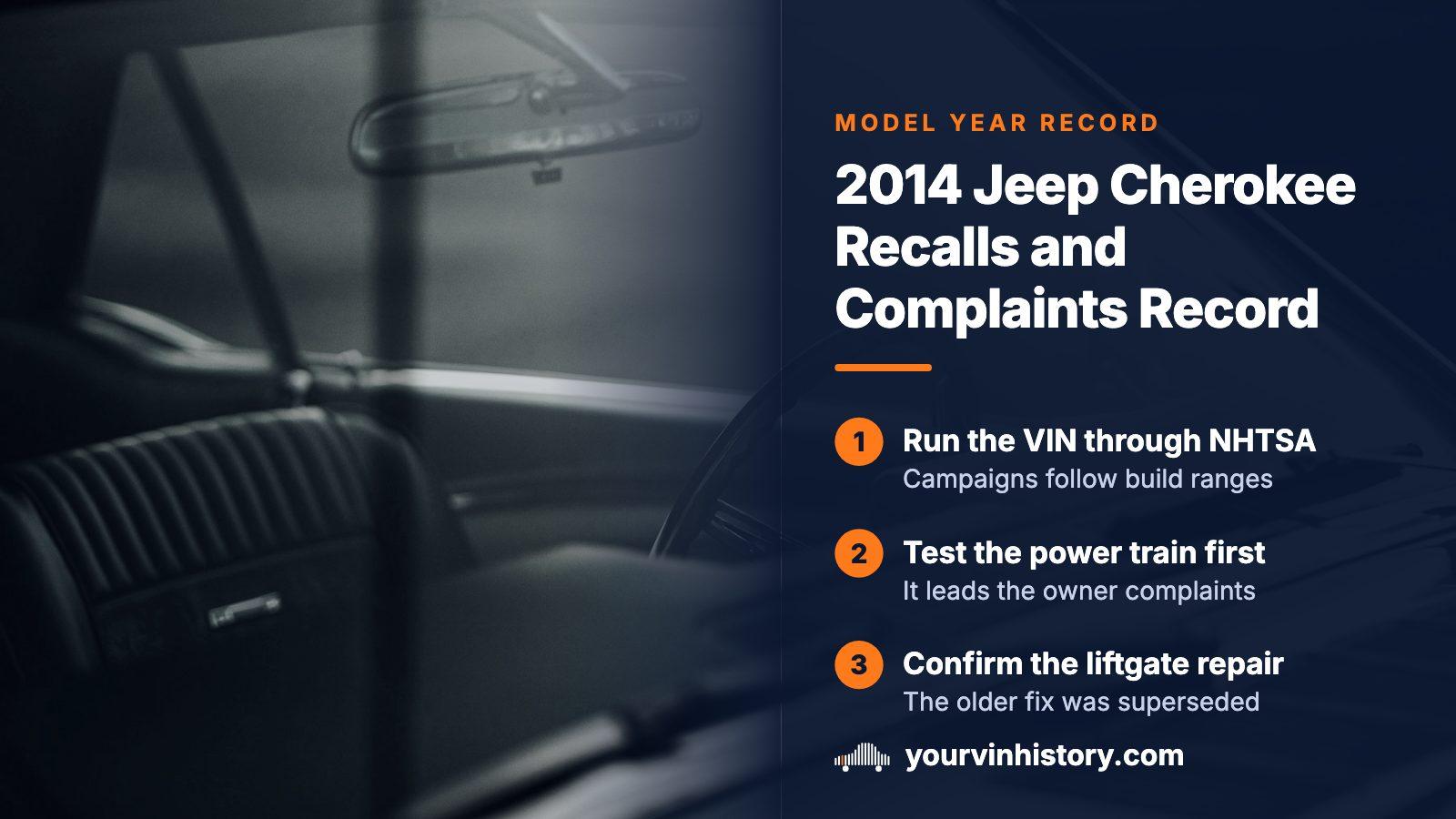
The 2014 Jeep Cherokee has 13 recall campaigns on file with NHTSA and 2,639 owner complaints, 1,463 of them (55%) about the power train. Federal crash tests gave it 4 of 5 stars overall and 5 of 5 for side impact. Recalls attach to VIN ranges, so the model-year count shows what could apply, not what does. Run the VIN through NHTSA's recall lookup and ask for proof that each repair was made.
- Recall campaigns
- 13 on file with NHTSA
- Owner complaints
- 2,639, led by the power train at 55%
- Crash ratings
- 4 of 5 overall, 5 of 5 side
- Among Cherokee years
- Heaviest of 9, at 1.99 times the median year
What the 13 campaigns and 2,639 complaints can and cannot tell you
A recall campaign is a defect the manufacturer has accepted, with a repair attached. A complaint is an owner's report to NHTSA that nobody has checked. This model year carries 13 of the first and 2,639 of the second, which tells a mechanic where to look but does not grade the car.
Filers can flag a crash, a fire or an injury: of the 2,639, 55 describe a crash, 16 a fire and 39 an injury. Those flags are the owner's account, and one event can produce several filings. NHTSA also ties 4 investigations to this model year, which may end in a recall or in nothing, so read them as leads.
The 13 campaigns, grouped by what each one puts at risk
Use the table as a checklist against one VIN. A build date outside a campaign's range, or a missing option, takes a car out of that row.
| Hazard | Campaign | Problem in plain terms |
|---|---|---|
| Loss of drive | 16V529000 | Weak sensor-wiring crimps in the 9-speed automatic |
| Loss of drive | 19V447000 | Stuck clutch lets software select neutral, 3.2L cars |
| Loss of drive | 20V343000 | Worn splines in a two-speed power transfer unit |
| Speed will not drop | 14V293000 | Adaptive cruise keeps accelerating after pedal release |
| Speed will not drop | 18V332000 | Wiring short can keep cruise control on |
| Fire | 15V393000 | Water reaches the power liftgate module |
| Fire | 23V338000 | Same module, reworked repair |
| Air bags | 15V041000 | Side curtain and seat bags can deploy unprompted |
| Seats | 16V590000 | Under-tightened fasteners, first or second row |
| Visibility | 15V509000 | Dry-glass wiper use can damage a control module |
| Handling and braking | 14V392000 | Rear shock weld that can let go |
| Remote access | 15V461000 | Radio software open to outside access |
| Equipment | 17V824000 | Kidde fire extinguishers that can clog |
Three ways a Cherokee can stop delivering power
Power train draws the most complaints, and three campaigns show why drivetrain faults count as safety defects. Campaign 16V529000 concerns the 9-speed automatic: sensor wiring in the transmission harness may be crimped too weakly, and the car can drop into neutral on its own. Dealers reprogram two computers and replace the harness where needed.
Campaign 19V447000 applies to cars with the 3.2L engine. If a transmission clutch sticks, the software may select neutral; the fix is a software update, available since August 8, 2019. Campaign 20V343000 involves a two-speed power transfer unit whose spline teeth wear until the drive connection lets go. A moving car loses drive and a parked one can lose its Park function, so the update has rear-wheel drive take over and sets the electronic parking brake.
Software fixes: cruise control, the accelerator and the radio
Campaign 14V293000 is narrow, limited to Cherokees built from March 6, 2014 to April 17, 2014. With adaptive cruise engaged, a driver pressing the pedal for extra speed may find the car still gaining speed briefly after letting go. Dealers re-flash the driver assistance system module; the recall began in June 2014.
Campaign 18V332000 is filed under electrical wiring. A short can leave cruise control unable to switch off, even by brake or switch, so the car holds speed or accelerates. Dealers reflash the engine or powertrain control module, and owners are told to skip cruise control until then.
Campaign 15V461000 is the odd one: a radio software weakness that could let an outsider reach networked vehicle systems, fixed by a USB update.
A liftgate fire risk, and the repair that was replaced
Campaign 15V393000 covers 2014 and 2015 Cherokees with the Power Liftgate option. Moisture can reach the module that runs the liftgate and set up a short circuit, which may start a fire. The 2015 remedy had dealers check the module and connectors for corrosion, swap a threaded grommet for a bolt and add a foam water shield, starting October 26, 2015.
NHTSA now shows that campaign as superseded by 23V338000, for 2014 to 2016 Cherokees with a power liftgate. The newer remedy moves the module and adds a water shield, and its text says cars repaired under the older campaign still need it. Owners are told to park outdoors until it is done.
A seller's 2015 paperwork therefore settles only half the question. Ask for the later repair.
Seats, air bags, wipers, shocks and an extinguisher
Five more campaigns carry less drama but still need a yes or no from the seller.
- 16V590000, seats: first or second row fasteners may be under-tightened, and dealers replace the seats.
- 15V041000, air bags: side curtain and seat bags can deploy while driving. Builds between January 1, 2013 and November 19, 2014 are covered, and the fix is a module re-flash begun March 4, 2015.
- 15V509000, wipers: dry-glass use can damage the body control module and stop the wipers. Dealers add a ground strap.
- 14V392000, rear shock: a weak weld can let one end of the shock detach, risking tire or chassis damage and reduced braking. Dealers inspect and replace.
- 17V824000, equipment: certain Kidde extinguishers can clog or lose a nozzle. Kidde supplies a replacement, relevant only if one is fitted.
Where the 2,639 complaints cluster
NHTSA files each complaint under the component the owner blames. Any popular car collects filings by being on the road, so the shape of the split says more than the total. Here one slice is large: the power train takes more than half.
| Component | Share | Complaints |
|---|---|---|
| Power train | 55% | 1,463 |
| Engine | 19% | 513 |
| Electrical system | 17% | 448 |
| Unknown or other | 11% | 283 |
| Service brakes | 7% | 187 |
| Fuel / propulsion system | 7% | 186 |
| Vehicle speed control | 7% | 185 |
| Steering | 5% | 119 |
| Structure | 4% | 110 |
| Electronic stability control | 3% | 88 |
| Visibility / wiper | 2% | 63 |
| Suspension | 2% | 63 |
Engine and electrical system trail by a wide margin, and the rest sit at 7% or below. Each figure is what an owner believed happened, so the inspection list at the end tests it.
How old the car was when owners say each system failed
A complaint carries the failure date, and subtracting the model year gives the car's age at that moment. Steering and speed control show up early, brakes late.
| System | Median age | Reports | Within three years |
|---|---|---|---|
| Steering | 2.7 years | 119 | 60% |
| Vehicle speed control | 3.2 years | 185 | 49% |
| Power train | 3.6 years | 1,461 | 46% |
| Engine | 4 years | 512 | 41% |
| Fuel / propulsion system | 5.4 years | 186 | 16% |
| Unknown or other | 5.5 years | 282 | 27% |
| Electrical system | 5.6 years | 448 | 35% |
| Service brakes | 6.8 years | 187 | 25% |
Steering complaints cluster early, so an example with a paper trail may have had that work done under warranty. Brakes arrive latest, at 6.8 years, the line to budget for on a car this old. These ages are medians of unconfirmed owner filings: timing clues, not failure rates or predictions.
How 2014 compares with the other Cherokee years
Against the Cherokee's own median year, the 2014 model sits at 1.99 times the median, the heaviest of the 9 model years on record from 2014 to 2022. The lightest settled year is 2022, at 0.04 times the median. Filings for the 2014 peaked in 2016, two years after the model year.
A peak that early usually signals faults surfacing in the first owners' hands, where a late peak would suggest wear that builds with mileage. The ranking measures filing volume, not quality, and at this age condition and maintenance history outweigh it.
Crash-test stars, and driver-assist equipment that varies
| NHTSA test | Result |
|---|---|
| Side impact | 5 of 5 |
| Overall | 4 of 5 |
| Front impact | 4 of 5 |
| Rollover resistance | 4 of 5 |
| Modeled rollover probability | 17.4% |
NHTSA scored the 2WD and 4WD SUV separately. Both landed at 4 stars overall with a 4-star rollover result.
Stars describe a new car in a laboratory. Earlier structural repair, aftermarket parts and accident damage change how a body behaves in a crash, and none of that shows in the rating. Forward collision warning and lane departure warning were options on this model year, so confirm each on the car.
Running the VIN, and where the no-charge repair rule stops
NHTSA's recall lookup takes the 17-character VIN and returns the campaigns that apply to that car, which turns 13 possible campaigns into the real list. Check what is still open and ask for dealer paperwork on the rest, since a mailed notice does not prove the work was done.
Campaign repairs are done at no charge to the owner, with an edge: under 49 U.S.C. 30120, the duty to remedy without charge does not apply to a car first bought more than 15 calendar years before the manufacturer's notice or NHTSA's order. The clock is read per campaign.
A recall lookup covers safety defects only. Title brands, accident records and odometer readings sit elsewhere, and a yourvinhistory report covers those for the same VIN.
What to inspect and what to ask before you pay
- Power train: shifting cold and warm, under light and hard throttle, and any stored transmission codes.
- Engine and electrical system: warning lamps, wiring repairs and amateur electrical work. Some owners reported fires, so look for heat damage under the hood.
- Rear liftgate area and suspension: dampness, corrosion and proof the module repair was done.
Ask for proof that all 13 campaigns were completed, any power train repair record and the service history. Ask whether it has been in a collision and whether insurance paid, whether the title is clear of liens, and whether your own mechanic may inspect it before you agree on a price.
Where this information comes from
- NHTSA: recalls by vehicle — Where a VIN is entered to see which of the 13 campaigns are open on one car.
- NHTSA: vehicle safety and complaints — Entry point to the owner filings behind the 2,639 total and the component shares.
- 49 U.S.C. 30120: remedy without charge — Statute text for the no-charge repair duty and its 15 calendar year limit.
- NHTSA: 5-Star Safety Ratings — The federal crash-test program behind the overall, frontal, side and rollover results.
- NMVTIS: national title information — Federal source for title brands, which recall and complaint data leave out.
Sources and photos: Facts checked against the sources above in October 2026. Photo by Dylan Michaud on Unsplash; diagrams by YourVINHistory.
Keep reading
- Jeep Cherokee years to avoid: 2014 leads 9,917 NHTSA complaintsRanks every Cherokee year against its own median, so you can see where 2014 falls.
- Jeep recallsShows how to look up open Jeep campaigns for any VIN.
- Buying a car with an open recallCovers what to ask for when a lookup shows a repair was never made.
- Pre-purchase inspectionExplains what an independent inspection adds to the seller's records.
Frequently asked questions
How many recall campaigns apply to a 2014 Jeep Cherokee?
NHTSA lists 13 for the model year, and some, like the cruise-control wiring campaign 18V332000 and the rear shock campaign 14V392000, also cover other Chrysler, Dodge, Jeep or Ram models. A VIN lookup shows which of the 13 apply to one car and which remain open.
Is the 2014 Jeep Cherokee reliable?
Federal records cannot rate reliability. They show 13 recall campaigns and 2,639 unverified complaints, 55% about the power train, so that is where to inspect hardest. How one car fares depends on its service history, finished recalls and what a mechanic finds.
Which 2014 Cherokee recalls should I confirm first?
Start with the ones that can cut power or start a fire: the transmission campaigns 16V529000 and 19V447000, the power transfer unit campaign 20V343000 and, on a car with a power liftgate, 23V338000. Then confirm the air bag and seat campaigns. For each, ask for the dealer invoice, not only the mailed notice.
Does a clean recall lookup mean the Cherokee has a clean history?
No. NHTSA's lookup covers safety defects only. Title brands like salvage come from NMVTIS, the federal title database, and accident, odometer and lien records come from other sources again. A Cherokee can show no open campaigns and still have been totaled, so run both checks before agreeing to a price.
Is a used 2014 Jeep Cherokee safe?
NHTSA gave it 4 of 5 stars overall, 4 in the frontal test, 5 in the side test and 4 for rollover, with a rollover probability of 17.4%. Those results come from a new car in a lab. A used Cherokee's collision repairs, aftermarket parts and open recalls decide how much of that protection it still has.
Now check the car itself
The guide explains what to look for. The report shows what this VIN has on record.