THE SHORT ANSWER
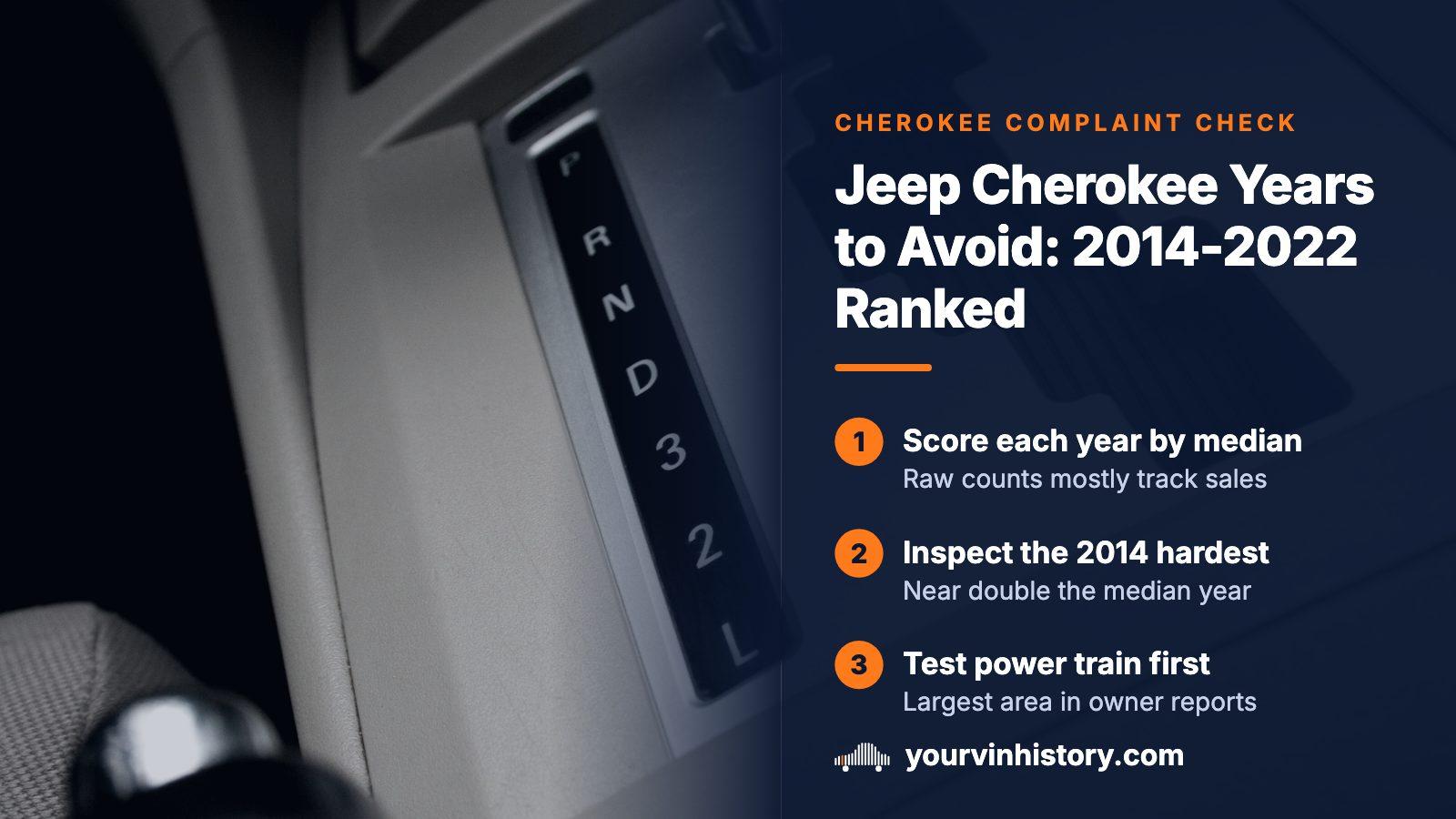
On NHTSA complaint volume, the 2014 Jeep Cherokee is the year to inspect hardest: 2,639 complaints against a nameplate median of 1,325, plus the most recalls in the run at 13. The 2020, 2021 and 2022 cars have the lightest records at 279, 151 and 48, though they are also the youngest. Power train is the largest complaint area at 5,063 reports. Complaints are unverified owner accounts, not failure rates.
- Complaints on record
- 9,917 across 2014 to 2022
- Median year
- 1,325 complaints
- Heaviest year
- 2014, with 2,639 complaints
- Top complaint area
- Power train, 5,063 reports
How each Cherokee year gets scored against its own median
NHTSA's complaint database is a pile of owner filings, and a pile grows with sales. A popular model year collects more reports than a scarce one even when both are equally sound. To blunt that effect, each Cherokee year here is held up against the Cherokee's own typical year instead of against other vehicles. The typical year is the median of the nine yearly totals from 2014 to 2022, which lands at 1,325 complaints.
The pool is 9,917 complaints, deduplicated on NHTSA's ODI complaint number and pulled on 2026-08-15. A year that scores 1 sits at the median. A year that scores 2 has drawn about twice as many reports as usual. The score describes how many owners wrote in. It is not a failure rate or a reliability grade.
All nine years, ranked from heaviest to lightest
The last column is a label written for this page, not an official rating. Rows run from heaviest to lightest, with the median year added at the bottom as the yardstick.
| Model year | Complaints | Times the median | Recalls | Reading |
|---|---|---|---|---|
| 2014 | 2,639 | 1.99× | 13 | Near double |
| 2015 | 1,780 | 1.34× | 11 | Elevated |
| 2019 | 1,611 | 1.22× | 11 | Somewhat elevated |
| 2016 | 1,403 | 1.06× | 9 | Typical |
| 2017 | 1,325 | 1× | 6 | Typical, the median year |
| 2018 | 681 | 0.51× | 7 | About half |
| 2020 | 279 | 0.21× | 3 | Light |
| 2021 | 151 | 0.11× | 4 | Very light |
| 2022 | 48 | 0.04× | 3 | Very light |
| Median year | 1,325 | 1× | n/a | Benchmark |
Read from the top, the shape is easy to describe. One year sits near double the median. Four years fall between 1 and 1.34 times it. 2018 drops to about half, and the last three rows fall far below.
2014: the one year far above the pack
The 2014 Cherokee has 2,639 complaints, 1.99 times the median, and the highest recall count in the run at 13. The next year down, 2015, has 1,780, well back.
Two things make 2014 the first year to question. Its complaint count and its recall count both top the table, so the two signals point the same way instead of offsetting each other. And power train and engine are the prominent complaint areas for that year, the same two categories that lead the whole nine-year record.
None of that makes a given 2014 bad. It means the car deserves a longer inspection and a firmer negotiation than a mid-pack year. This site also has a record page for the 2014 Jeep Cherokee with its recall campaigns and complaint areas.
2015 to 2019: a crowded middle and one odd dip
From 2015 through 2019 the totals bunch together, with one exception. The 2015 car logged 1,780 complaints (1.34 times the median), the 2019 car 1,611 (1.22), the 2016 car 1,403 (1.06), and 2017 is the median itself at 1,325. Recall counts across those four run from 6 to 11.
The exception is 2018, with 681 complaints, 0.51 times the median and 7 recalls. It sits between a 2017 and a 2019 that both land well above it. A drop that sharp in the middle of a run is unusual, and complaint data cannot explain it. Fewer sales, a quieter year in service or different filing habits could each produce it.
Treat the dip as a reason for curiosity, not a pass. Any single 2018 Cherokee can carry the same wear and open campaigns as the years on either side.
The lightest records come with a catch about age
The lowest totals belong to 2020 with 279 complaints, 2021 with 151 and 2022 with 48, or 0.21, 0.11 and 0.04 times the median, with 3, 4 and 3 recalls. Model years newer than 2022 are left out of this ranking altogether, because a car that has barely been on the road looks clean by default.
That effect does not stop neatly at the cutoff. A 2022 Cherokee has had far fewer years in owners' hands than a 2014, so part of its small count is simply less time to file. The 2016 and 2017 cars have long records and still land at or near the median, which makes them the easier pair to read.
Quiet is not the same as clean
A small complaint count can mean a sound car, a young one, or a model year that sold in lower numbers. The data cannot tell those apart, so read the 2020 to 2022 rows as the quietest records so far, not as proof of a trouble-free Cherokee.
Where owners file: power train first, by a wide margin
NHTSA sorts each complaint under component categories that the filing owner picks. Across the nine Cherokee years, six categories lead.
| NHTSA component | Reports, 2014 to 2022 | What the bucket can include |
|---|---|---|
| Power train | 5,063 | The transmission and other drive components |
| Engine | 2,121 | Any engine fault, not one named part |
| Electrical system | 2,002 | Battery, wiring, lighting and control modules |
| Unknown or other | 1,675 | Reports with no named component |
| Service brakes | 480 | Owner-reported brake defects, not routine pad wear |
| Steering | 120 | Owner reports filed under steering |
Power train draws more than twice the reports of engine, the runner-up. The six counts add up to more than the 9,917 complaints on record, which suggests some complaints list more than one component. The figures here do not name symptoms, so a power train count says where owners looked, not which part failed. That is still useful: it tells a mechanic which systems to test first on any Cherokee, whatever the year.
What the recall counts add, and where they stop
A recall measures something different from a complaint. It is a defect the manufacturer has acknowledged and must remedy at no charge, whereas a complaint is a single owner's account, unverified. The no-charge duty has an end date: under 49 U.S.C. §30120(g) it lapses 15 years after the first sale. An older Cherokee can therefore carry an open recall that the maker is no longer required to fix for nothing.
A year with many recalls and few complaints usually means problems were caught and repaired under warranty. In this table, 2014 breaks that pattern, with the most recalls at 13 and the most complaints. At the other end, 2020 and 2022 each carry 3 recalls next to very small complaint counts.
Recalls attach to production ranges, not to whole model years. Two 2016 Cherokees can differ in which campaigns cover them, so the only dependable check is NHTSA's recall lookup, run on the exact VIN.
Four ways to misread a complaint table
- Sales volume: a model that sold well collects more reports than one that sold poorly, which is why each year here is held against the Cherokee's own median.
- Time on the road: older cars have had longer to collect filings, so the youngest rows look better than they have earned.
- Unverified accounts: a complaint records what an owner believes happened. That is useful in bulk and shaky one report at a time.
- Population versus car: a model year describes thousands of vehicles, and none of the figures describes the one in the driveway.
A flag is a reason to look harder
Every model year holds cared-for Cherokees and neglected ones. Use a flagged year to inspect longer and bargain harder, not as grounds to dismiss a car before you have seen it.
What to check on a used Cherokee, starting with the year
Match the checks to where owners file most. The steps follow the complaint table, and a 2014 deserves extra time on the first two.
- Power train: ask for service records covering the transmission and drivetrain, then drive the car cold and again warm, noting hesitation, harsh or delayed shifts and warning lights.
- Engine: look for oil-change history, leaks, rough running and unusual noises at idle and under load, and have a shop scan for stored fault codes.
- Electrical system: run every window, light, screen and warning lamp, check the battery date, and watch for dash messages that come and go.
- Brakes and steering: these draw fewer reports, 480 and 120, but a soft pedal or a loose wheel is not something to wave through.
- Recalls: run the VIN at NHTSA and confirm each open campaign was repaired, with paperwork to show it.
Pay for an independent pre-purchase inspection. On a vehicle this age, a thick folder of service receipts outweighs any model-year statistic.
From the model year to the car you are buying
Start by confirming the model year from the tenth character of the VIN, so the year you priced is the year on the car. After that, the decision turns on things a table cannot show: which recall campaigns cover that production range and whether the work was done, how the title reads, whether odometer readings climb in a believable order, and what turns up when a mechanic gets it on a lift.
Title history sits in NMVTIS, the national title record, and the NICB's VINCheck screens a VIN for reported theft and total-loss claims at no cost. A yourvinhistory.com report gathers title brands, accident records, odometer readings and open recalls for one VIN; the preview comes first and the full report is a one-time purchase.
Where this information comes from
- NHTSA: Vehicle safety — The federal agency whose consumer complaint records supply the owner reports counted for each Cherokee model year.
- NHTSA: Recalls — Where the yearly recall counts come from, and where a VIN is entered to see open campaigns on a single car.
- Bureau of Justice Assistance: NMVTIS — The federal overview of the national title record, which covers the paper history of one vehicle that a model-year table cannot.
- NICB: VINCheck — A no-cost screen of one VIN for reported theft and total-loss status.
Sources and photos: Facts checked against the sources above in October 2026. Photo by Thakur Jaideep Singh on Unsplash; diagrams by YourVINHistory.
Keep reading
- 2014 Jeep Cherokee recalls: 13 campaigns, 2,639 complaints, 4 starsThe model-year page for the heaviest year, with its recall campaigns and leading complaint areas.
- Jeep recallsHow the Jeep recall lookup works and what it leaves out, the first check on any Cherokee.
- Jeep Grand Cherokee years to avoid, and the ones with cleaner recordsThe same year-by-year comparison for the larger Jeep, if you are weighing the two.
- Pre-purchase inspectionWhat a mechanic covers before you buy, and how to book one for a flagged year.
Frequently asked questions
Which Jeep Cherokee years should I avoid?
By NHTSA complaint volume, 2014 is the one to treat with the most caution, with 2,639 complaints where the median year has 1,325, and 13 recalls. The 2015 car is the next step up at 1,780. Avoid is a strong word, though. Plenty of 2014 cars are sound, and a clean service history and a fair price can justify one after a thorough inspection.
Which Jeep Cherokee year has the fewest complaints?
The 2022 car has the fewest at 48, followed by 2021 at 151 and 2020 at 279. They are also the youngest cars in the table, so owners have had the least time to file. For a more settled comparison, 2016 and 2017 make better reference points, since their records are long and still sit close to the median.
Is there a most reliable Jeep Cherokee year?
No complaint table can name one, because it records filings, not repairs or miles driven. What it can show is which records are quietest, and those are 2022, 2021 and 2020 at 48, 151 and 279. They are also the youngest, so a car's own service history is a better guide than the year printed on the title.
Which problem do Jeep Cherokee owners report most?
Owners file under power train more than any other component: 5,063 reports across 2014 to 2022, ahead of engine at 2,121 and electrical system at 2,002. A power train filing can cover more than one part, and the data does not name symptoms, so a cold-and-warm test drive and a shop's scan are how you learn what matters on a given car.
How do I check one specific Jeep Cherokee before buying?
Use its VIN. Run it through NHTSA's recall lookup for open campaigns, screen it with NICB VINCheck for theft and total-loss reports, and pull the title and odometer history before any money changes hands. Then book an independent inspection, since records cover paperwork and only a mechanic can judge wear.
Now check the car itself
The guide explains what to look for. The report shows what this VIN has on record.