THE SHORT ANSWER
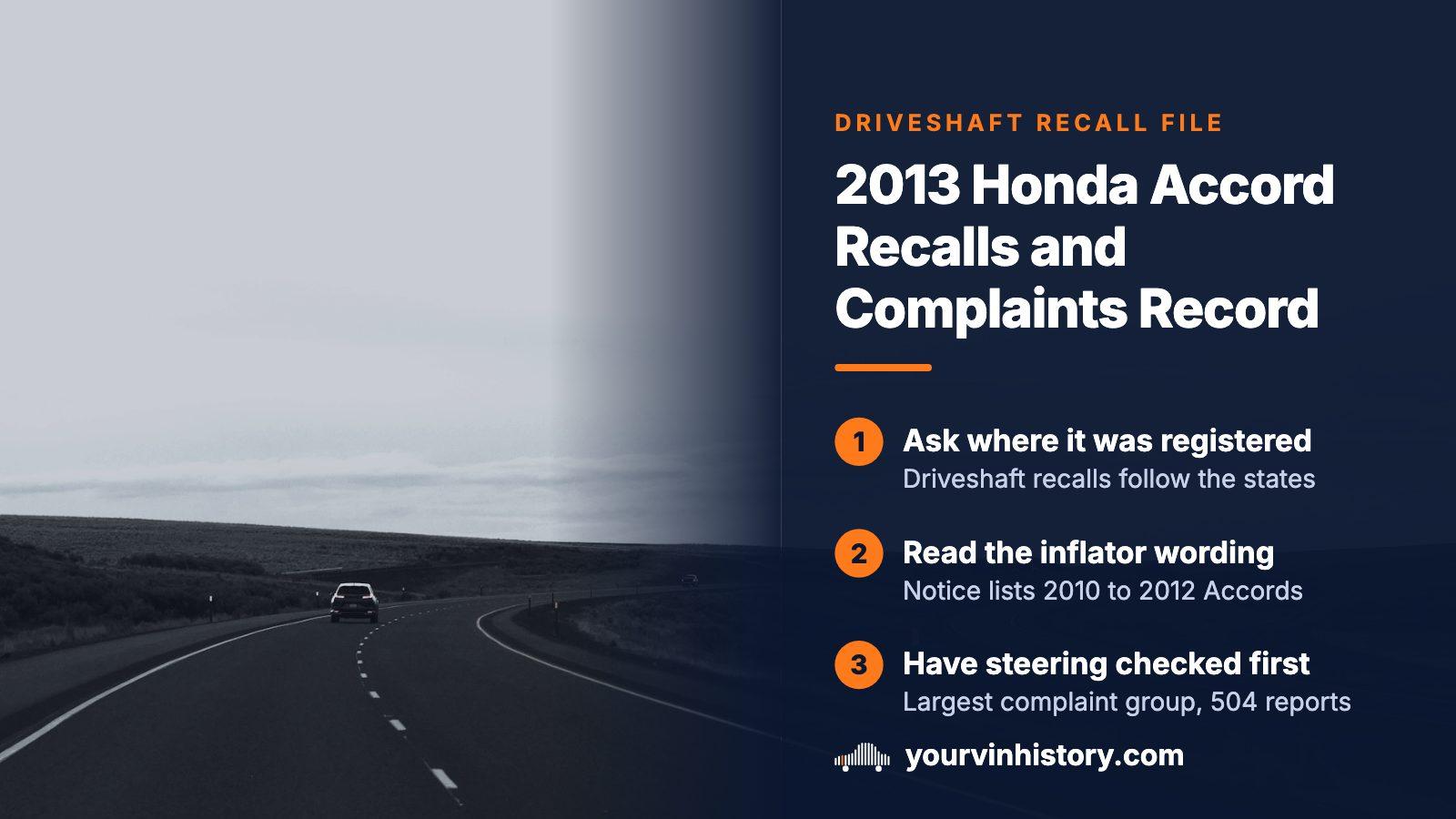
The 2013 Honda Accord carries 6 recall campaigns at NHTSA: a battery sensor, a fuel tank neck, a fuel pump module, two driveshaft actions and a passenger air bag inflator. Owners filed 1,429 complaints, 504 of them about steering. NHTSA rates the car 5 stars overall and 4 in the frontal test. Campaigns follow VIN ranges, engines and registration history, so only a VIN lookup shows what applies to one car.
- Recall campaigns
- 6 on file with NHTSA
- Owner complaints
- 1,429, with 35% about steering
- NHTSA overall rating
- 5 stars, 4 in the frontal test
- Against the Accord median
- 2.4 times, second heaviest of 15 years
Recalls and complaints answer different questions
A recall campaign means Honda reported a defect to NHTSA and filed a plan to repair it. A complaint is an owner's own account, filed without anyone confirming it. Recalls show what the maker has acknowledged; complaints show where owners believed things went wrong, which helps decide what to test but proves nothing about one car.
Of the 1,429 complaints for this model year, 67 describe a crash, 9 a fire and 59 an injury. Those tags reflect the owner's wording, and one incident can produce several reports, so read the narratives. NHTSA also lists 5 investigations touching the 2013 Accord; an investigation can end in a recall or in nothing, so treat it as an early signal.
The six campaigns and what each one is about
NHTSA files six campaign numbers under this model year, and the newest owner letters went out in August 2025, so a recall printout saved at an earlier sale may be out of date.
| Campaign | Part | Hazard in the notice | Who is in scope |
|---|---|---|---|
| 17V418000 | Battery sensor | Water in the sensor case can short it; fire risk | 2013 to 2016 Accords |
| 13V297000 | Fuel tank neck | Poor pump seal can leak fuel; fire risk | Low-emission (LEV II) cars built January 15 to April 5, 2013 |
| 20V769000 | Driveshafts | Shaft can break; lost drive power, or rollaway in park | 2013 to 2015, 4-cylinder, CVT gearbox, listed states |
| 25V422000 | Driveshafts | Corrosion can break a shaft; same outcomes | 2013 only, same engine, gearbox and states; expands 20V769 |
| 23V858000 | Fuel pump module | Pump can fail and stall the engine | Many Honda and Acura lines |
| 18V042000 | Air bag inflator | Inflator can burst, throwing metal fragments | Registration zones; see below |
Treat scope as a first filter. The notices cut by build date, engine, transmission and registration history, so a VIN lookup, not the model year, settles each car.
Driveshafts, road salt and the ever-registered rule
Campaigns 20V769000 and 25V422000 address the same part. Honda reported that the lubricant used in assembling the driveshafts may have weakened their coating, leaving the metal open to road salt until a shaft corrodes and breaks. That means a sudden loss of drive power, or a car rolling away in park with no parking brake set.
The later notice expands the earlier one: it names 2013 cars only, while the first reached 2013 through 2015. Both cover 4-cylinder Accords with a continuously variable transmission (CVT) first sold in, or ever registered in, a long list of mostly northern and mid-Atlantic states plus the District of Columbia. An Accord that wintered in Ohio and now sits on a Texas lot can still be inside. Ask for proof of completion under each campaign number.
Battery sensor, fuel tank neck and fuel pump module
Battery sensor, 17V418000: Honda reported that the sensor case may let water in and cause a short, which raises fire risk. Dealers replace the sensor and, as an interim step, seal the case with adhesive. The recall began on November 8, 2017 and covers Accords from 2013 through 2016.
Fuel tank neck, 13V297000: only low-emission (LEV II) cars built from January 15 to April 5, 2013 are included. An out-of-specification neck may keep the fuel pump from sealing, and the leak is a fire risk. The remedy is a new tank, nut and O-ring gasket; the recall began in August 2013.
Fuel pump module, 23V858000: NHTSA's record says the in-tank pump may fail and stall the engine while the car is moving. Ask the seller whether it has been done.
The passenger air bag inflator campaign and its wording
Campaign 18V042000 is one of the industry-wide inflator recalls, the kind associated with Takata. Honda's notice says certain frontal air bag inflators, original or fitted as replacements after a crash, may burst after long exposure to humidity and heat, and metal fragments could cause serious injury or death. Dealers replace the passenger frontal inflator; the recall began on February 16, 2018.
Read the wording closely. The notice sorts vehicles into three registration zones, and for the Accord it names 2010 through 2012 cars, with the Accord Crosstour reaching 2013. NHTSA still files it under the 2013 Accord, so the VIN lookup should decide whether a given sedan is covered. After any collision repair, ask whether the passenger inflator was replaced.
Where the 1,429 complaints land
Owners pick the component category when they file, so the table reflects where people thought the trouble was, not what a technician confirmed.
| Component category | Share of all | Reports |
|---|---|---|
| Steering | 35% | 504 |
| Electrical system | 29% | 416 |
| Engine | 13% | 179 |
| Unknown or other | 8% | 119 |
| Service brakes | 8% | 115 |
| Power train | 8% | 110 |
| Air bags | 4% | 51 |
| Vehicle speed control | 3% | 50 |
| Seats | 3% | 47 |
| Forward collision avoidance | 3% | 44 |
| Fuel and propulsion system | 2% | 35 |
| Electronic stability control | 2% | 31 |
Steering and the electrical system lead by a wide margin, with engine third. The categories are broad, so a count does not name the failed part. Read a sample of the steering narratives in NHTSA's public database before deciding what a mechanic should test.
How 2013 compares with the rest of the Accord run
A big sales year files more complaints simply by having more cars, so the useful comparison is against the nameplate's own median model year. As a multiple of that median, the 2013 stands at 2.4 times, second heaviest of 15 model years from 2008 through 2022.
Only 2008 is heavier, at 2.55 times; the lightest settled year is 2018, at 0.19 times. Filings for the 2013 cars peaked in 2021, a late peak that points toward age and mileage rather than launch-year defects, though timing cannot prove it. A multiple like this compares a complaint count with a baseline; it is not a failure rate.
How old the car was when owners filed
Each complaint carries the date the owner says the trouble happened, so the gap from the model year gives the car's age at that moment. The table shows median age, report count and the share filed within the first three years.
| System | Median age at filing | Reports | Filed within 3 years |
|---|---|---|---|
| Steering | 7.8 years | 503 | 22% |
| Electrical system | 5.4 years | 414 | 15% |
| Engine | 4.3 years | 179 | 30% |
| Unknown or other | 5.5 years | 119 | 14% |
| Service brakes | 10.3 years | 114 | 21% |
| Power train | 4.2 years | 110 | 43% |
| Air bags | 4.7 years | 50 | 36% |
| Vehicle speed control | 2.4 years | 49 | 57% |
Vehicle speed control came earliest (57% inside three years), so a well-kept car may already have had that work done under warranty; ask for paperwork. Service brakes came latest, at 10.3 years, the line to budget for on a car this old.
Timing is not a forecast
These medians come from owners who chose to complain, and nobody verified the reports. They show timing among complainers, not the odds that any car fails.
Crash ratings and optional driver aids
- Overall: 5 of 5 stars
- Frontal crash: 4 of 5 stars
- Side crash: 5 of 5 stars
- Rollover: 5 of 5 stars, with a 9.9% rollover probability
NHTSA scored the 4-door and 2-door front-drive versions separately, and each earned 5 stars overall and 5 for rollover. Forward collision warning and lane departure warning were options, so confirm what this car has. Stars rate the design as built, not what a past collision did to this car's structure or air bags. That makes them a fair way to compare Accord years with one another and a poor way to judge one used example.
The 15-year limit on no-charge recall repairs
Federal law does not promise a no-charge recall repair forever. Under 49 U.S.C. §30120(g), a manufacturer need not repair a vehicle without charge once more than 15 calendar years separate the first purchaser's purchase from the notice to owners, or an enforcement order if that came first.
The six campaigns here were all announced inside that span for a car sold new in its model year or soon after, but a notice issued years from now could fall outside it. Some dealers repair older cars anyway as a courtesy, not an entitlement. Put the VIN, not the model year, into NHTSA's recall lookup before you pay a deposit.
What to inspect and what to ask the seller
- Steering: the largest complaint group, so have a mechanic check play, noise and warning lights first.
- Charging system: look for repair orders mentioning the battery sensor, and ask whether 17V418000 was done.
- Engine: check for leaks, unusual noise and stored fault codes.
- Underbody: corrosion on driveshafts, axles and suspension, especially from a road-salt state.
- Engine bay: with fire reports on file, look for heat damage and amateur wiring.
- Trunk floor and spare well: standing water or collision repair. Uneven ride height at the corners can point to an unreported crash.
Then put these to the seller:
- Which campaigns apply to this VIN, and is dealer paperwork available for each?
- In which states has the car been registered?
- Has anything in the steering been replaced or repaired?
- Who serviced it, and may I read the records?
- Was it ever in a collision, and was a passenger air bag inflator replaced?
- May my own mechanic inspect it before a price is agreed?
The federal safety file omits title brands, accident and salvage records, odometer readings and liens. A history report from this site starts with a free preview, and the full report is a one-time purchase.
Where this information comes from
- NHTSA: recalls by vehicle — The lookup that takes a VIN and returns the campaigns open on that one car, with the full notice text behind each campaign number.
- NHTSA: vehicle safety and consumer complaints — Entry point to the public complaint database holding the owner reports, component categories and narratives counted on this page.
- NHTSA: New Car Assessment Program ratings — Star ratings and tested configurations for the 2013 Accord, including the 4-door and 2-door versions.
- U.S. Code Title 49, section 30120 — The statute on remedy without charge, including the 15-calendar-year limit counted from the first purchase.
- NMVTIS: national title record — The federal title information system, which holds the brands and history that a safety file never shows.
Sources and photos: Facts checked against the sources above in October 2026. Photo by John Kakuk on Unsplash; diagrams by YourVINHistory.
Keep reading
- Honda Accord years to avoid: 2008, 2013 and 2014 lead the complaintsRanks the 2013 model year against every other Accord year by complaint volume.
- Honda recallsWalks through Honda recall lookups by VIN and the older models that carry stop-driving warnings.
- Honda Accord alternator replacement cost: rule out the battery sensor firstExplains how the battery sensor can pass for an alternator fault, which ties to the first campaign above.
- Buying a car with an open recallCovers what the law does and does not require when a used car still has an open recall.
Frequently asked questions
How can I tell which recalls apply to a particular 2013 Accord?
Copy the 17-character VIN from the windshield base or the door jamb sticker and enter it in NHTSA's recall lookup. It lists the campaigns open on that exact car. Run it again on signing day, because the newest notice for this model year went out in August 2025.
Do the driveshaft recalls cover every 2013 Honda Accord?
No. Both name 4-cylinder cars with a CVT that were sold in, or at any time registered in, the listed states. A car with another engine or gearbox falls outside them as written. Registration history counts as much as the build.
Is the 2013 Honda Accord a safe used car?
NHTSA gave it 5 stars overall, 4 in the frontal test and 5 for rollover resistance, and those stars rate the design. A used example is only as safe as its history, so ask about collision repairs, replaced air bags and the passenger inflator campaign.
Will a dealer still fix a 2013 Accord recall at no charge?
Usually, if the notice came within 15 calendar years of the first sale, since federal law requires a no-charge remedy inside that span. Past it the maker is not obliged, though a dealer may agree anyway. Call a dealer with the VIN and campaign number before you buy.
Do the steering complaints mean the 2013 Accord is unreliable?
Not by themselves. The 504 steering reports are unverified owner claims, and a complaint count is not a failure rate. It does show where to point a mechanic: ask for steering repair records, drive on a straight road with light hands on the wheel, and have the system checked on a lift.
Now check the car itself
The guide explains what to look for. The report shows what this VIN has on record.