THE SHORT ANSWER
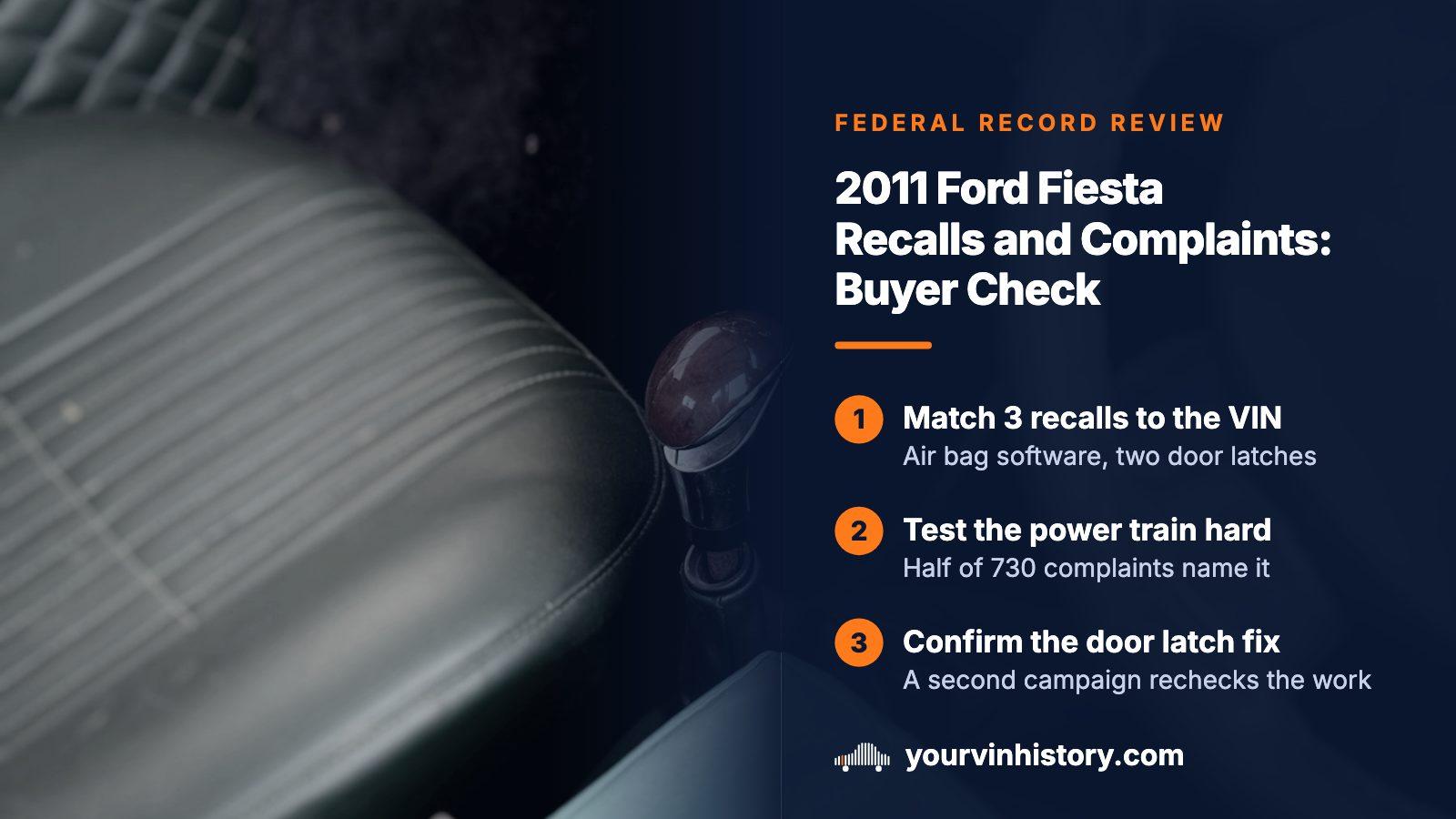
NHTSA has 3 recall campaigns on file for the 2011 Ford Fiesta: a passenger-side curtain air bag that switches off when the front seat is empty, and two door latch campaigns. Owners filed 730 complaints, led by power train with 366. The overall crash rating is 4 of 5 stars. Recalls follow VIN ranges, so enter the car's VIN on NHTSA's recall page to see what is open or done.
- Recall campaigns
- 3 on file with NHTSA
- Owner complaints
- 730, power train the largest at 366
- NHTSA overall rating
- 4 of 5 stars
- Complaint filings peaked
- 2014
The 2011 Fiesta's federal file in six lines
Two kinds of evidence sit in NHTSA's database, and they should not be weighed the same way. A recall is a defect or rule violation the maker has accepted and must repair for affected owners. A complaint is one owner's account, which the agency has not verified.
| Item in the file | 2011 Fiesta | How to read it |
|---|---|---|
| Recall campaigns | 3 | Repair duties tied to VIN ranges |
| Owner complaints | 730 | Unverified accounts, not a failure rate |
| Largest complaint label | Power train, 366 | Half of everything filed |
| Complaints flagged crash, fire, injury | 32, 5 and 34 | Flags come from the filer's own words |
| Investigations touching the year | 3 | Early signals, open or closed |
| Overall crash rating | 4 of 5 stars | A ceiling for the model, not this car |
One incident can produce several reports, so read the flagged narratives in full on NHTSA's site. An investigation may lead to a recall or fizzle out, so treat the three listed as a prompt, not a finding.
The three campaigns side by side
Campaign numbers start with the year NHTSA logged them, so the air bag recall is the oldest and the door latch follow-up the newest.
| Campaign | Part of the car | Problem NHTSA records | Dealer repair |
|---|---|---|---|
| 12V488000 | Passenger-side curtain air bag | Stays off in a side impact if an empty front seat is detected, and the owner's guide never says so | Reprogram the software so the bag stops shutting off |
| 15V246000 | Door latches | A part inside the latch can break, so a door may look shut when it is not | Replace all four latches with an improved part |
| 20V331000 | Door latches | Earlier latch repairs may not have been done correctly | Read the latch date codes, replace side door latches if needed |
Both latch campaigns also reach other Ford models, so a VIN lookup, not the model year, decides which apply.
12V488000: the curtain air bag that switches itself off
Ford's notice covers Fiestas from model years 2011 through 2013 built between November 3, 2009 and September 21, 2012. The system was designed to hold back the passenger-side curtain air bag when nobody sits in the front passenger seat. The cars fall short of Federal Motor Vehicle Safety Standard No. 208 because the owner's guide never explained that behavior. A person in the right rear seat would have no curtain bag in a side impact while the front seat was vacant.
The repair is software only. Dealers reprogram the car at no charge, and the recall began on October 26, 2012. Nothing on the outside of the car shows whether the update was installed, so ask for the repair order.
15V246000 and 20V331000: one latch, asked about twice
Both campaigns concern the door latch. In the first, a component inside the latch can break, leaving a door hard to close or letting the driver believe it is secure when it is not. A door that is not truly latched could swing open while the car moves. The remedy was four new latches, and the campaign spans Fiestas from 2011 through 2014.
The second campaign exists because some of those repairs may have gone wrong. Dealers read the date codes on the latches and replace the side door latches only if the codes call for it. Owner narratives echo the theme: structure reports mostly describe doors and handles that will not stay shut or snap off. A Fiesta with the first repair on paper still needs the second one confirmed.
Whether a recall repair is still no-charge on a car this old
Federal law requires a maker to repair a recalled vehicle without charge, but with a time limit. Under 49 U.S.C. §30120(g), the duty lapses for a vehicle whose first purchaser bought it over 15 calendar years ahead of the notice. The three Fiesta campaigns were announced years ago, inside that window for a car first sold around 2011. A campaign announced from now on may reach cars outside it, and then a free repair is no longer a right. Dealers often do the work anyway, but ask first.
Use NHTSA's own lookup
Enter the 17-character VIN on NHTSA's recall page. It shows which campaigns are open on that exact car, which a model-year page like this one cannot do.
Where the 730 complaints land by component
| Component label | Share of 730 | Complaints |
|---|---|---|
| Power train | 50% | 366 |
| Structure | 17% | 125 |
| Engine | 15% | 108 |
| Electrical system | 13% | 96 |
| Unknown or other | 8% | 58 |
| Vehicle speed control | 8% | 57 |
| Latches, locks and linkages | 6% | 41 |
| Steering | 4% | 26 |
The counts add up to more than 730, so many complaints carry more than one label. NHTSA has no category for a single part, and power train is a broad bucket that includes the transmission and more. Read it as a pointer to an area of the car, not a count of one failure.
What the power train and structure reports describe
Reading the narratives behind the labels, several themes recur. Power train reports talk about a car that jerks or shudders when pulling away, hesitates when the pedal goes down, stalls, or refuses to engage reverse or drive. Some owners write about a control module replaced more than once with the symptom returning, and several mention a dual-clutch gearbox. Others dispute whether a warranty or recall should cover the repair.
These are unverified accounts, so use them to decide what to test, not to diagnose. Find out which transmission the car has, because some narratives name the dual-clutch design specifically.
When owners filed, and how old the cars were
Filings for this model year peaked in 2014. A peak a few years after the model year tends to point at parts that wear with time and mileage, not an assembly error caught early.
| System | Median age at failure | Reports inside the first three years |
|---|---|---|
| Power train | 4 years | 33% |
| Structure | 3.8 years | 7% |
| Engine | 4.3 years | 23% |
| Electrical system | 5.5 years | 21% |
| Vehicle speed control | 4 years | 39% |
| Latches, locks and linkages | 3.8 years | 10% |
| Steering | 5.1 years | 12% |
| Unknown or other | 6.3 years | 10% |
No system had most of its reports inside the first three years; the highest share is 39% for vehicle speed control. The problems mostly arrived later, when the bill usually falls on the owner unless a recall applies.
Medians of owner reports, not a forecast
These ages describe when people who did complain say the problem happened, not how likely a given Fiesta is to fail. Full service records can carry a car past every figure here.
Crash-test stars and what they leave out
| What NHTSA measured | Stars out of 5 |
|---|---|
| Side impact | 5 |
| Frontal impact | 4 |
| Rollover resistance | 4 |
| Overall score | 4 |
| Chance of a rollover (not a star rating) | 14.3% |
NHTSA rated two configurations separately, a 5-door hatchback and a 4-door model, both front-wheel drive. Each scored 4 of 5 overall and 4 of 5 for rollover. Forward collision warning and lane departure warning were not offered on this model year.
The stars describe a new test car. They cannot show how well a damaged Fiesta was repaired, which is the variable that matters on a used one. Accident history lives in title, insurance and auction records.
What to check on the car itself
Start where the complaint file points, then add the checks any hatchback of this age needs.
- Drivetrain: pull away from a stop several times, creep in traffic, shift between reverse and drive, and note any jerk, shudder or warning light.
- Gearbox history: ask for repair orders on the transmission and its control module. A module replaced more than once is a flag.
- Doors: open and close each one from both sides, and feel for loose handles.
- Engine bay and wiring: five reports mention a fire, so look for heat damage and amateur electrical work.
- Recall completion: check by VIN that the repairs for all three campaigns were made, not merely announced.
- Corrosion and suspension: at this age, condition counts for more than anything in the federal file.
These next items never appear in NHTSA's records. They are what a small hatchback does to itself over the years.
- The tailgate: hinges, gas struts and the wiring loom entering it.
- Wheel arches at the back and the seams beside them, where water and road salt sit.
- Rear seat fold latches, and the cargo floor lifted to check for damp.
- Suspension bushes at all four corners.
Questions for the seller, then the VIN
- Were all three campaigns repaired, and can you show the dealer paperwork?
- Has the power train or its control module been repaired or replaced, and by whom?
- Who has serviced the car, and can I see the records?
- Has the car been in a collision, and was the repair paid by an insurer?
- Is the title in your name, with no lien?
- Can my own mechanic inspect it before we agree on a price?
Model-year figures only go so far. The particular Fiesta you are looking at carries its own record: which campaigns match its VIN range, whether the repairs were made, and what its title says. NHTSA's recall lookup answers the first two. Title brands come from NMVTIS, which the safety file does not include.
A yourvinhistory report covers that ground and more, including accidents with a damage map, odometer readings, salvage and auction records, liens and open recalls. It begins with a VIN preview, and the full report is a one-time purchase.
Where this information comes from
- NHTSA: recalls lookup — Where a VIN shows which of the three campaigns are open on one car, and where the campaign wording summarized here can be read in full.
- NHTSA: vehicle safety and complaints — Entry point to the owner filings behind the 730 total, the component counts, the narratives and the crash, fire and injury flags.
- 49 U.S.C. §30120: remedy without charge — Statute text for the no-charge recall remedy and the 15 calendar year limit for cars first bought long before a notice.
- NHTSA: 5-Star Safety Ratings — The federal crash-test program behind the star ratings, including the two Fiesta configurations and the rollover figure.
- NMVTIS: national title information system — Federal source for title brands and history, which a recall and complaint record does not cover.
Sources and photos: Facts checked against the sources above in October 2026. Photo by Thakur Jaideep Singh on Unsplash; diagrams by YourVINHistory.
Keep reading
- Ford recallsShows how to check any Ford for open campaigns, beyond the three on this model year.
- Buying a car with an open recallCovers what to do if the lookup shows the air bag or latch repair was never made.
- Pre-purchase inspectionExplains what a mechanic's inspection adds for the power train questions raised here.
- NMVTIS reportDescribes the title record that sits outside NHTSA's recall and complaint data.
Frequently asked questions
How many recall campaigns cover the 2011 Fiesta?
NHTSA lists 3: 12V488000 for the passenger-side curtain air bag, plus 15V246000 and 20V331000 for door latches. Each follows a VIN range, so two Fiestas can differ. Only a VIN lookup shows which apply and whether the repair is recorded as done.
What problems do owners report most on the 2011 Fiesta?
Power train leads with 366 of 730 complaints, then structure at 125 and engine at 108. Narratives describe jerking, shuddering, hesitation, stalling and trouble engaging gears, while structure reports mostly concern doors. All are unverified, so treat them as things to test on the drive.
How did the 2011 Fiesta do in NHTSA crash tests?
It earned 4 of 5 stars overall, 4 for frontal impact, 5 for side impact and 4 for rollover. The stars describe a new test car, so a used Fiesta's repair history needs checking separately.
Does Ford still have to fix 2011 Fiesta recalls at no charge?
Not always. Federal law ends the no-charge duty for a car first bought more than 15 calendar years before the notice. The three existing campaigns were announced inside that window, but a future one may not be. Dealers often honor old recalls anyway, so call one with the VIN before you buy.
Does a clean recall check mean the Fiesta has no problems?
No. Recall data covers only defects the maker has acknowledged, and complaints cover only what owners chose to report. Neither shows title brands, accident history, odometer readings or maintenance. Pair the lookup with the NMVTIS title record, service receipts and a mechanic's inspection before you pay.
Now check the car itself
The guide explains what to look for. The report shows what this VIN has on record.