THE SHORT ANSWER
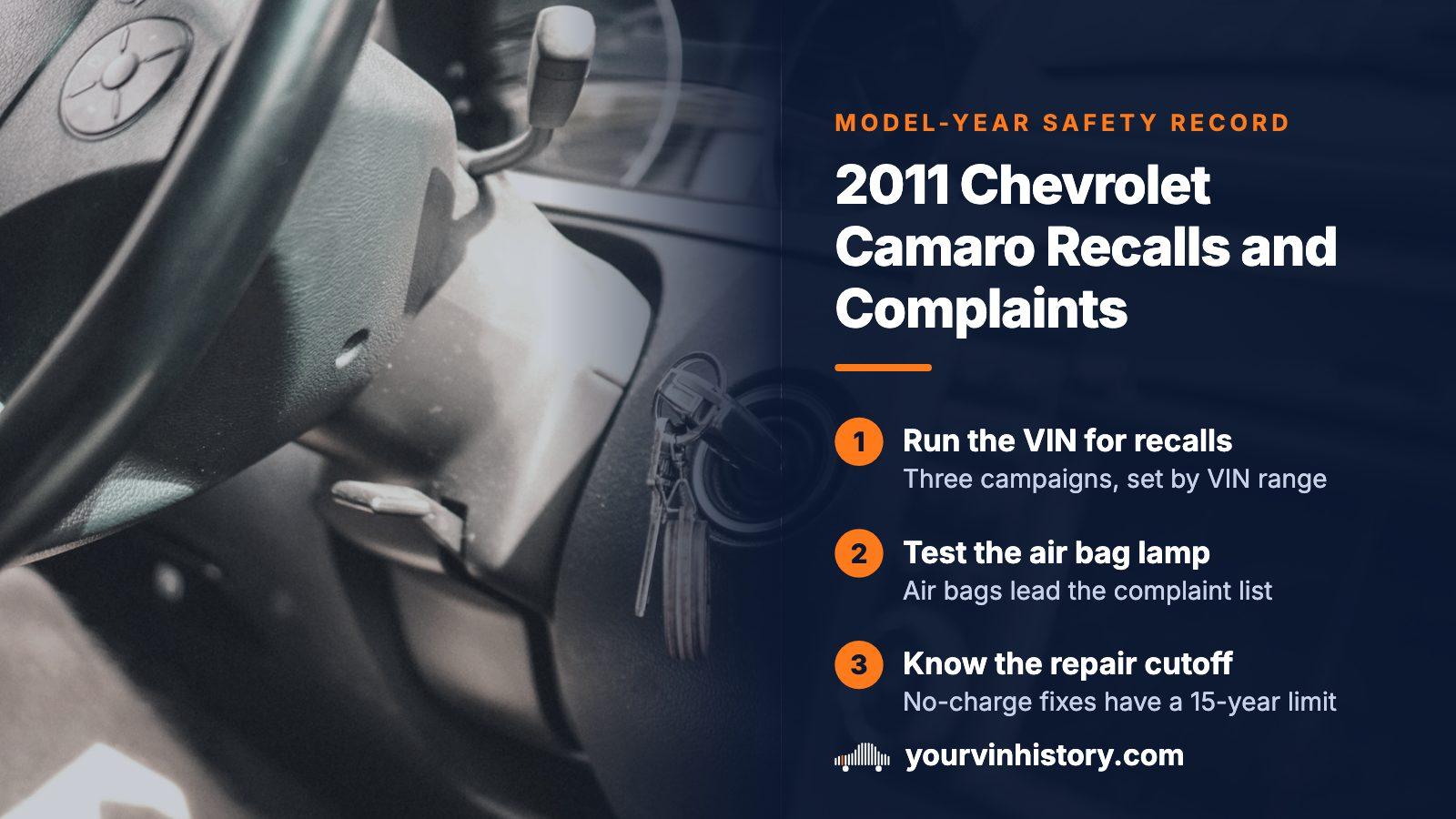
The 2011 Chevrolet Camaro has 3 recall campaigns on record: two cover the ignition key, which a driver's knee can push out of the run position, and one covers the power seat height adjuster. Owners filed 194 complaints, 69 about air bags. NHTSA publishes no overall, frontal or side crash rating for it, only a rollover result of 5 of 5. Recalls attach to VIN ranges, so check the exact car on NHTSA's lookup.
- Recall campaigns
- 3 on file with NHTSA
- Owner complaints
- 194, with 36% about air bags
- Rollover rating
- 5 of 5; no overall, frontal or side rating
- Busiest filing year
- 2014
What NHTSA's file on this Camaro can and cannot tell you
Two kinds of record sit behind this page, and they carry different weight. A recall means the manufacturer accepts that a defect exists and owes a repair; the 2011 Camaro has 3. A complaint is one owner's account, sent to the government and never tested by it; this model year has 194.
Filers can flag what happened. Among the 194, 15 mention a crash, 2 a fire and 11 an injury. Those flags are the owner's own telling, not an agency finding, and one event can produce several reports. At this age, how the Camaro was kept counts for more than anything in the federal file.
The three campaigns, side by side
Not every campaign reaches every Camaro, so the table sorts the three by fault, cars involved and repair, using NHTSA's campaign records.
| Campaign | The fault | Cars involved | The repair |
|---|---|---|---|
| 14V346000 | A driver's knee can push the key out of the run position | 2010-2014 Camaros built December 3, 2008 through May 23, 2014 | Dealer takes the blade off the flip-key fob and supplies new keys; began August 25, 2014 |
| 19E064000 | Old-design key assemblies sold as replacements | Parts sold for 2010-2015 Camaros | Dealer inspects and fits the flat-blade key where needed; began February 4, 2020 |
| 14V447000 | Bolt in the power seat height adjuster can fall out | Certain Camaros with power height-adjustable seats, plus other GM models | Dealers replace the adjuster bolts; began in December 2014 |
In the numbering, V marks a vehicle recall and the E in 19E064000 marks equipment, a part sold apart from the car.
Campaign 14V346000: a knee, a flip key and the run position
This is the widest of the three. GM recalled every 2010-2014 Camaro built between December 3, 2008 and May 23, 2014, which takes in the whole 2011 model year. The fault is geometric: a driver's knee can brush the key, push it out of the run position and shut off the engine.
GM names loss of power steering and power braking as consequences, plus air bags that may not deploy in a crash. The repair takes the blade off the original flip-key fob and supplies replacement keys and rings. Dealers began it on August 25, 2014.
Until a car was repaired, GM advised drivers to set the seat and steering column so the knee clears the key. A buyer should ask for the dealer record showing this campaign was completed.
Campaign 19E064000: when the replacement key was the recalled one
The 2019 campaign closes a gap in the first. GM found that dealers had mistakenly sold old-design flip-key assemblies as replacement keys for 2010-2015 Camaros, though those were the very parts recalled in 14V346000. A Camaro that had a key replaced could carry the original flaw.
Dealers inspect the key and, as needed, fit the flat-blade design at no charge. Interim notices were mailed November 6, 2019, a second notice followed, and the campaign began February 4, 2020.
Hold every key
Ask the seller to put every key in your hand. If one was replaced, find out where it was bought and whether it is the flat-blade design. A separately sold part may not appear in the car's repair history.
Campaign 14V447000: the seat that can drop
The third campaign is mechanical. NHTSA files it under front seat power adjustment, and its text says that on cars with power height-adjustable seats the bolt securing the adjuster can fall out, dropping the seat to its lowest position without warning. GM cites driver distraction and a changed seating position as the crash risk.
Dealers replace the adjuster shoulder bolts, and the remedy began in December 2014. Only cars with the power height option are included, so a VIN lookup tells you whether a given Camaro is in it.
On a test drive, run each front seat through its full height travel and note any that settles lower than you left it.
Where the 194 complaints land, and how old the car was
NHTSA sorts each complaint by the component the owner blames, and one filing can carry several tags, so the shares add to more than the whole. The table adds the car's median age when owners say trouble happened, for the eight biggest areas.
| Area | Filings | Share | Median age at the incident | Within the first three years |
|---|---|---|---|---|
| Air bags | 69 | 36% | 4.2 years | 28% |
| Electrical system | 29 | 15% | 3.9 years | 10% |
| Engine | 28 | 14% | 4.7 years | 18% |
| Power train | 18 | 9% | 3.8 years | 44% |
| Unknown or other | 17 | 9% | 7.3 years | 6% |
| Seats | 15 | 8% | 7.1 years | 13% |
| Steering | 14 | 7% | 4.8 years | 36% |
| Structure | 9 | 5% | 1.3 years | 78% |
Further down sit service brakes and tires at 8 each, electronic stability control at 7, wheels at 6 and seat belts at 5. These count owner reports and are not failure rates. The ages come from owners who chose to file, so they show when something went wrong for them, not how likely it is for you.
What the air bag filings say, and when owners filed
A read through the air bag narratives on NHTSA's complaint site shows one recurring theme: the passenger-side warning lamp. Owners describe a lamp that lights or flickers whether or not anyone sits there, and some report a dealer naming the seat sensor or belt switch as the next suspect. Other entries question what the bags did, in a crash or without one. That is a reading of unverified stories, not a tally.
The key recall's stated danger includes air bags that may not deploy once the key leaves the run position. The complaint category cannot separate that from a lamp fault, so the 69 filings cannot be traced to that campaign.
Timing adds context. Filings for this model year peaked in 2014, the year both vehicle campaigns date from, and a recall can prompt owners to file; the federal file does not say so, so call it a coincidence rather than a cause. Structure reports sit at a median of 1.3 years, with 78% inside the first three, so most were warranty visits: ask for the paperwork. Unknown-or-other and seats sit at 7.3 and 7.1 years, where a car this old now lives.
Crash ratings: a rollover score and little else
| Test | NHTSA result |
|---|---|
| Overall | No rating published |
| Frontal crash | No rating published |
| Side crash | No rating published |
| Rollover | 5 of 5 stars |
| Rollover probability | 8.7% |
NHTSA's 5-Star program lists two configurations for this model year, a C RWD and a 2 DR RWD, and both show the same pattern: rollover 5 of 5 and no overall rating. The rollover score says nothing about a frontal or side impact.
Forward collision warning was not offered on this model year and lane departure warning was not available. Ratings also describe a new car as tested; a Camaro rebuilt after a collision may behave differently, and only its history can say.
The 15-year limit on no-charge recall repairs
Federal law makes a manufacturer repair a recalled vehicle at no charge, with a limit. Section 30120 of Title 49 of the U.S. Code says the duty does not apply when the first buyer bought the car more than 15 calendar years before the manufacturer's notice.
A 2011 Camaro is now at or near that age. Its three campaigns were announced in 2014 and 2019, well inside the window, so those repairs should still be available at no charge. A campaign announced from here on could fall outside the rule, though dealers sometimes honor one anyway; ask in writing what a dealer will do and charge before you agree on a price.
What to put in front of a mechanic
These checks follow the complaint pattern and come before the general inspection any used coupe needs.
- Air bag lamp: key on, watch it light and go out, then repeat with a passenger seated.
- Keys and ignition: match every key to the dealer record for the 2014 and 2019 campaigns, and see how close your knee comes to the key.
- Seat height control: run both front seats through full travel and listen for clunks or a seat that settles.
- Electrical system and engine, 29 and 28 complaints: scan for stored codes and ask about any lamp that has come and gone.
- Wiring and engine bay: fire was reported twice for this model year, so look for heat marks, melted insulation and amateur electrical work.
- Steering and structure, 14 and 9 complaints: check for pull or play, uneven panel gaps and fresh sealer hinting at collision repair.
- Rust and worn suspension parts: on a car this old, they matter more than any federal count.
Questions for the seller, then the VIN
- Which of the three campaigns apply to this car, and where is the proof each repair was done?
- Has a key ever been replaced, and where was it bought?
- Have the air bags, the passenger seat sensor or the warning lamp ever been repaired or reset?
- Has it ever been in a crash, and did an insurer pay for the body work?
- Who has serviced it, and may I see the records?
- Can my own mechanic inspect it before we settle on a price?
Then enter the VIN into NHTSA's recall lookup at nhtsa.gov/recalls for open campaigns on that exact car. It does not show title brands, accidents or odometer readings; a yourvinhistory report, which starts with a free preview before a one-time paid purchase, covers those, with title data from NMVTIS.
Where this information comes from
- NHTSA: recalls lookup — Where a VIN is entered to see open campaigns; the campaign summaries on this page come from the same records.
- NHTSA: vehicle safety and complaints — Entry point to the owner filings behind the complaint total, the area shares and the crash, fire and injury flags.
- 49 U.S.C. 30120: remedy without charge — The statute that requires a no-charge recall repair and sets the cutoff for cars first bought long before a campaign.
- NHTSA: 5-Star Safety Ratings — The federal crash-test program behind the rollover score and the not-rated lines in the crash table.
- NMVTIS: national title record — Where title brands are tracked, a record the federal safety data on this page does not include.
Sources and photos: Facts checked against the sources above in October 2026. Photo by Shadow Photography on Unsplash; diagrams by YourVINHistory.
Keep reading
- Chevrolet recallsShows how to check a Chevrolet by VIN and covers GM's separate, much larger ignition switch campaign.
- Airbag deployed checkShows how to test the air bag lamp and spot a bag that was never replaced.
- Buying a car with an open recallCovers what the law lets a seller do with an open recall and where the 15-year cutoff bites.
- Recall check by VINWalks through reading a recall record and what a clean lookup still misses.
Frequently asked questions
Does the 2011 Chevrolet Camaro have any open recalls?
Not from the model year alone. NHTSA lists 3 campaigns, but each reaches certain VINs, and a finished repair is logged against the VIN. Enter the 17-character number into NHTSA's lookup when you view the car and again before paying, since new campaigns can appear.
What do 2011 Camaro owners complain about most?
Air bags lead with 69 of 194 filings, about 36%, then the electrical system at 29 and the engine at 28. Many air bag entries concern the warning lamp. One filing can carry several tags, so the shares add up to more than the whole.
Is the 2011 Camaro safe in a crash?
NHTSA has published no overall, frontal or side rating for the configurations it listed, so the stars cannot settle it. Rollover is 5 of 5, with a rollover probability of 8.7%. Both key campaigns name air bags that may not deploy, which is why those repairs matter.
What should I do if the Camaro still has the original flip key?
Ask whether the 2014 key campaign was done and whether any key is a dealer replacement, since a separate 2019 campaign covers replacement assemblies. Until then, GM advised setting the seat and steering column so the knee clears the key. A Chevrolet dealer can inspect it.
Where does the data on this page come from?
From NHTSA's recall records, owner complaint database and crash-test program; the 3 recalls and 194 complaints match NHTSA's public data as checked for this page. Complaints keep arriving, so counts can rise. Title brands sit in NMVTIS, which safety data omits.
Now check the car itself
The guide explains what to look for. The report shows what this VIN has on record.