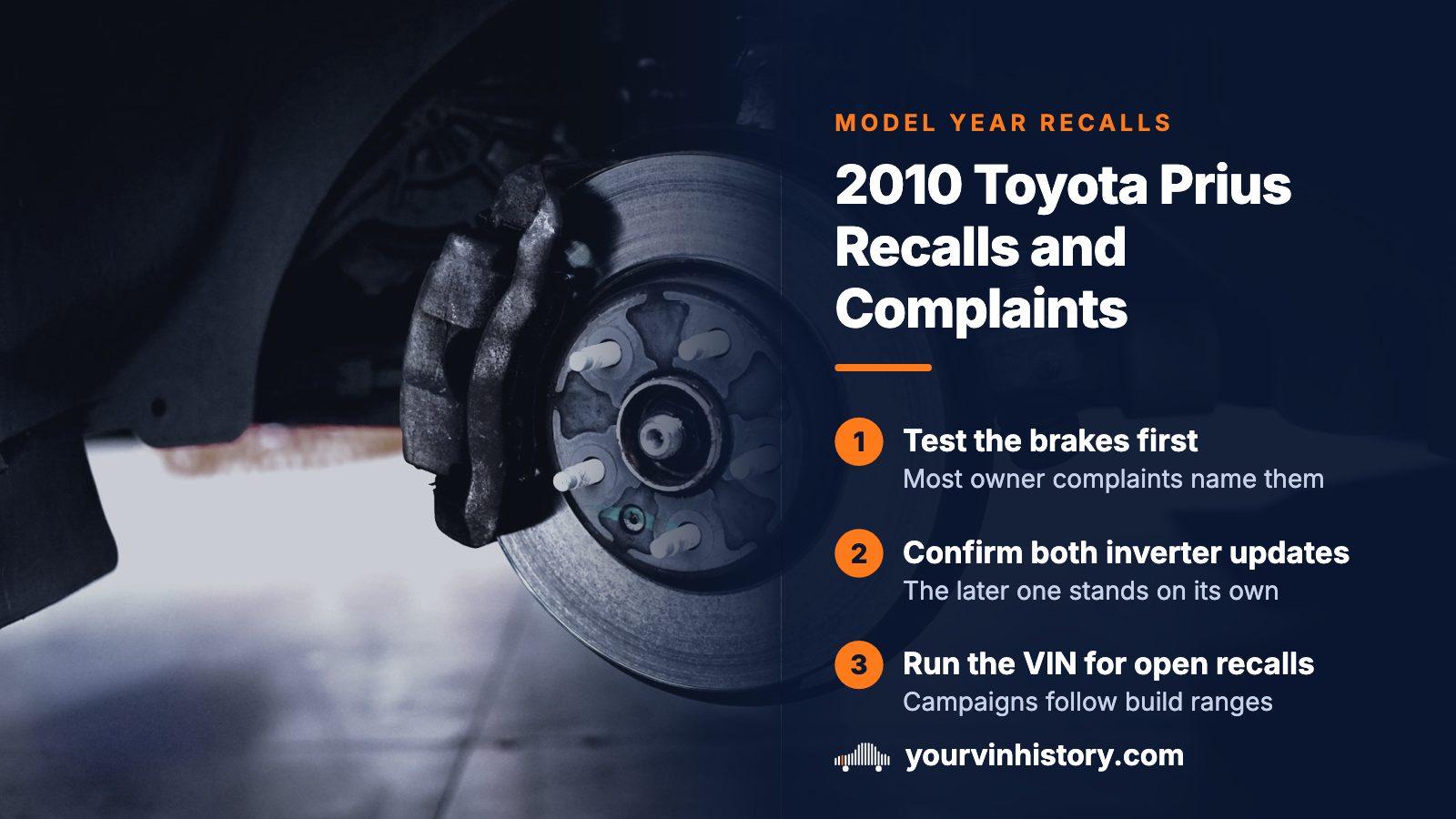
THE SHORT ANSWER
The 2010 Toyota Prius has 10 recall campaigns on file with NHTSA, covering brake software and a booster pump, two hybrid inverter stall risks, a curtain air bag inflator, passenger sensor calibration, seat heater wiring and load labels. Owners filed 2,826 complaints, 70% of them naming the service brakes. NHTSA shows no crash rating for the configuration it tested. Recalls follow VIN ranges, so each car needs its own lookup.
- Recall campaigns
- 10 on file with NHTSA
- Owner complaints
- 2,826, with 70% naming service brakes
- Crash rating
- Not rated in this configuration
- Against other Prius years
- Heaviest of 15, at 13.65 times the median
Recalls versus complaints: how to read this Prius's file
NHTSA keeps two different records for a model year. A recall campaign is a defect the manufacturer has acknowledged and promised to remedy, a checklist for one car. A complaint is an owner's unverified account, so a pile of them is a map of where owners believed things went wrong.
The Prius pile holds 2,826 complaints. Owner wording flagged 185 as involving a crash, 13 a fire and 65 an injury. Those flags are not investigator findings, and one incident can produce several filings, but they deserve a full read. NHTSA also lists 4 investigations touching this model year; an investigation may end in a recall or in nothing.
All ten campaigns, grouped by the system they touch
Campaign numbers are the handle dealers and NHTSA use, so copy them down before calling anyone.
| System | Campaign numbers | The fault in plain terms |
|---|---|---|
| Brakes | 10V039000, 13V235000 | Uneven pedal feel after the antilock system acts; gas leaking into brake fluid |
| Hybrid inverter | 14V053000, 18V684000 | Inverter faults that can cut power or stall the car on the road |
| Air bags | 16V487000, 13V014000 | A cracked inflator weld; passenger sensing calibration possibly skipped |
| Seat heaters | 14V743000, 16V396000 | Accessory heater wiring that can short when the cushion compresses |
| Labels | 10V035000, 10V036000 | Required load-capacity labels missing |
Several campaigns name other models too, such as the Prius V and the Lexus CT200h, and each production range is narrower than the model year. Appearing on this list does not put your Prius in a campaign.
The brake campaigns and the complaint pile beside them
10V039000 is the antilock software campaign. NHTSA's summary says brake feel could turn inconsistent after the antilock system activated on rough or slick roads, lengthening stops; dealers reprogrammed the control unit. 13V235000 is hardware: nitrogen gas can leak into the brake fluid, lowering pedal pressure, and the remedy replaces the brake booster pump assemblies.
The complaint file leans the same way. Service brakes carry 1,975 of the 2,826 reports, and the next two lines, hydraulic and electric, are brake labels in NHTSA's component list too. The file cannot tie a complaint to a campaign, so no one can say how many trace to these recalls. Only a work order separates a recalled car from a repaired one.
Two inverter campaigns that both end in a stall risk
Under 14V053000, transistors in the inverter's Intelligent Power Module can be damaged by high operating temperatures. Warning lamps light, power drops into a limp-home mode good for a short drive, and the hybrid system can shut down, stalling the car. The fix is a software update for the motor/generator and hybrid control units, with a repaired or replaced inverter at no charge if it fails first.
18V684000 targets the same module: excessive voltage can shut the hybrid system down while moving. Its update began January 22, 2019, and Toyota says it is needed even if the car got the earlier software under 14V-053 or 15V-449. A Prius updated in 2014 can still have an open campaign, so ask the dealer to show both on the record.
Air bags, seat heaters and the paperwork campaigns
16V487000 concerns the curtain shield air bags, where a cracked inflator weld can send pieces into the cabin; dealers fit retention brackets. 13V014000 is a calibration matter: dealer-installed accessories may have gone on without testing the passenger occupant sensing, so the passenger air bag might not deploy properly. Dealers test and recalibrate.
The seat heater pair, 14V743000 and 16V396000, involves accessory heaters with copper strand elements. A compressed cushion can damage the wiring, and a short risks a scorched seat or a fire. The remedy is to disconnect the heater and refund the accessory. A Prius that never had that accessory should have nothing to correct. The label pair, 10V035000 and 10V036000, is paperwork: dealers mail or install the missing load-capacity label.
Where the 2,826 complaints cluster
Owners choose the component when they file, and one filing can name several, which is why the shares add up to more than the whole.
| Reports | Share of all filings | Component label |
|---|---|---|
| 1,975 | 70% | Service brakes |
| 849 | 30% | Service brakes, hydraulic |
| 502 | 18% | Service brakes, electric |
| 288 | 10% | Vehicle speed control |
| 193 | 7% | Electrical system |
| 148 | 5% | Exterior lighting |
| 141 | 5% | Engine |
| 109 | 4% | Unknown or other |
| 84 | 3% | Air bags |
| 79 | 3% | Power train |
| 60 | 2% | Fuel and propulsion system |
| 58 | 2% | Electronic stability control |
The top three lines are brake labels, and no other system comes close. A cluster this tight reads as a specific weakness rather than a thin spread of ordinary wear.
How old the cars were when owners filed
Each complaint carries the date the owner says the problem occurred, so the gap from the model year is the car's age at that moment. Filing activity peaked in 2010 itself. Early clusters tend to be factory issues that warranty work absorbed; later ones are wear and miles, the part a later owner inherits.
| Component label | Filed within three years | Typical age at failure | Reports counted |
|---|---|---|---|
| Service brakes | 72% | 0.1 years | 1,967 |
| Service brakes, hydraulic | 98% | 0 years | 842 |
| Service brakes, electric | 100% | 0 years | 501 |
| Vehicle speed control | 85% | 0 years | 286 |
| Electrical system | 27% | 5.8 years | 193 |
| Exterior lighting | 26% | 5.3 years | 147 |
| Engine | 5% | 7.3 years | 141 |
| Unknown or other | 27% | 6.8 years | 106 |
Brake reports sit at or near zero years, so a looked-after car may already have had that work done; request the paperwork. Engine reports arrive latest, 7.3 years in, so engine is the line to budget for. Counts here sit a little below the previous table, so a few filings fall outside the age figures.
A median is not a failure rate
These ages summarize unverified owner reports. They show when complainers say a problem occurred, not how likely a given car is to have it.
Where 2010 stands among Prius model years
Raw complaint counts follow sales volume as much as trouble, so a fairer yardstick sets each year against the same nameplate's own median year. The median is the middle year when all of them are lined up by complaint count, so one extreme year cannot drag the benchmark.
By that measure 2010 is the heaviest of 15 Prius model years on record, 2008 through 2022, at 13.65 times the median. The lightest settled year is 2021, at 0.08 times. Heaviest means the most owners wrote to NHTSA; it is not a failure rate or a reliability score.
Crash ratings and driver aids on this model year
NHTSA shows no overall, frontal, side or rollover rating for the configuration it tested, listed as 4-DR.w/SAB, and publishes no rollover probability. Ratings describe the design as built. They help compare one model year with another, but they cannot tell you how a particular used car would fare after years of use and any repairs.
Forward collision warning came as an option, so equipment differs between cars, while lane departure warning was not offered. Confirm equipment from the VIN rather than the model year.
When a recall repair stops being a no-charge job
Dealers perform recall repairs at no charge, but only within limits written into federal law. Under 49 U.S.C. §30120(g), a manufacturer's no-charge obligation lapses when the first buyer purchased the car over 15 calendar years ahead of the recall notice. The clock runs from that first sale, so a later owner does not restart it.
For a car sold new in 2010, the ten campaigns above were announced well inside the window. Anything announced after it closes may carry no right to a no-charge repair, though some dealers still do the work. Settle that before the purchase.
What to put in front of a mechanic
- Brakes: pedal feel over a rough patch and in a firm stop, antilock behavior, any brake warning light, and work orders for the booster pump or antilock software.
- Hybrid system: warning lamps, reduced power or limp-home episodes, and proof that both inverter software updates were done.
- Air bags and seat heaters: warning lamps at startup, the curtain air bag brackets, and any accessory heater fitted or disconnected.
- Wiring and engine bay: some owners reported fires on this model year, so look for heat damage and amateur electrical work.
- Tailgate: hinges, struts and the wiring running into the hatch.
- Body: rear wheel arch seams where salt collects, folding seat latches, the load floor for damp or repair evidence, and the suspension bushes.
At this age, condition and maintenance history outweigh the federal record. The complaint list points to where to look; it does not predict what you will find.
Questions for the seller, then the VIN lookup
- Did a dealer complete all 10 campaigns, and can you show the work orders?
- Was the 2019 inverter software update done, or only the earlier one?
- Have the brakes ever been repaired or replaced, and by whom?
- Has the car been in a collision, and did an insurer pay for repairs?
- May my own mechanic inspect it before we settle on a price?
- Does the title sit in the seller's name with no lien on it?
Then run the VIN through NHTSA's recall lookup, a no-cost agency tool; only the VIN shows which of the ten apply. A yourvinhistory report adds what those files omit: title brands, accidents, odometer readings and salvage records, with title data from ClearVin LLC, an approved NMVTIS provider.
Where this information comes from
- NHTSA: recalls lookup — Where a VIN is entered to see open campaigns; the ten campaign summaries here come from the same agency records.
- NHTSA: vehicle safety and consumer complaints — Entry point to the owner filings behind the 2,826 total, the category counts and the crash, fire and injury flags.
- 49 U.S.C. §30120: remedy without charge — Statute text for the no-charge remedy and the 15 calendar year limit measured from the first sale.
- NHTSA: 5-Star Safety Ratings — The federal crash-test program whose blank ratings for this configuration are described above.
- NMVTIS: national title information system — Federal source for title brands and history, which a safety record does not include.
Sources and photos: Facts checked against the sources above in October 2026. Photo by ün LIU on Unsplash; diagrams by YourVINHistory.
Keep reading
- Toyota Prius years to avoid, ranked by NHTSA complaintsSets all 15 Prius model years against the nameplate median, with 2010 at the top.
- Toyota recallsShows how to check any Toyota by VIN for open campaigns.
- Toyota Prius head gasket replacement cost, and what Toyota documentedPrices a major Prius engine repair, the system whose reports arrive latest on this model year.
- Buying a car with an open recallCovers what to do when the lookup shows a repair was never made.
Frequently asked questions
How many recall campaigns cover the 2010 Prius?
The federal file shows 10, the earliest filed in 2010 and the latest begun in 2019. Each covers certain production ranges, so only a VIN lookup shows which apply. The seat heater campaigns concern accessory heaters, so a car without that accessory may have nothing outstanding.
What do owners complain about most on a 2010 Prius?
Brakes, by a wide margin. Of 2,826 filings, 1,975 name the service brakes, 849 the hydraulic brake label and 502 the electric one, and a single filing can name more than one. They are owner opinions, not confirmed defects, but a cluster this tight is the reason to test the brakes first.
Did the 2010 Toyota Prius get a crash-test rating?
Not for the configuration NHTSA lists: overall, frontal, side and rollover ratings are blank, and no rollover probability is published. A gap like this can occur for trims NHTSA never tested and is not a failed test. Lean on the recall and complaint record, plus an inspection for past collision repair.
Do I have to pay for a recall repair on a 2010 Prius?
Dealers do recall repairs without charge, but federal law lets a manufacturer decline once the car was bought new over 15 calendar years before the notice. The ten campaigns on file fall well inside that window for a car sold new in 2010; for anything newer, get the dealer's answer first.
Where does the data on this page come from?
NHTSA's public recall, complaint and crash-test databases. Complaint totals shift as NHTSA adds and updates records, so a lookup today may differ by a few reports. Title and ownership history lives elsewhere: NMVTIS-reporting sources supply title brands, which no safety database includes.
Now check the car itself
The guide explains what to look for. The report shows what this VIN has on record.