THE SHORT ANSWER
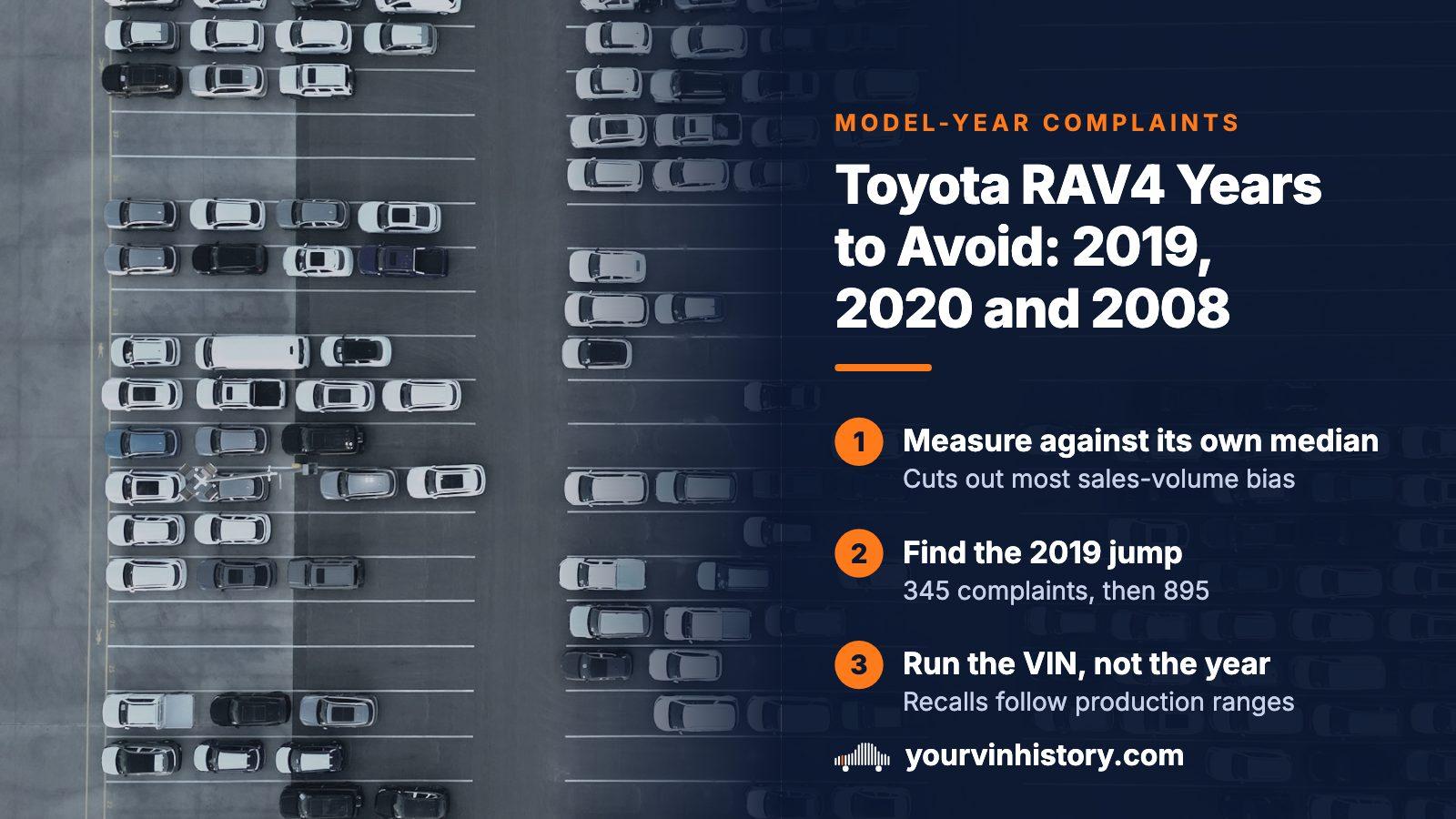
The RAV4 years to approach carefully are 2019, 2020, 2008 and 2021. The 2019 model leads with 895 NHTSA complaints against a yearly median of 318, up from 345 in 2018. No settled year sits clearly below the rest, and electrical system is the largest complaint area at 908 reports. These are unverified owner accounts, not failure rates, so a flagged year means inspect harder, not walk away.
- Complaints on record
- 5,738 across 2008 to 2022
- Median year
- 318 complaints
- Heaviest year
- 2019, with 895 (2.81 times the median)
- Largest complaint area
- Electrical system, 908 reports
The yardstick: each year against the RAV4's own median
Raw complaint totals follow sales and age at least as much as they follow quality. A popular model year piles up filings simply because more of them were sold, and an older year has had longer to collect them. To dull the first effect, every RAV4 year here is measured against the typical RAV4 year: the median of its fifteen yearly counts, which is 318 complaints. A score of 1× means ordinary for this nameplate, and 2× means double the usual load.
The pool is every NHTSA consumer complaint for 2008 through 2022, 5,738 in total, with duplicates removed by ODI complaint number. The pull is dated 2026-08-15, so anything filed later is missing.
One rule covers every number that follows. A complaint is a single owner's unverified account, which makes a count neither a failure rate nor a reliability score. It shows where owners bothered to complain, and that is all.
All fifteen RAV4 model years in one table
Standing is a plain reading of the multiple: near the median, above it, or well above it. The median itself is 318 complaints, which is exactly where 2017 lands.
| Model year | Complaints | Times the median | Recalls | Standing |
|---|---|---|---|---|
| 2008 | 575 | 1.81× | 14 | Above |
| 2009 | 327 | 1.03× | 15 | Near |
| 2010 | 400 | 1.26× | 14 | Near |
| 2011 | 287 | 0.9× | 11 | Near |
| 2012 | 266 | 0.84× | 5 | Near |
| 2013 | 260 | 0.82× | 2 | Near |
| 2014 | 206 | 0.65× | 4 | Near |
| 2015 | 302 | 0.95× | 4 | Near |
| 2016 | 251 | 0.79× | 3 | Near |
| 2017 | 318 | 1× | 3 | Near |
| 2018 | 345 | 1.08× | 3 | Near |
| 2019 | 895 | 2.81× | 7 | Well above |
| 2020 | 640 | 2.01× | 6 | Well above |
| 2021 | 501 | 1.58× | 1 | Above |
| 2022 | 165 | 0.52× | 1 | Near, but a young car |
The break at 2019: 345 complaints, then 895
Through 2018 the counts stay inside a tight band. Then the next model year records 895, the highest of the fifteen and 2.81 times the median. No other pair of neighboring years in the table moves anywhere near as far.
A break that sharp is the pattern often seen after a redesign or a big mechanical change, though complaint data cannot say which happened here. What it does show is that a 2019 behaves differently from the cars before it, so what you learned about a 2016 or 2017 RAV4 should not be carried across to it.
Seven recalls are listed against 2019. Owners point most often at the fuel and propulsion system, with engine also prominent, so the service history for those two areas is the first thing to read on any car from that year.
2020 and 2021: the surge thins out
2020 keeps most of the weight, with 640 complaints, 2.01 times the median and six recalls. Engine is its most-reported area. 2021 falls to 501, or 1.58 times, and its leading area switches to air bags. It carries a single recall.
The slide from 895 through 640 and 501 to 165 in 2022 invites a cheerful reading, that the trouble faded away. Go slower than that. Young cars have had less time to collect complaints, so the 0.52 times for 2022 says as much about age as about the car. That is why the newest year stays out of any cleanest-years conversation here.
Treat 2021 as the edge of the flagged group: still above normal, but with the lightest recall record of the four.
2008 and the early recall load
The oldest year in the set sits at 575 complaints, 1.81 times the median, with engine again the most-reported area. It also carries 14 recalls, and its neighbors look alike: 15 for 2009, 14 for 2010 and 11 for 2011, before the figure drops to 5 for 2012 and 2 for 2013.
Those recall counts do not track complaints. 2009 and 2010 pile up recalls yet land at only 1.03 and 1.26 times the median. Many recalls beside ordinary complaint volume often means defects were found and repaired while the cars were young, which is the recall system doing its job. 2008 is the exception, high in both columns.
An old car adds a second problem: age itself. Worn seals, tired suspension parts and deferred maintenance matter as much as any recall history, so a 2008 with thin records is a bigger gamble than its multiple suggests.
2009 through 2018: no year clearly cleaner
Ten model years share a narrow lane. Their multiples run from 0.65 for 2014 up to 1.26 for 2010, and their raw counts from 206 to 400. No single reputation-making year emerges from that spread.
2014 posts the lowest count among them at 206 complaints, with 2016, 2013 and 2012 following at 0.79, 0.82 and 0.84 times. None sits far enough under the median to be called better than its neighbors, and the data does not justify naming one. 2022 has a smaller count still, 165, but it is too young to qualify as settled.
For a shopper, that means condition and paperwork should break ties. A 2011 with a full service file beats a 2014 with none.
Where owners point: six NHTSA complaint areas
Pooled across all fifteen years, these are the six largest NHTSA component categories for the RAV4:
- 908 reports in electrical system
- 838 reports in engine
- 787 reports in unknown or other
- 394 reports in fuel and propulsion system
- 393 reports in vehicle speed control
- 305 reports in service brakes
Read these as areas, not parts. NHTSA has no category for a single component: electrical system takes in the battery, wiring, lighting and control modules, and engine takes in any engine fault. The 787 filed under unknown or other could not be assigned to a named system.
Notice that none of the four flagged years has electrical system on top. 2019 leads with fuel and propulsion, 2020 and 2008 with engine, 2021 with air bags. The electrical total is probably spread thinly over many model years, which makes it a check for every RAV4 rather than for one year.
How to read the recall column
A recall is a defect the manufacturer has acknowledged and must remedy at no charge, so it is a different kind of record from a complaint. The promise has an end date. Under 49 U.S.C. §30120(g), the no-charge duty lapses for a vehicle first bought more than 15 calendar years before the recall notice or order. A campaign announced from here on would fall outside that window for a 2008 car.
Recalls also follow production ranges rather than whole model years. The table shows how busy a year has been; it cannot say whether the RAV4 in front of you has an open campaign. Only the VIN can. NHTSA's recall lookup is free and takes the 17-character number.
Where a campaign is open, ask a Toyota dealer to confirm in writing that the repair is still covered at no charge before the sale closes.
Inspection plan for a 2019, 2020, 2008 or 2021 RAV4
These steps tie the inspection to the areas the complaint data highlights.
- Run the VIN through NHTSA's recall lookup before the test drive and write down any open campaign.
- Read the service file for repairs in the leading area for that year: fuel and propulsion for 2019, engine for 2020 and 2008, air bags for 2021.
- Start the engine cold. Listen for rough running or odd noises, and watch for warning lights that stay lit after startup.
- Ask a shop to test the battery and charging system and read the modules for stored fault codes, since electrical system is the biggest category overall.
- Drive with attention on braking and on how the car holds its speed. Service brakes and vehicle speed control both sit in the top six, and brake complaints are about defects, not routine pad wear.
- Pay for an independent pre-purchase inspection and keep the written findings for the price talk.
A flag raises questions, not a verdict
Every model year in the table includes cared-for cars and neglected ones. Treat a flag as a reason to ask for paperwork and a lift inspection, and as bargaining power if something turns up.
From model year to the exact car on the lot
Everything above describes a group of cars. The one you are about to pay for has its own paperwork, and a ranking by model year cannot see it: title brands, past damage, odometer entries, open campaigns, liens.
Three public lookups cover part of that ground. NHTSA's recall search lists open campaigns for a VIN, NICB's VINCheck is a free screen for theft and total-loss records, and NMVTIS is the federal national title system meant to protect buyers from title fraud and unsafe vehicles.
A yourvinhistory report gathers title brands, accidents, odometer readings and open recalls for a VIN into one document. The preview is free; the full report is a one-time purchase. Run it on a flagged-year RAV4 before you make an offer.
Where this information comes from
- NHTSA: Vehicle safety — The federal consumer complaint database that supplies every owner-report count in the ranking.
- NHTSA: Recalls — Source of the recall counts by model year, and the VIN search for open campaigns on one car.
- Bureau of Justice Assistance: NMVTIS — The federal national title system, which covers the title side that a model-year ranking cannot.
- NICB: VINCheck — A no-cost screen for theft and total-loss records tied to one VIN.
Sources and photos: Facts checked against the sources above in October 2026. Photo by Iain on Unsplash; diagrams by YourVINHistory.
Keep reading
- 2014 Toyota RAV4 recalls, electrical complaints and what to inspectThe one RAV4 year with its own record page, covering campaigns, complaints by component and crash ratings.
- Toyota recallsHow to look up open Toyota recalls by VIN, the first check on a RAV4 from any flagged year.
- Toyota RAV4 brake pads and rotors cost, and what recalls and bulletins changeService brakes drew 305 owner reports, and this post prices the work after checking recalls and bulletins.
- Pre-purchase inspectionWhat an independent shop looks at before you commit to a used SUV from a flagged year.
Frequently asked questions
Which Toyota RAV4 years should I avoid?
Start with 2019 and 2020, at 2.81 and 2.01 times the median, then 2008 and 2021 at 1.81 and 1.58. Avoid is too strong a word, though. A practical order is to shop 2009 through 2018 first, where counts stay near ordinary, and ask for fuller records on any car from the flagged years.
What is the most reliable Toyota RAV4 year?
Complaint data cannot crown one. 2014 has the lowest count among settled years at 206, or 0.65 times the median, but it still sits in the same near-median group as its neighbors. A count is not a reliability score, so choose between those years on service history, recall status and an independent inspection.
Is the 2019 Toyota RAV4 a bad year?
It has the most complaints, 895, and seven recalls, with fuel and propulsion leading. The numbers do not show how many 2019 cars were sold, and heavy reporting is not the same as heavy failure. A 2019 with a clean recall lookup, complete records and a good shop inspection is a different proposition from the raw count.
What goes wrong most often on a Toyota RAV4?
By NHTSA category, electrical system, with 908 reports, ahead of engine at 838. Both are broad: electrical covers battery, wiring, lighting and modules, and engine covers any engine fault. Another 787 reports are filed as unknown or other, so a large share of the record never names a system.
Do newer RAV4 years have fewer problems?
Not necessarily. 2022 shows 165 complaints, or 0.52 times the median, but young cars have had less time to collect them, and the pull ends on 2026-08-15. 2021 already sits at 501 and 1.58 times. Treat the newest counts as provisional and look at the car's own recall status and records.
Now check the car itself
The guide explains what to look for. The report shows what this VIN has on record.