THE SHORT ANSWER
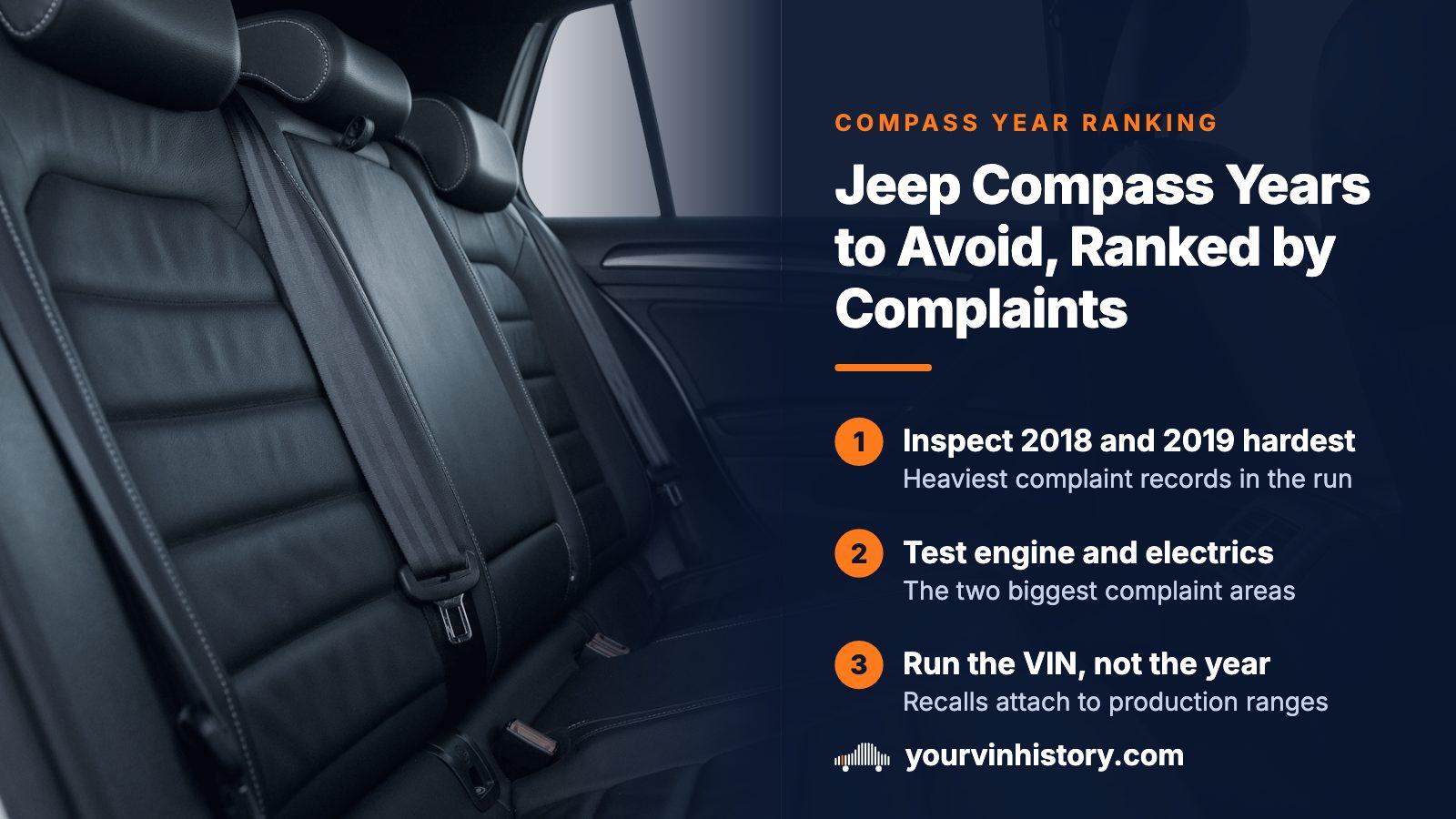
By NHTSA complaint count, the 2018 Jeep Compass is the year to inspect hardest: 931 complaints, or 5.06 times the model's median of 184. The 2019, 2014 and 2016 cars come next at 325, 306 and 291. The lightest records belong to 2009, 2021, 2013 and 2010. Engine is the biggest complaint area overall, with 1,158 reports. A complaint count is not a failure rate, so a flagged year means look closer, not walk away.
- Complaints on file
- 3,394, model years 2008 to 2022
- Median model year
- 184 complaints
- Peak year
- 2018: 931 complaints, 5.06 times the median
- Largest area
- Engine, 1,158 reports
How each Compass year is scored
Raw complaint totals mostly reflect how many cars were sold and how long a model year has been on the road. A popular year will out-collect an unpopular one even when the two were built equally well. To damp that effect, every Compass year on this page is measured against the Compass's own middle year instead of against other vehicles.
The figures come from NHTSA filings for the 2008 to 2022 model years, with duplicate reports removed by their ODI numbers, pulled in August 2026. Sort the fifteen yearly counts from lightest to heaviest and 184 sits in the middle; that count belongs to 2012. Each other year is shown as a multiple of it: 2× means twice that load, and 2009, at 0.35×, drew just over a third of it. The comparison runs between Compass years only, never against another nameplate.
All fifteen Compass years, side by side
The standing column is shorthand. Light means well under the median, typical means near it, heavy means clearly over it, and far above is used for a single year.
| Model year | Standing | Complaints | Recalls | Times the median |
|---|---|---|---|---|
| 2008 | Typical | 172 | 0 | 0.93× |
| 2009 | Light | 64 | 1 | 0.35× |
| 2010 | Light | 81 | 2 | 0.44× |
| 2011 | Typical | 187 | 3 | 1.02× |
| 2012 | Typical | 184 | 4 | 1× |
| 2013 | Light | 80 | 1 | 0.43× |
| 2014 | Heavy | 306 | 2 | 1.66× |
| 2015 | Typical | 113 | 1 | 0.61× |
| 2016 | Heavy | 291 | 1 | 1.58× |
| 2017 | Typical | 228 | 4 | 1.24× |
| 2018 | Far above | 931 | 6 | 5.06× |
| 2019 | Heavy | 325 | 2 | 1.77× |
| 2020 | Typical | 137 | 1 | 0.74× |
| 2021 | Light | 76 | 0 | 0.41× |
| 2022 | Typical | 219 | 4 | 1.19× |
The labels are bands, so 2015 at 0.61× still lands in typical while 2013 at 0.43× lands in light. The median itself is 184 complaints.
The step from 228 to 931 between 2017 and 2018
No other pair of neighboring years in the table comes close to the move from 2017 to 2018. The 2017 Compass logged 228 complaints, a typical 1.24× year. The 2018 car logged 931, or 5.06× the median, and it also carries the most recalls of any year in the run, with six.
Engine and electrical system are the components that stand out for 2018, and they are also the two largest areas for the nameplate as a whole. A jump this size often points to something changing on the vehicle, such as a redesign or a major mechanical revision, but complaint data cannot say which. A shopper weighing a 2017 against a 2018 is choosing across a visible seam. A Jeep dealer or a good independent shop can tell you what differs between the two.
This site also keeps a separate record page for the 2018 model that breaks out its recall campaigns and complaint components.
2019, 2014 and 2016: heavy but not extreme
Three more years sit clearly above the median. None approaches 2018, but each is worth a harder look than a typical year.
| Model year | Most-reported area | Complaints | Times the median |
|---|---|---|---|
| 2019 | Engine | 325 | 1.77× |
| 2014 | Air bags | 306 | 1.66× |
| 2016 | Engine | 291 | 1.58× |
Engine tops the list for 2019 and 2016, as it does for the nameplate overall. The 2014 car breaks the pattern: air bags lead there, even though the air bag bucket totals only 170 reports across the whole run. On a 2014, watch the air bag warning light and confirm the recall lookup shows nothing open. Just under this tier, the 2017 car at 228 complaints counts as typical, and 2011 at 187 and 2012 at 184 are nearly level with the median.
The lightest records: 2009, 2021, 2013 and 2010
- 2009: 64 complaints, 0.35× the median, one recall
- 2021: 76 complaints, 0.41× the median, no recalls
- 2013: 80 complaints, 0.43× the median, one recall
- 2010: 81 complaints, 0.44× the median, two recalls
These counts are low enough to be tempting, but young cars have not had long to collect reports, which is why a list of the cleanest years skips the newest model years on purpose. All fifteen Compass years counted as settled here, 2021 among them, yet a 2021 count of 76 still reflects fewer years on the road than a 2009 count of 64 does.
Recall numbers deserve the same caution. The 2008 Compass has no recalls and still drew 172 complaints.
Where the complaints concentrate
NHTSA files each complaint under one or more vehicle components. Totaled across the Compass run, engine leads by a wide margin, with the electrical system second.
| Component category | Reports, 2008 to 2022 |
|---|---|
| Engine | 1,158 |
| Electrical system | 898 |
| Unknown or other | 624 |
| Power train | 457 |
| Air bags | 170 |
| Exterior lighting | 114 |
These six counts add up to more than the 3,394 complaints on file, which suggests some complaints are filed under several components at once. The labels are also broad. Engine takes in any engine fault, electrical system takes in wiring, battery and modules as well as charging parts, and power train takes in the transmission and more. None of them names a particular part, and the counts here do not summarize what owners wrote. The third-largest bucket is unknown or other, so a good share of complaints cannot be pinned to an area at all. NHTSA's complaint search shows the owner narratives, so read the ones filed against the year you are considering.
What the recall column adds, and where it stops
A recall is a different kind of record from a complaint. It is a defect the manufacturer has acknowledged and must remedy at no charge, whereas a complaint is a single owner's claim that nobody has checked. That is why the two columns can disagree. The 2022 Compass shows four recalls beside a typical 219 complaints, and the 2008 shows none beside 172. A year with many recalls and modest complaints can mean problems were caught and repaired under warranty.
The no-charge promise has an end date. Under 49 U.S.C. §30120(g), the free-remedy duty does not reach a vehicle whose first purchase came more than 15 calendar years before the manufacturer's recall notice or NHTSA's order, whichever came first. The earliest Compass years are now at or beyond that distance, so a campaign announced today may not come with a free repair for them.
Campaigns also attach to production ranges, not to whole model years. A year's recall count therefore cannot tell you whether the car in front of you is affected. Only the VIN answers that.
Four ways to misread these numbers
- Age: older model years have had longer to collect reports, so a young year's low count is partly a head start.
- Accuracy: a complaint records what the owner believed happened, which is useful in bulk and shaky one report at a time.
- Direction: many recalls on one year are not automatically a warning sign, since every recall comes with a repair.
- Scope: a model year describes a group of cars, never the single one you are about to buy.
A complaint count is not a failure rate, and nothing here amounts to a reliability score.
A flagged year is a bargaining position
Every year in the table includes carefully maintained cars and neglected ones. A flag is a cue to look closer and haggle harder, not a verdict on an example you haven't seen.
What to check on a Compass from a flagged year
The complaint areas show a mechanic where to start. On any flagged Compass, and on a 2018 above all, a short list covers most of the ground.
- Ask for service records before anything else. On an SUV this age, a documented maintenance history says more than any model-year statistic.
- Start the engine cold, listen for unusual noise and watch the dash for warning lights. Have a shop scan for stored fault codes, since engine is the largest complaint area.
- Test the electrical system on purpose: exterior and interior lights, windows, locks, the audio and screen, and charging. Electrical system is the second-largest area and a leading one in 2018.
- Drive far enough to load the power train. Note any hesitation or harsh shifting, and ask whether the transmission has ever been serviced.
- Confirm the air bag light comes on and then goes out at start-up, and run the VIN through NHTSA's recall lookup. That matters most on a 2014.
- Book a pre-purchase inspection on a lift, where leaks, repairs and hidden damage show up. A seller who refuses it has told you something.
From the model year to the car on the lot
Once a year looks acceptable, everything that matters is specific to one vehicle. NHTSA's recall lookup takes the 17-character VIN and lists campaigns that are still open. NICB's VINCheck is a free screen of a VIN for theft and total-loss records. National title history comes from NMVTIS, the federal title database, which approved data providers package into reports.
A yourvinhistory report starts with a free preview, then covers title brands, accident records and odometer readings for that VIN in a one-time paid purchase. Read the odometer sequence for gaps or drops, read the title for brands, and compare both with the seller's story and the service records.
Where this information comes from
- NHTSA: vehicle safety and owner complaints — Where owners file and search complaints; the 3,394-complaint total and the component counts are drawn from filings here.
- NHTSA: recalls lookup — The VIN search for open recall campaigns on a specific car, and the source of the yearly recall counts.
- NMVTIS: national title information — The federal title database behind brand and title history, which a model-year table cannot show for one car.
- NICB: VINCheck — No-cost screening of one VIN for theft and total-loss records.
Sources and photos: Facts checked against the sources above in October 2026. Photo by Erik Andersson on Unsplash; diagrams by YourVINHistory.
Keep reading
- 2018 Jeep Compass: 6 recalls, 931 complaints and what to checkThe heaviest year in detail, with its recall campaigns and complaint components.
- Jeep recallsHow to run a Jeep VIN through the recall lookup and read what comes back.
- Jeep Cherokee years to avoid: 2014 leads 9,917 NHTSA complaintsAnother Jeep SUV ranked year by year with the same method.
- Buying a car with an open recallWhat to do when the lookup shows an open campaign on the car you want.
Frequently asked questions
Which Jeep Compass years should I avoid?
Start with 2018, which logged 931 complaints, then 2019, 2014 and 2016. Avoid is a strong word for what the data supports, though. Every one of those years includes well-kept cars, so a better rule is to pass on any flagged-year Compass that arrives without service records and to budget for an inspection on the ones that come with them.
Which Jeep Compass year has the fewest complaints?
The 2009 model, with 64 complaints, is the lightest in the 2008 to 2022 run, followed by 2021 at 76, 2013 at 80 and 2010 at 81. Fewer complaints is not the same as a better car, though. A quiet year can still hide a neglected example, and only a VIN check and an inspection show what one particular Compass has been through.
What goes wrong most often on a Jeep Compass?
By NHTSA component category, engine tops the list with 1,158 reports, then the electrical system at 898, an unknown or other group at 624, and the power train at 457. Those are category labels, not diagnoses, so ask a mechanic to start with the engine and charging system, and read the owner narratives for your model year.
Does a high recall count make a Compass year worse?
Not on its own. A recall means the manufacturer acknowledged a defect and owes a remedy within the federal time limit. The 2018 Compass has six recalls, the most in the run, and 2012, 2017 and 2022 have four each. Judge a car by whether its own recalls were completed, which the VIN lookup shows, not by how many campaigns its model year attracted.
How do I check one specific Jeep Compass before buying?
Use the 17-character VIN. Run it through NHTSA's recall lookup for open campaigns, NICB's VINCheck for theft and total-loss flags, and a title-history report built on NMVTIS data for brands and odometer readings. Then compare the results with the seller's account and the service records, and have a shop look at the car on a lift.
Now check the car itself
The guide explains what to look for. The report shows what this VIN has on record.