THE SHORT ANSWER
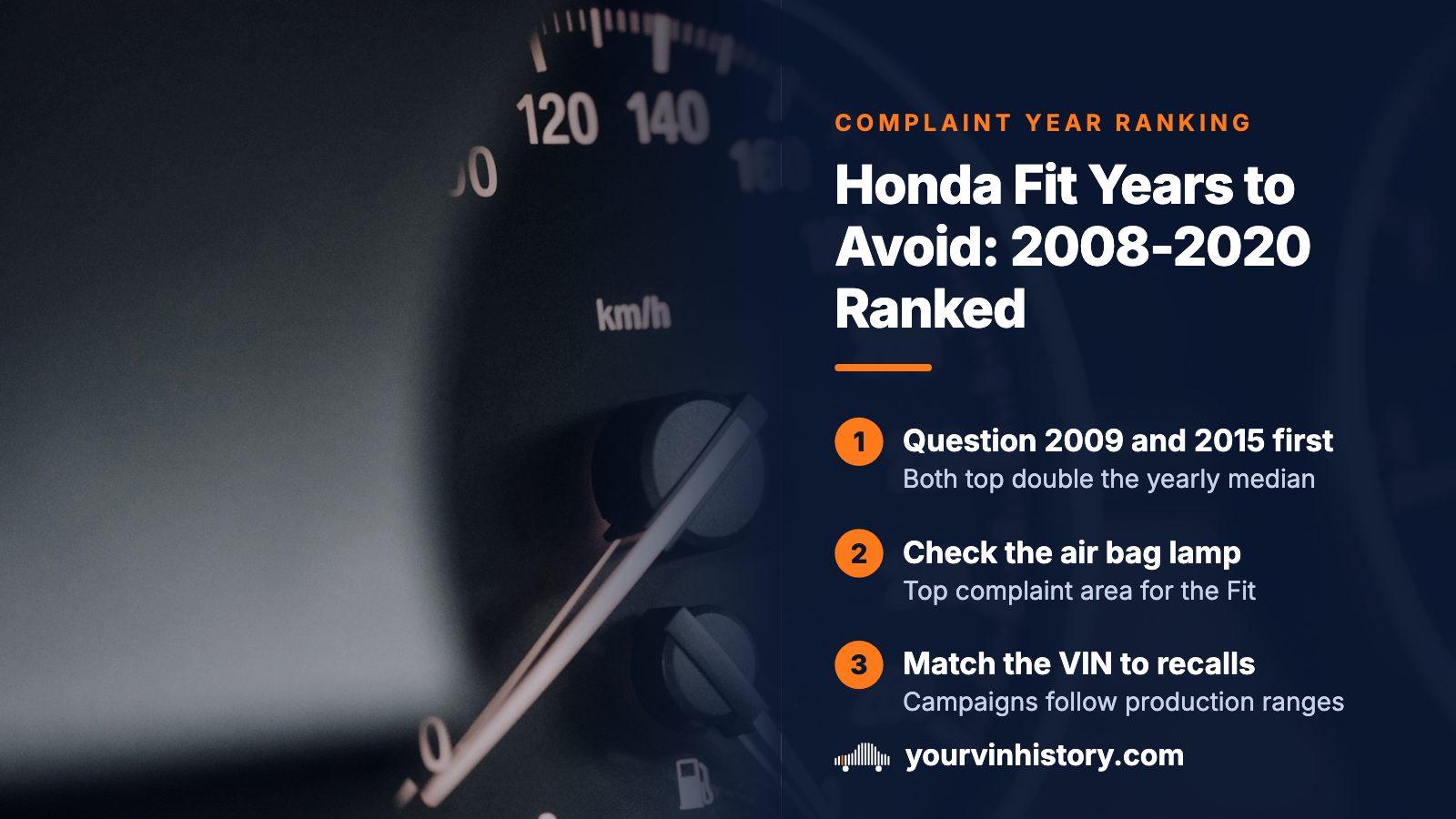
On NHTSA complaint volume, the Honda Fit years to approach most carefully are 2009 and 2015, with 287 and 282 reports against a yearly median of 127. The 2008 cars follow at 217. The lightest records belong to 2017 and 2020, though 2020 is the newest year and has had the least time to collect filings. Air bags lead the complaint areas at 441 reports. Counts are unverified owner accounts, not failure rates, so a flagged year is a reason to inspect harder.
- Complaints on record
- 1,816 across 2008 to 2020
- Median year
- 127 complaints
- Heaviest year
- 2009, with 287 complaints
- Top complaint area
- Air bags, 441 reports
What the Fit's complaint record covers
The data is every NHTSA consumer complaint filed against the Honda Fit for model years 2008 through 2020, 1,816 in all, spread over 12 model years. Duplicates were dropped by matching the ODI complaint number, and the pull is dated 2026-08-16, so anything filed afterward is missing.
A raw total mostly follows sales. A big-selling year piles up reports even when the cars are sound, and a slow seller can look spotless for the same reason. To soften that, each year is divided by the Fit's own median year, which is 127 complaints. A year at 1 times the median is ordinary for this car, and a year at 2.26 times has drawn more than double its usual volume. Nothing here compares the Fit with any other nameplate.
All 12 Fit model years in one table
The reading column is a plain-word label, not an official grade. Far over means more than double the median, over means clearly above it, typical covers the middle band, and light means well under it.
| Model year | Reading | Times the median | Complaints | Recalls |
|---|---|---|---|---|
| 2008 | Over | 1.71× | 217 | 8 |
| 2009 | Far over | 2.26× | 287 | 11 |
| 2010 | Over | 1.44× | 183 | 12 |
| 2011 | Typical | 0.89× | 113 | 11 |
| 2012 | Typical | 0.89× | 113 | 11 |
| 2013 | Over | 1.39× | 176 | 10 |
| 2015 | Far over | 2.22× | 282 | 4 |
| 2016 | Typical | 0.94× | 119 | 1 |
| 2017 | Light | 0.33× | 42 | 0 |
| 2018 | Typical | 0.91× | 115 | 4 |
| 2019 | Typical | 1.06× | 134 | 6 |
| 2020 | Light | 0.28× | 35 | 4 |
| Median year | Benchmark | 1× | 127 | n/a |
The table has no 2014 row, so the data runs from the 2013 cars straight to the 2015 cars. Of the 12 years, five sit over the median, five are typical and two are light.
2009 and 2015: the two tall peaks
Only two years pass twice the median. The 2009 cars hold the record at 287 complaints, or 2.26 times, and the 2015 cars follow at 282, or 2.22 times. Their volumes are nearly equal, but the complaints point at different places.
- 2009: air bags lead, steering is also prominent, and the year lists 11 recalls.
- 2015: the electrical system is the most reported area, and the year lists 4 recalls.
From 176 complaints on the 2013 cars to 282 on the 2015 cars, the count climbs sharply with no 2014 row between them. Jumps like that are what a redesign tends to leave behind, though the complaint data cannot name the cause. Ask the seller exactly which version of the Fit is in the driveway, then check the answer against the VIN.
2008, 2010 and 2013: older Fits that still run high
Three more years sit clearly above the median without reaching double. The 2008 cars log 217 complaints at 1.71 times, the 2010 cars 183 at 1.44 times, and the 2013 cars 176 at 1.39 times. Air bags are the top area in all three, which matches the pattern for the Fit as a whole.
Recall counts run high in this stretch too: 8 for 2008, 12 for 2010 and 10 for 2013. The 2010 year lists more recalls than any other Fit year in the table, and every year from 2009 through 2013 sits between 10 and 12. Recalls are the maker's own admissions and complaints are owner stories, so the two columns say different things and belong side by side.
The typical middle: 2011, 2012, 2016, 2018 and 2019
Five years sit near the median. The 2011 and 2012 cars each show 113 complaints, or 0.89 times. The 2016 and 2018 cars show 119 and 115, at 0.94 and 0.91 times. The 2019 cars show 134, which is 1.06 times and the only one of the five slightly above the line.
The recall column splits this group. The 2011 and 2012 years each list 11 recalls beside unremarkable complaint counts, a mix that suggests defects were found and repaired before many owners wrote in. The 2016, 2018 and 2019 years list 1, 4 and 6. A typical reading means no loud pattern in the data. It does not promise that a given car is trouble free.
The lightest records: 2017 and 2020
Two years fall far below the median. The 2017 cars have 42 complaints at 0.33 times the median and no recalls at all in the data. The 2020 cars have 35 complaints at 0.28 times, with 4 recalls.
Weigh them unequally. The 2017 cars have spent more years on the road than the 2020 cars and still draw few reports, which is the stronger evidence. The 2020 cars are the youngest in the table, so part of their short record is simply calendar time. A zero in the recall column describes this data pull only. A campaign announced later would not appear in it.
Where Fit owners aim their complaints
NHTSA files each complaint under a component category chosen when the report is made. Six categories lead across the whole 2008 to 2020 run, and the first is well ahead of the field.
| NHTSA category | Reports | What to test on a used example |
|---|---|---|
| Air bags | 441 | Warning lamp at key-on, recall status by VIN, repair paperwork |
| Electrical system | 351 | Windows, locks, lights, dash display, battery strength |
| Engine | 162 | Cold start, idle quality, oil seepage, warning lights |
| Power train | 148 | Shift behavior and noise on a test drive |
| Fuel / propulsion system | 142 | Fuel smell, hard starting, gauge behavior |
| Unknown or other | 135 | A catch-all bucket that points at no single part |
These are filing buckets, not diagnoses. The electrical category sweeps in battery, wiring and lighting along with control modules, so its 351 reports are an upper bound for any single electrical fault.
Why the air bag line comes first on any Fit
Air bags are the Fit's most reported area over the full run, and the top area in 2008, 2009, 2010 and 2013. That makes the category more useful than any year label, because it follows the car and not the calendar. A buyer cannot judge an air bag system by looking at it.
Turn the key and watch the air bag lamp, which should light briefly and go out. A lamp that stays on or never comes on is a fault to settle before any money changes hands. Ask for invoices behind any past air bag, seat belt or collision repair, and look up the VIN for open campaigns, because air bag recalls attach to production ranges and not to a model year as a whole.
What the recall column does and does not promise
A recall is a defect the manufacturer has acknowledged, and the maker must repair it at no charge. That duty has an age limit. Under 49 U.S.C. §30120(g), a vehicle first bought more than 15 calendar years before the recall notice falls outside the no-charge rule. The clock runs from first sale to the notice date, so an old campaign and a brand-new one can treat the same older Fit differently.
Recalls also attach to production ranges. Two Fits from the same model year can differ in which campaigns apply to them. The reliable check is the 17-character VIN in NHTSA's recall lookup, which lists open campaigns for that exact car at no cost. Print the result, and ask for proof of any repair already done.
Checking a used Fit from a flagged year
- Run the VIN through NHTSA's recall lookup and keep a copy of the result.
- Check the air bag lamp, then ask for paperwork behind any air bag, seat belt or collision repair.
- Work the electrical system: every window, lock, light and dash display, plus a battery test.
- Drive it cold and listen for engine and power train trouble before the car warms up.
- Screen the VIN with NICB's VINCheck for theft and total-loss flags, and read the NMVTIS title record through an approved provider.
A yourvinhistory report adds what no model-year table can: for one VIN it lists title brands, accident records with a damage map, odometer readings and open recalls. It opens with a preview before any purchase.
A flagged year is a bargaining position
A model year is a crowd of cars, and every crowd has well-kept members and abused ones. Treat a flagged year as grounds to look harder and to ask for a lower price. It is not grounds to dismiss a car you have not yet seen.
Where this information comes from
- NHTSA: vehicle safety and consumer complaints — The federal agency where owners file the complaints counted here, sorted into the component categories used in this guide.
- NHTSA: recalls lookup — Search by VIN to see which recall campaigns are still open on one specific Fit.
- NMVTIS: national title information — The federal title-record system behind brand and title checks, which a model-year table cannot supply.
- NICB: VINCheck — A no-cost lookup that screens a VIN for theft and total-loss records.
Sources and photos: Facts checked against the sources above in October 2026. Photo by CHUTTERSNAP on Unsplash; diagrams by YourVINHistory.
Keep reading
- Honda recallsHow to look up Honda recall campaigns by VIN and read the result.
- Airbag deployed checkAir bags lead the Fit's complaints, so learn how a past deployment shows up.
- Buying a car with an open recallWhat to do when the VIN lookup turns up an open campaign.
- Honda Civic years to avoid: where 7,501 NHTSA complaints landThe same year-by-year complaint ranking for Honda's compact sedan.
Frequently asked questions
Which Honda Fit model years should I avoid?
The 2009 and 2015 cars draw the most NHTSA complaints, at 287 and 282 against a median year of 127, and the 2008 cars come next at 217. None of that condemns a particular car. If you are choosing between years, the typical group of 2011, 2012, 2016, 2018 and 2019 is a quieter place to start, and then the VIN and a mechanic decide.
Does a high complaint count mean the Honda Fit is unreliable?
No. A complaint is one owner's unverified account, and counts rise with sales and with years on the road. The 2011 and 2012 cars show 113 complaints each, right at the typical line, yet carry 11 recalls apiece, a reminder that complaints and recalls measure different things. Neither number is a failure rate or a reliability score for a given car.
Which problem do Honda Fit owners report most often?
By NHTSA category, air bags, with 441 reports from 2008 to 2020, followed by the electrical system at 351. Those are filing buckets, not diagnoses, and the electrical bucket spans battery, wiring and lighting as well as modules. On an inspection, that puts the air bag lamp and a thorough electrical check ahead of everything else.
Is a newer Honda Fit automatically a better pick?
Not automatically. The 2015 year has the second-highest total in the table at 282, and the 2019 year sits slightly above the median at 134. The 2017 and 2020 cars look light, but 2020 is the youngest year in the data, so some of that is time. Judge the specific car by its recalls, records and condition, and use the year as a loose guide.
How do I check a specific Honda Fit before I pay?
Start with the VIN. NHTSA's recall lookup lists open campaigns, NICB's VINCheck screens for theft and total-loss flags, and NMVTIS-backed records cover title brands. A yourvinhistory report gathers title, accident and odometer records for the same VIN. Then pay a mechanic to put the car on a lift, because no database can see worn parts.
Now check the car itself
The guide explains what to look for. The report shows what this VIN has on record.