THE SHORT ANSWER
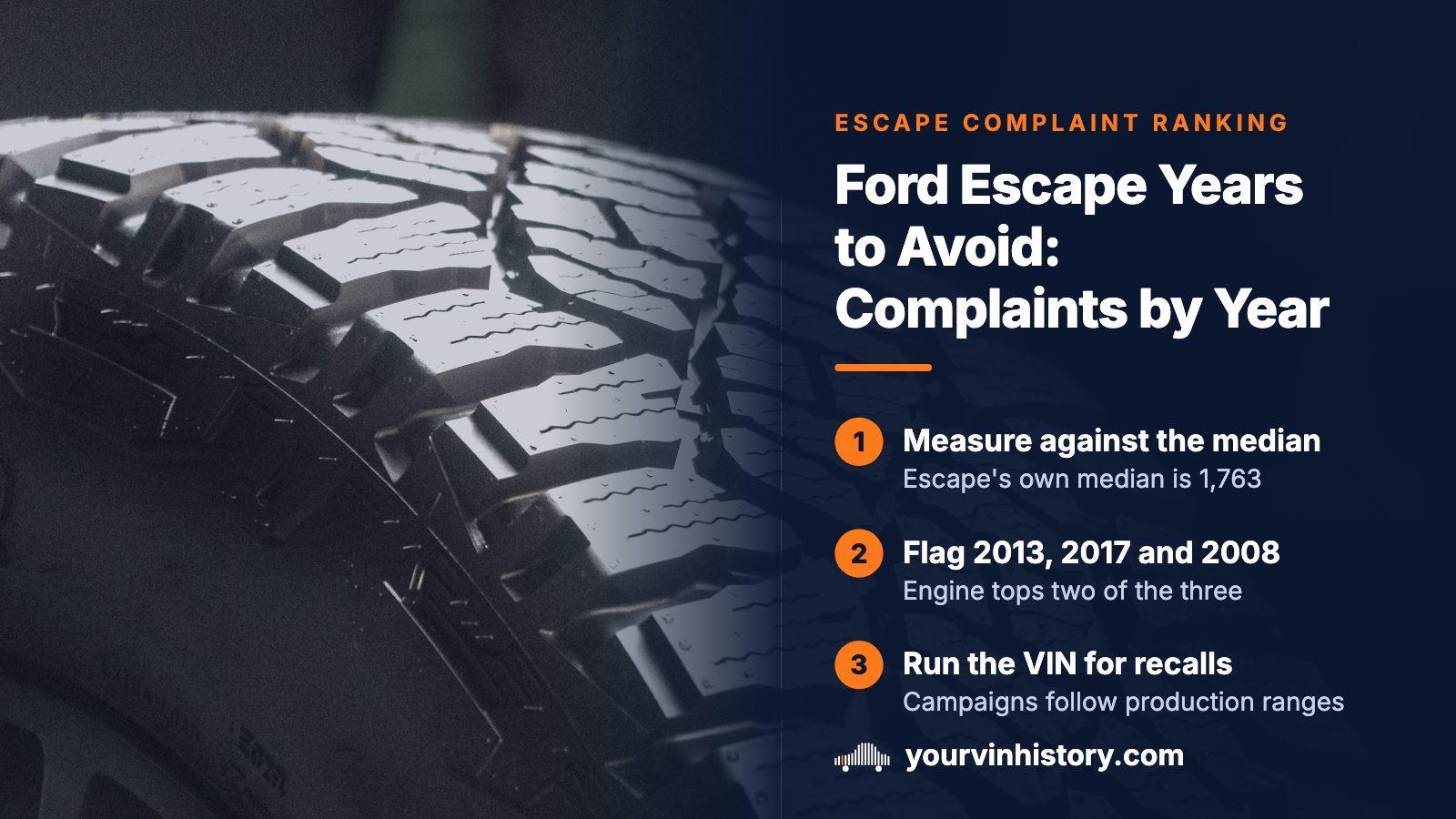
By NHTSA complaint volume, the Escape years to question first are 2013 with 2,748 complaints, 2017 with 2,652 and 2008 with 2,416, all above the Escape's own median of 1,763. Engine is the largest complaint area, at 6,823 reports. The lightest records are 2021, 2022 and 2019, though the two newest are simply young. A complaint count is an owner report, never a failure rate.
- Complaints on file
- 22,813 for 2008 to 2022
- Median model year
- 1,763 complaints
- Peak year
- 2013, with 2,748 complaints
- Top complaint area
- Engine, 6,823 reports
How the Escape comparison is built, and its limits
The figures behind this page are NHTSA consumer complaint filings for 2008 through 2022 Escapes. Duplicates were removed using the ODI complaint number, and the data was pulled on 2026-08-16, so anything filed later is missing, along with every problem that never reached NHTSA.
A raw total makes a poor yardstick, because a popular vehicle collects more reports than a rare one of identical quality. To soften that, each year is set against the Escape's own middle year. Line the fifteen yearly totals up from lowest to highest and the median lands on 1,763. A multiple of 1× is an ordinary Escape year; the higher the multiple, the heavier the pile.
Use the result as a screening tool for deciding where to look first. It is not a failure rate and it is not a reliability score.
All fifteen Escape model years side by side
Recalls are the recall records attached to each model year. Standing is this page's own shorthand, not an NHTSA term: High means 1.37× or more, Typical runs from 1× up to 1.21×, Lighter covers 0.6× to 0.77×, and Light means 0.35× or less.
| Model year | Standing | Multiple of median | Complaints | Recalls |
|---|---|---|---|---|
| 2008 | High | 1.37× | 2,416 | 5 |
| 2009 | Typical | 1.05× | 1,845 | 3 |
| 2010 | Typical | 1.21× | 2,127 | 5 |
| 2011 | Lighter | 0.77× | 1,351 | 3 |
| 2012 | Light | 0.35× | 613 | 2 |
| 2013 | High | 1.56× | 2,748 | 18 |
| 2014 | Typical | 1.18× | 2,074 | 16 |
| 2015 | Lighter | 0.6× | 1,057 | 9 |
| 2016 | Lighter | 0.61× | 1,077 | 4 |
| 2017 | High | 1.5× | 2,652 | 4 |
| 2018 | Typical | 1× | 1,763 | 4 |
| 2019 | Light | 0.32× | 571 | 3 |
| 2020 | Typical | 1.02× | 1,793 | 23 |
| 2021 | Light | 0.2× | 356 | 19 |
| 2022 | Light | 0.21× | 370 | 19 |
| Median | Benchmark | 1× | 1,763 | n/a |
Because 2018 lands exactly on the median, it scores a flat 1×. The standings do not slope from old to new, either. High years turn up in 2008, 2013 and 2017, with quieter years wedged between them.
Sudden steps instead of a gentle slope
The sharpest move in the data comes between 2012 and 2013. Complaints go from 613 to 2,748, and the recall count climbs from 2 to 18. A step that size often lines up with a redesign or a major mechanical change. The complaint numbers cannot say which happened here, but they do say that a 2012 and a 2013 Escape should be judged separately.
It is not the only jump. Complaints rise from 1,077 in 2016 to 2,652 in 2017, and from 571 in 2019 to 1,793 in 2020. In each case the earlier year is a Lighter or Light one.
In practice, find the model year of the car you are considering and glance at its neighbors. Comparing two Escapes a year apart can mean comparing two very different complaint histories.
The three years that stand out
Three Escapes top the sheet, each between 1.37× and 1.56× the median. The area owners mention most is listed for each.
- 2013: 2,748 complaints, 1.56× the median, 18 recalls. Engine leads, with power train also prominent.
- 2017: 2,652 complaints, 1.5×, 4 recalls. Engine leads.
- 2008: 2,416 complaints, 1.37×, 5 recalls. Steering leads.
Engine tops two of the three flagged years, and the exception, 2008, points to steering instead. Two more years deserve a second glance even though they fall short of the flagged group: 2010 with 2,127 complaints (1.21×) and 2014 with 2,074 (1.18×). Both are large raw numbers, and 2014 also carries 16 recalls. Skipping the three flagged years only to shop a 2010 or 2014 as though it were spotless moves the risk around without removing it.
The quietest years, and the footnote each one needs
Four years carry the smallest piles: 2021 with 356 complaints, 2022 with 370, 2019 with 571 and 2012 with 613.
- 2021 (0.2×, 19 recalls) and 2022 (0.21×, 19 recalls) are the two newest years in the data. Owners have had the least time to report, so a thin file is partly a matter of age.
- 2019 (0.32×, 3 recalls) is older and still light, so its quiet record carries more weight than the two youngest years do.
- 2012 (0.35×, 2 recalls) is quiet, but it sits right beside the 2013 jump. Read it as good news for that model year only, not for its neighbor.
Leave anything newer than 2022 out of this reasoning altogether. The data does not include those cars, and a vehicle that young looks spotless for the same reason: it has barely been on the road.
Why recall counts and complaint counts disagree
Each complaint is a single owner's unverified account. A recall is different: the manufacturer has acknowledged a defect and owes a repair. The two columns in the table answer different questions, so a year can score high on one and low on the other.
The 2020 Escape shows it plainly. It has the most recalls of any year at 23, yet its 1,793 complaints put it at 1.02×, an ordinary showing. The 2021 and 2022 cars each have 19 recalls beside the lightest complaint counts. One plausible reading of many recalls with few complaints is that problems were found and repaired under warranty instead of piling up.
Recall repairs have an age limit
Dealers do recall repairs at no charge to the owner, but only within the federal rule's limits. Under 49 U.S.C. §30120(g), that obligation lapses 15 years after a vehicle's first sale. On the oldest Escapes in this range, ask a Ford dealer whether a repair is still covered before assuming it is.
Where Escape owners point: engine, then power train and steering
NHTSA files each complaint under a component category. Added up across all fifteen years, these are the largest ones for the Escape.
| Component category | Reports, 2008 to 2022 |
|---|---|
| Engine | 6,823 |
| Power train | 3,997 |
| Steering | 3,435 |
| Electrical system | 1,612 |
| Unknown or other | 1,568 |
| Vehicle speed control | 1,385 |
These are broad buckets. Engine covers every kind of engine trouble, and power train takes in the transmission and related parts, so none of these counts isolates one failing part. They tell a mechanic where to start, and nothing finer.
Engine is also the top area in 2013 and 2017, and power train stands out in 2013 as well. On a 2013 Escape, both deserve attention.
What to check before paying for a flagged Escape
A flagged year is a reason to look harder, and the checks below follow the complaint areas in the data.
- Ask for the service history first. On an SUV of this age, a documented record says more about the car than any model-year statistic does.
- Run the VIN through NHTSA's recall lookup. Campaigns apply to production ranges rather than whole model years, so only the VIN settles whether a given Escape is covered, and an invoice should show the repair was completed.
- On a 2013 or 2017, have a mechanic examine the engine before anything else, since engine is the leading complaint area in both years.
- On a 2013, also pay attention to how the transmission shifts on a long test drive, because power train stands out in that year.
- On a 2008, test the steering: play in the wheel, pulling to one side, noises at full lock and any warning light. Steering is the area owners report most for that year.
- Use what you find when you negotiate. A flagged year with clean records and finished recall work is a better car than a quiet year with neither.
Four ways these numbers can mislead you
- Age: older model years have had longer to collect reports, which is why the newest years read as young, not as clean.
- Unverified accounts: a complaint records what an owner believed happened. That is useful in bulk and unreliable one report at a time.
- Sales volume: using the Escape's own median softens the effect, but the table holds no sales figures, so it is not gone.
- One car versus a population: none of this describes the vehicle in front of you. Its history is its own, and only its VIN reveals it.
Every year in the table includes sound, well-kept Escapes, and every quiet year includes neglected ones. Let the flag change how closely you inspect and how hard you bargain, not whether you look at a car at all.
Moving from the model year to the car in front of you
Once you have settled on a year, the remaining questions belong to a single vehicle: which recalls apply to its production range and whether the work was done, what its title record says, whether the odometer readings hold together, and what a mechanic finds underneath.
Two outside tools cover part of that. NHTSA's recall lookup is free and shows open campaigns for a VIN, and NICB's VINCheck is a free screen for theft and total-loss records. The national title record, NMVTIS, adds the title side.
A vehicle history report by VIN pulls those layers together with accident, salvage, lien and odometer records. The preview on this site is free, and the full report is a paid one-time purchase.
Where this information comes from
- NHTSA: Vehicle safety and complaint reporting — The agency whose consumer complaint filings supply the yearly counts and component categories on this page.
- NHTSA: Recalls — Where a VIN can be searched for open recall campaigns, which apply to production ranges.
- NMVTIS: National Motor Vehicle Title Information System — Federal title data system for one car's title history, which a model-year table cannot show.
- NICB: VINCheck — A theft and total-loss screen for a single VIN.
Sources and photos: Facts checked against the sources above in October 2026. Photo by Rob Wingate on Unsplash; diagrams by YourVINHistory.
Keep reading
- 2013 Ford Escape recalls and complaints: what NHTSA has on fileThe peak complaint year on its own page, with its recall campaigns and complaint areas.
- Ford recallsHow to look up open Ford recalls for the exact car you are weighing.
- Ford Escape transmission replacement cost and the recalls to check firstPower train is the second-largest complaint area; this covers the transmission repair bill.
- Buying a car with an open recallWhat to do when the VIN lookup turns up a recall that was never repaired.
Frequently asked questions
Which Ford Escape years should I avoid?
Going by NHTSA complaint volume, start with 2013, 2017 and 2008, which run from 1.37× to 1.56× the Escape's median. Avoid is a strong word, though. A flagged-year car with complete service records and finished recall work can be a better buy than a quiet-year car with no paperwork, so let the records decide, not the year alone.
Is the 2013 Ford Escape a bad year?
It is the most-complained-about year in the data, with 2,748 reports and 18 recalls, and engine and power train are the prominent areas. That makes it the Escape to inspect hardest, not one to rule out unseen. Its model-year record page lists the recall campaigns and splits the complaints by component.
What problem do Ford Escape owners report most?
By NHTSA category, engine, with 6,823 reports across the full run, followed by power train at 3,997 and steering at 3,435. The category names are broad, so engine counts every kind of engine complaint rather than one failing part. A mechanic can use the ranking to choose what to test first on any Escape.
Does a high recall count make an Escape year risky?
Not by itself. The 2020 year has 23 recalls, the most of any, yet its complaint count is ordinary at 1.02× the median. A recall means the maker acknowledged a defect and must remedy it, so the used-car question is whether the work on that VIN was completed and whether the federal age limit still lets a dealer do it at no charge.
How do I check a specific Ford Escape before buying?
Start with the VIN. NHTSA's recall lookup shows open campaigns, NICB's VINCheck screens for theft and total-loss records, and the national title record covers brands and title history that no model-year table can. Then pay a mechanic for an inspection, because a VIN cannot tell you what is worn or leaking.
Now check the car itself
The guide explains what to look for. The report shows what this VIN has on record.