THE SHORT ANSWER
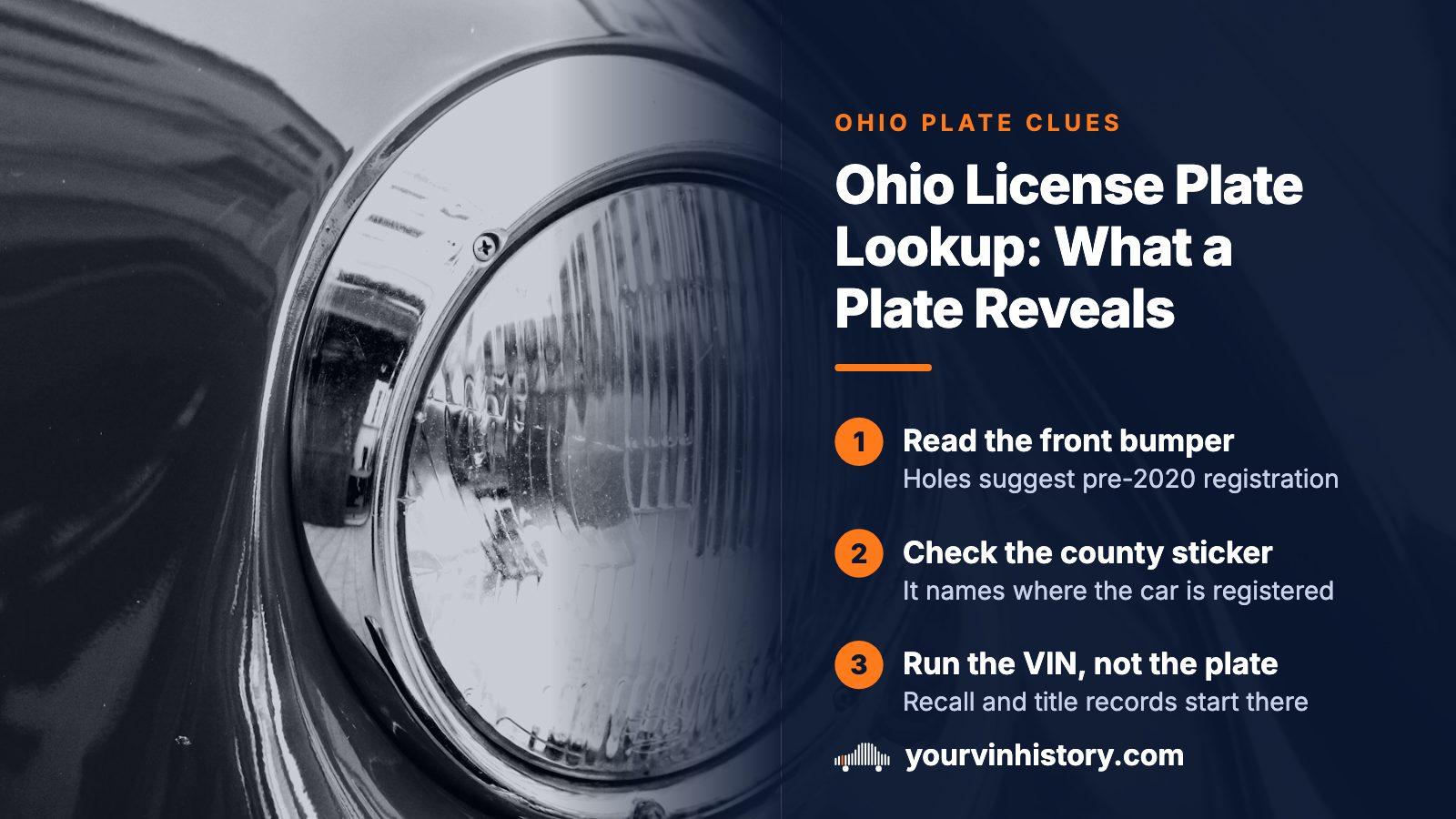
You cannot look up the owner of an Ohio plate out of curiosity. Federal law lets the BMV release owner records only for listed purposes, such as insurance claims, court cases or police work. A buyer learns more from the car: front-bumper holes suggest registration before July 1, 2020, the county sticker names where the car is registered, and the VIN opens recall, title and history records that the plate cannot.
- Front plate rule ended
- July 1, 2020
- Title issuer
- County clerk of courts, one of 88 counties
- Plate ownership
- Stays with the seller at sale
- E-Check area
- Seven northeast counties only
Read the front bumper before you read the plate
Until July 1, 2020, Ohio wanted a plate on both ends of a car. The state then went to a rear plate only, and the change left a mark you can spot from a driveway. Drilled holes or a mounting bracket on the front bumper point to a car plated under the old rule, so it was probably living in Ohio before mid-2020. A smooth, untouched bumper points the other way: a later registration, or a past in a state that never asked for a front plate.
Treat this as a dating hint, not a certificate. Looking takes ten seconds and gives you a fair thing to raise with the seller, namely how long the car has lived in Ohio and where it was before. Check the answer against the title and a VIN-based record, not against your impression of the bumper.
Three reasons the bumper never settles the question
- A front plate is allowed, just not required. A bracket on its own does not prove how long a car has been registered in the state.
- Cars arrive from rear-plate states all the time. An older vehicle with a spotless nose may simply have been plated elsewhere for most of its life.
- Bodywork hides holes. A replaced or freshly painted bumper can erase the evidence, and new paint exactly where a bracket should be is a reason to ask about the repair history.
None of these is a verdict. Each one is a reason to look at paperwork instead of guessing.
What the county on the sticker tells you
The validation sticker on an Ohio plate carries the name of the county where the vehicle is registered. With 88 counties to choose from, the sticker works as a small geographic claim that you can hold up against the ad. A seller who describes a quiet life in a farming county while the sticker names a Lake Erie county has handed you something to ask about.
Geography matters for wear. Counties near the lake get lake-effect winters and a lot of road salt, so a sticker from one of them is a good reason to get the car on a lift and look at the underbody, brake lines and subframes. When the sticker and the story disagree, believe the title history over either of them.
What an Ohio owner search can legally return
The person behind an Ohio plate is protected by a federal statute, 18 U.S.C. § 2721, known as the Driver's Privacy Protection Act. It bars state motor vehicle agencies from releasing personal details held in their records unless the request fits a listed purpose. The list is specific: government agencies and courts, insurers working a claim, parties in a lawsuit, employers checking commercial drivers, licensed private investigators, towing notices and a few others. Curiosity about a stranger's car is not on it.
Websites that promise to name an Ohio owner from a plate number to anyone with a card are selling old scraped data at best. The BMV releases records inside the statute, and what the public can get stays on the vehicle side. If a crash or a crime is involved, give the plate number to the police and let them request the record.
Turning a plate into a VIN you can check
For a purchase the plate is a poor starting point. It can be swapped, it leaves with the seller and it carries no history. The VIN is stamped on the car, printed on the title and used as the key by every serious record. A workable order of operations:
- Read the VIN off the car itself, then match it to the title and the listing.
- Run the recall lookup from NHTSA and the VINCheck from NICB. Both are free tools run by others.
- Pull a national title record. NMVTIS, the federal title information system, holds brands reported by states and is sold to consumers by approved providers.
- Set the results beside what you saw in person: the county sticker, the bumper and the paper title.
A yourvinhistory report gathers those threads by VIN: title brands, accident and damage records, odometer readings, salvage and auction entries, liens, theft and open recalls. The preview costs nothing and the report is a one-time purchase.
Two counters: the clerk of courts and the BMV
Ohio splits its paperwork in a way that surprises people from other states. Titles come from title offices run by county clerks of courts. Registration and plates are handled by the Bureau of Motor Vehicles, working through deputy registrar offices. Buying from a private seller means visiting both places, title first:
- Collect the title with the seller's signature notarized and the odometer disclosure completed.
- Take it to a clerk of courts title office. Any county's office will do, sales tax is collected there, and the 30 days after the sale are the window to plan around.
- Register at a deputy registrar, where you receive plates and the county validation sticker. Buyers living in an E-Check county pass the test first.
- Decide about a front plate. It is optional, and older cars already have the holes.
The plate goes home with the seller
In Ohio the plates belong to the person selling, not to the car. The seller takes them off at the handover and may move them to the next vehicle through the BMV, so expect to receive a bare car and plan the registration visit around that. If a car still wears plates when you meet, ask whose name the registration is in and whether it matches the name on the title.
Check the notary before money moves
The seller must sign an Ohio title in front of a notary. Without that signature the transfer will not go through, and the clerk can turn you away. Inspect the signature line at the viewing and settle any gap before you pay, not at the counter afterward.
Emissions in seven counties, safety inspection nowhere
Ohio's emissions program, E-Check, reaches seven counties in the northeast, clustered around Cleveland and Akron. They are Summit, Cuyahoga, Lake, Geauga, Lorain, Medina and Portage. Registering most vehicles there takes a passing test every other year, and the test itself costs nothing. The rest of the state skips it entirely.
For a buyer, a lapsed registration in one of those counties can hint at a failed test. Ohio also has no routine safety inspection. The state trooper inspection the state is known for applies only to rebuilt salvage vehicles, and it looks for stolen parts rather than judging roadworthiness. A passed E-Check or a passed rebuild inspection says nothing about brakes, tires or rust.
Plate designs you will meet on Ohio cars
| Plate type | What it means to a buyer |
|---|---|
| Sunrise standard | The current everyday design, introduced in 2021 with letters and digits. |
| Older standard bases | Earlier designs stay valid, so one on a long-registered car is normal. |
| County validation sticker | Shows which county the vehicle is registered in, so it is worth reading on any passenger plate. |
| Specialty and collegiate | Charity, university and military designs, each with its own series. |
| Historical vehicle | Aimed at qualifying older cars, with limits on how they may be driven. |
A specialty plate says something about the owner's loyalties, not the car's condition. A historical plate on a car sold as a daily driver is a mismatch worth raising before you agree on a price.
A walk-around checklist for an Ohio listing
- Front bumper: holes or a bracket suggest an older Ohio registration, while a clean nose has several explanations, including new bodywork.
- County sticker: compare it with the seller's story, and give a lake-county car a thorough underbody look.
- Registration county: if it is one of the seven E-Check counties, ask when the car last passed.
- Title: signature notarized, odometer line filled in, seller's name matching the paper.
- Past life: Ohio sits between big salvage hubs. A plate will not show a rebuilt history, but NMVTIS title data does.
One mismatch can have an innocent explanation. Two or three that point the same way mean the deal should wait until the title record explains them, whatever the seller says about the car's history.
Where this information comes from
- Ohio BMV: vehicle registration — Starting point for plates, validation stickers, registration and the deputy registrar offices that issue them.
- Federal Driver's Privacy Protection Act, 18 U.S.C. 2721 — Statute text that limits release of personal information from motor vehicle records to listed permitted uses.
- NMVTIS: National Motor Vehicle Title Information System — Federal program page for the national title record that states and approved providers use to check a VIN.
Sources and photos: Facts checked against the sources above in October 2026. Photo by Rafał Karoń on Unsplash; diagrams by YourVINHistory.
Keep reading
- License plate lookupThe national rules on permitted uses and why plate-search sites disappoint.
- OhioThe Ohio checks that start from the VIN once you have the plate story.
- Ohio title checkHow the clerk of courts record works and what it cannot show.
- Michigan platesThe neighboring state's rear-plate rules and what its plates reveal.
Frequently asked questions
Can I find out who owns a car from its Ohio license plate?
Not for curiosity or a private dispute. The federal privacy act allows owner details to be released only for listed purposes, and the Ohio BMV applies that list to requests. After a crash or a crime, report the plate to the police. Before a purchase, skip the owner and ask the seller for the VIN and the title.
Do Ohio cars still need a front license plate?
No. The requirement ended on July 1, 2020, so Ohio is a rear-plate state now. Drivers may still mount a front plate if they like. Vehicles from other states can carry one plate or two, which is why a bumper by itself never proves where a car has lived.
What does the sticker on an Ohio license plate mean?
It is the registration validation sticker, and it names the county where the vehicle is registered. Compare that county with the seller's address and with the title. A mismatch does not mean fraud, but it is a good prompt to ask where the car has actually been kept during the winters.
Does the license plate stay with the car when I buy it in Ohio?
No. The plate belongs to the seller, who removes it and may transfer it to another vehicle through the BMV. You title the car at a clerk of courts office, then register and receive your own plates. Because the plate leaves with the seller, a photo of it in the listing is no use for tracing history. Use the VIN.
Which Ohio counties require an emissions test?
Seven counties in the northeast, centered on the Cleveland and Akron area. The test follows where you register the car. If you live in one of those counties, plan for a passing E-Check before you register. If you live anywhere else in Ohio, it does not apply, and there is no safety inspection to replace it.
Now check the car itself
The guide explains what to look for. The report shows what this VIN has on record.