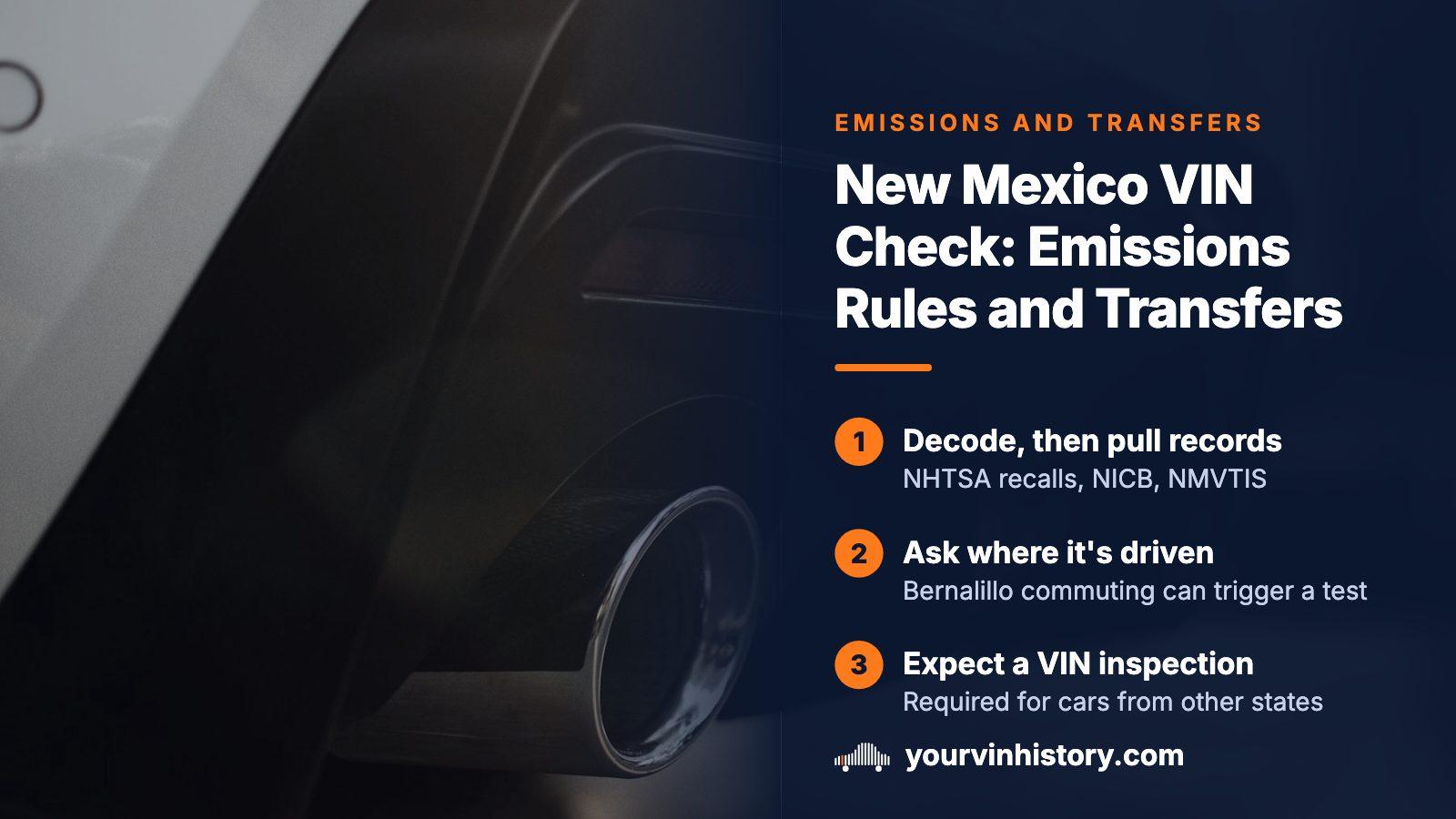
THE SHORT ANSWER
Decode the VIN, check NHTSA recalls and NICB theft and salvage records, then pull the national NMVTIS title record from an approved provider. In New Mexico, add two local questions: does the Bernalillo County emissions rule reach this car, through a commute of 60 or more days a year or a sale, and does a car from another state still need its VIN inspection?
- Who must test
- Bernalillo County residents and drivers commuting in 60 or more days a year
- Second trigger
- A test is also due when ownership changes
- Covered cars
- Gasoline vehicles, model year 1991 and later, 10,000 lb GVW or less
- Out-of-state arrivals
- A VIN inspection is required
The commute clause: where the car is driven counts
Most emissions programs work from the registration address, since an address is easy for an agency to read off a record. New Mexico's program in Bernalillo County, the Albuquerque metropolitan area, adds a second group. People who drive into the county on 60 or more days in a year fall under the requirement even if they live somewhere else.
Take two cars that share a rural registration address: they can land on opposite sides of the rule, depending on where each driver works. Neither the listing nor a VIN decode will show which side a given car is on. Only the seller, or whoever will be at the wheel, can say.
Ask about use, not just the address
A car registered outside Bernalillo County can still be covered through the commute of the person driving it. If you plan to work in or near Albuquerque, count yourself in before you count the car out.
A sale can set off a test of its own
For covered vehicles, a passing test is due every second year and again whenever the car changes hands. The second trigger is the one private buyers miss. A car can sit comfortably in the middle of its two-year cycle and still need a fresh test because it is being sold.
If that test fails, someone pays for repairs that nobody priced into the deal. Sellers seldom think about it while haggling, and buyers who have never lived near Albuquerque may not know the requirement exists. Whichever of you ends up carrying the bill, decide it before money moves, because the surprise arrives between the handshake and the registration.
Which vehicles the testing rule reaches
The covered group is gasoline vehicles from model year 1991 forward, with a gross vehicle weight of 10,000 pounds or less, that are tested in the county or driven into it by commuters. Here is how the common cases line up.
| Vehicle | Position under the program |
|---|---|
| Gasoline vehicle, model year 1991 or later, 10,000 lb GVW or less | Covered: a test every two years and when ownership changes |
| Dedicated electric vehicle | Exempt |
| Diesel | Listed as exempt on the MVD emissions page |
| A car registered and driven wholly outside the covered area | No test required by this program |
The exemption list names only electric vehicles and diesels. Hybrids are not mentioned, and age brings no relief to a covered car: a 1994 gasoline sedan takes the same test as a recent one. Exemption lists get revised, so confirm a diesel or a hybrid with the testing program instead of leaning on a table in a guide.
Settling who pays if the car fails
A failed test is a repair problem, and repair problems belong in the price conversation. Before you agree on a number, get answers to a handful of practical points.
- Ask where the car is registered and where its driver works.
- Ask for the date of the last passing test and the certificate that came with it.
- Find out whether the sale will require a new test, and who books and pays for it.
- Agree what happens on a failure: the seller repairs it, the price drops, or the deal lapses.
Write whatever you agree on the bill of sale or in a short signed note. A spoken promise that the car will pass is thin protection once a repair estimate is sitting on the counter.
A car arriving from another state gets its VIN read
New Mexico requires a VIN inspection for any vehicle that comes in from another state. An MVD agent at a field office usually carries it out, though not every field office offers it and some want an appointment first. The other option is a certified VIN inspector.
Anyone fetching a car from Texas, Arizona or Colorado should treat this as a scheduling matter to settle in advance, not at the counter. It also does real work. Someone compares the number on the car with the number in the out-of-state paperwork, which shows that the car at the counter is the car the paperwork describes.
Call the office before you drive over
Phone the field office you plan to use, ask whether it performs VIN inspections, and ask whether you need to book a time. A wasted trip with a car you have just bought is easy to avoid.
Why the national title record matters in a border state
New Mexico shares borders with several states and with Mexico, and vehicles cross those lines all the time. A car on a local lot may well have been titled elsewhere, with a brand or an odometer reading that sits in another state's files. The NMVTIS title record is the place where those histories come together in one search.
A yourvinhistory report draws its NMVTIS title records from ClearVin LLC, an approved NMVTIS data provider, and sets accident, odometer, salvage and auction records beside them. Pull the record before you travel to a field office. A brand in a car's past is far better found before the paperwork starts than during it.
Sun, dust and altitude do the damage, not salt
New Mexico is high, dry and bright. Cars here seldom rust the way northern cars do, and a buyer from the salt belt can mistake a clean underbody for a clean bill of health. The wear simply shows up in other places.
Strong ultraviolet light at altitude breaks down paint, clearcoat, dashboards, seals and wiring insulation, while wind-blown dust wears anything that filters, slides or seals. So the inspection order flips: spend your first minutes on the parts the sun hits and the parts that keep dust out.
- Headliner and dash top: sagging, fading or cracks.
- Door, window and trunk seals: stiff, split or pulling away from the frame.
- Rubber hoses and lines under the hood: hardened or cracked.
- Paint and clearcoat on the roof and hood: dull, chalky or peeling patches.
- Air filter housing and window tracks: packed dust or grit.
A plate will not produce an owner's name
A New Mexico plate will not legally produce an owner's name. Under the federal Driver's Privacy Protection Act, state motor vehicle records release personal details only for a short list of approved uses, and naming a driver out of curiosity is not one of them. Treat any site that promises an owner lookup from a plate with suspicion.
Work from the VIN instead. Ask the seller to send it in writing before you meet, then compare it character by character with the dash plate, the label in the door jamb and the number printed on the title. A mismatch at any of those three points ends the conversation.
A New Mexico check, in order
The sequence below puts the cheap and quick steps first and the local questions in the middle, so you know the car is worth a trip before you book anything.
- Decode the VIN to confirm the build and model year, which also tells you whether the car falls in the 1991-and-later group that the testing rule covers.
- Search the NHTSA recall lookup. The search is free, but ask a dealer about repair terms, because the federal repair rule does not reach every vehicle and very old ones can fall outside it.
- Run NICB VINCheck for theft and salvage reports from participating insurers.
- Order the NMVTIS title record through an approved data provider.
- Work out whether a commute or a change of ownership puts the car under the emissions rule, and who covers a failure.
- Inspect for sun and dust damage rather than rust.
- If the car comes from out of state, book its VIN inspection.
Where this information comes from
- New Mexico MVD: Emission Testing — Sets out the Bernalillo County requirement, the commuter clause, the two-year cycle and the test at change of ownership.
- New Mexico MVD: Register Your Vehicle — Describes the VIN inspection for vehicles arriving from another state and why to call a field office first.
- New Mexico MVD: Vehicle Titles — Explains how the state issues titles and what an application with an out-of-state title involves.
- NHTSA: Recalls — The federal lookup where a VIN shows whether a safety recall is still open, separate from any emissions program.
Sources and photos: Facts checked against the sources above in October 2026. Photo by Farhan Abid on Unsplash; diagrams by YourVINHistory.
Keep reading
- VIN inspectionHow VIN inspections work across states, who may sign one and what happens after a failure.
- Smog check historyWhat an emissions test log can tell a buyer, and what an empty one means.
- Buying a car out of stateWhere out-of-state purchases go wrong, and which records cross a border with the car.
- ArizonaA neighboring desert market where heat, not rust, sets the inspection priorities.
Frequently asked questions
Do I need an emissions test to sell a car in New Mexico?
Only if the car falls under the Bernalillo County program, which covers county residents and people commuting in on 60 or more days a year. For those cars a test is due at change of ownership as well as on the two-year cycle. A car that lives entirely outside the covered group is not required to test, so confirm which side yours is on before listing it.
I live outside Bernalillo County. Can the emissions rule still apply to me?
Yes, if you commute into the county on 60 or more days a year. The rule follows the driving, so neighbors at the same address can be treated differently. If you work in or near Albuquerque, keep a rough tally of your days in the county, and tell a buyer or seller plainly which side of the line you fall on.
Where can I get a VIN inspection for a car from another state?
Usually at an MVD field office, where an agent does it, or from a certified VIN inspector. Offices differ: some do not offer the service and others want an appointment. Bring the car along with your out-of-state paperwork, since the inspection compares the number on the vehicle against the documents you present.
Can I find a New Mexico car's owner from its license plate?
No lawful public lookup returns that. The Driver's Privacy Protection Act confines personal information in state records to defined permitted purposes, and a curious buyer is not on the list. What you can legitimately get comes from the VIN: build details, recalls, theft and salvage flags and the title record. Ask the seller to show the title in their own name.
How do I check a used car's history in New Mexico?
Start with the no-cost steps: decode the VIN, search NHTSA recalls and run NICB VINCheck. Next, order the NMVTIS title record through an approved provider, since New Mexico cars often arrive from or pass through other states. Before you pay, settle the emissions question in writing, and finish with a hands-on look at the sun-exposed parts.
Now check the car itself
The guide explains what to look for. The report shows what this VIN has on record.