THE SHORT ANSWER
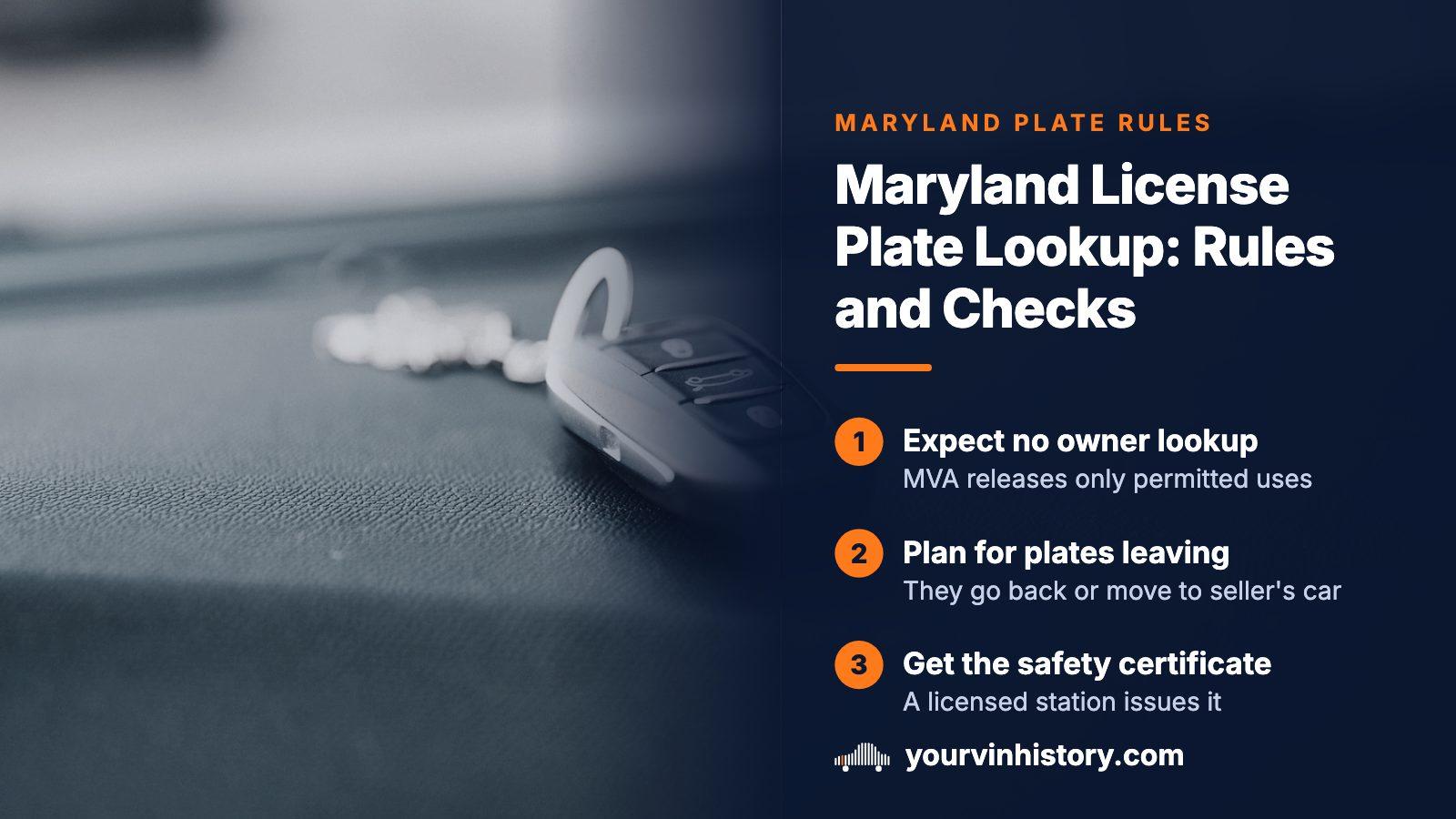
No public tool will turn a Maryland plate into an owner's name. The Driver's Privacy Protection Act lets the MVA release owner details only for permitted uses, such as court cases, insurance claims and police work. Maryland plates belong to the seller, and a used car needs a licensed station's safety certificate before the MVA will title it. For vehicle history, use the 17-character VIN, not the plate.
- Owner details
- Released only for uses the federal privacy law permits
- Safety inspection
- Required to title a used car, not repeated every year
- Emissions (VEIP)
- Every two years in areas where the program applies
- At sale
- Plates go back to the MVA or move to the seller's next vehicle
What a Maryland plate search can actually return
Type a Maryland plate into a search box and plenty of sites will offer to help. None of them has a lawful feed from the MVA's owner file, so a name, an address or a driving record is not something they can honestly deliver. At best they recycle scraped data of unknown age. At worst they show a teaser and ask for payment before revealing anything.
The reason is federal. Section 2721 of Title 18 of the U.S. Code, the Driver's Privacy Protection Act, bars a state motor vehicle agency from knowingly disclosing personal information from its records, then lists the narrow exceptions. Curiosity about a seller, an ex or a car parked down the street is not one of them.
Who the law lets the MVA release owner details to
Maryland follows the federal list when it decides whether to hand over a record. These are the permitted uses a private person is most likely to run into:
- Courts, police and other government agencies doing their jobs
- Insurers handling a claim or setting a rate
- Parties to a lawsuit, including serving papers and enforcing a judgment
- Notifying the owner of a towed or impounded vehicle
- Licensed private investigators, for a purpose the statute allows
- Employers verifying a commercial driver's license
- Anyone holding the person's express consent
Buyers are missing from that list, and they do not need to be on it. Everything a shopper must learn about the car can be pulled with its VIN. If a driver clipped your parked car and left, write down the plate and give it to the police and your insurer, since those are the channels the law leaves open.
Two plates, issued by the MVA
Maryland's equivalent of a DMV is the Motor Vehicle Administration, and it issues plates for both the front and the rear of the car. Because they come as a pair, a Maryland car normally has a bracket or mounting holes on its nose. A bare front bumper deserves a question. The answer may be harmless, such as a car that arrived from a rear-plate-only state, or it may point to front-end bodywork.
The plate design is a choice the owner made, not a record of the car. The table covers the families you will meet and what each can hint at.
| Plate family | What it tells a buyer |
|---|---|
| Standard passenger | A routine registration; the design alone says little about the car |
| War of 1812 bicentennial | Still common on the road, so it does not mark a car as old or unusual |
| Chesapeake and agricultural | Specialty designs that fund their programs; they reflect the owner's taste, not the car's condition |
| Personalized | Owner-chosen characters on eligible designs, approved by the MVA, and gone with the seller |
| Historic or street rod | For qualifying older vehicles, with limits on how they are used |
At the sale, the plates leave with the seller
Maryland plates belong to the seller, not to the car. Tidy plates in the listing photos mean nothing for pickup day; expect a bare bumper. The seller has a fixed order of steps, and it protects the seller more than the buyer:
- Take both plates off once the sale is done.
- Hand them back to the MVA, or move them to a replacement vehicle the seller is registering.
- Keep the return receipt as proof that the registration stopped.
- Cancel the insurance only after that, never before.
The order exists because Maryland penalizes coverage gaps on registrations that are still active. A seller who cancels coverage first and forgets the plates can face penalties for a car they no longer own. As a buyer, do not offer to drive off on the old plates. That registration was issued to a person who is about to stop owning the car.
The safety inspection comes at titling, not every year
Plenty of states want a sticker renewed each year. Maryland puts its weight on the moment of transfer instead. Before the MVA titles a used vehicle, the buyer must present a Maryland Safety Inspection Certificate issued by a licensed station, and that certificate must still be valid when the paperwork is processed.
The station looks over brakes, steering, suspension, tires, lights, glass and exhaust. Anything that fails gets repaired before the certificate is issued. After the car is titled, there is no yearly safety recheck; neighboring Virginia does the reverse and inspects on an annual cycle.
The MVA recognizes a few situations where the requirement does not apply, so confirm yours before booking a station. For an ordinary private purchase, plan on the inspection.
Reading a listing: with inspection or as-is
The titling rule creates two kinds of Maryland listing, and the asking price should differ between them. A car offered with a certificate has already been through a station, and the repairs that station demanded are done. That is worth money, and a seller is fair to ask for it.
A car offered as-is, with no inspection, hands the whole job to you. Whatever the station finds becomes your repair bill before the MVA will register the car. Ask which station issued the certificate and on what date, and treat the answer as your first negotiating point.
As-is leaves the estimate unwritten
If the seller skipped the inspection, the station's repair list still exists in principle; nobody has typed it up yet. Have an independent mechanic check brakes, steering and tires before money moves, and take the total off your offer.
VEIP: the emissions test that repeats every two years
Separate from the safety certificate, Maryland runs the Vehicle Emissions Inspection Program, called VEIP. In the areas where it applies, most vehicles are tested on a two-year cycle, with the onboard diagnostic check handled at a station or a kiosk.
Registration renewal depends on compliance, and a test taken late accrues fees. For a buyer, that history works like a small health record. Passing on schedule suggests the emissions system is functioning. Late fees and a lapsed cycle suggest the owner kept putting the test off, possibly because the car was unlikely to pass.
Ask the seller for the latest passing result and read the registration expiry. Once the car is yours, the two-year clock runs under your name wherever the program covers your address, so put the date on a calendar.
Registering a Maryland purchase in the right order
A private purchase follows a sequence, and the inspection sits in the middle of it:
- Collect the signed title with the odometer disclosure, and compare the seller's name with photo ID.
- Book the safety inspection at a licensed station, and fix whatever it flags before the certificate is issued.
- Take the certificate to the MVA to title and register the car. Excise tax, fees and a fresh pair of plates are settled in one visit.
- Note the VEIP due date if the program covers where the car will live.
Skipping ahead costs time. The MVA will not register a used car without the certificate, so a buyer who pays first and inspects afterward learns what the car needs only once it belongs to them.
Clues a Maryland car gives a careful buyer
- A certificate dated close to the sale: the station's work is finished and on paper.
- No certificate on offer: assume repairs are waiting and put a number on them.
- VEIP paperwork in order: the car has been taking its tests on time.
- A bare front bumper on a Maryland-titled car: ask about front-end repair or a rear-plate-only past, then look for either in the records.
- A car kept near the Chesapeake or the coast: check fasteners, subframes and seams, where salt does its damage first.
None of these proves anything by itself. They tell you which questions to ask and where to point a flashlight.
Why the VIN does the work a plate cannot
A plate is a tag attached to a registration, and it leaves with the seller. The VIN is stamped into the car, runs 17 characters, and is the key every database uses. NHTSA's recall lookup and the NICB's VINCheck theft search both accept it, and both are free tools from other organizations.
NMVTIS, the federal title record system, is keyed to the VIN as well. Title brands reported by any participating state can surface there, so a salvage or flood brand from across the border can show up even when the Maryland title reads clean. A vehicle history report built on the VIN adds accident records with a damage map, odometer readings and open recalls. A report from this site begins with a preview, and you decide afterward whether to buy.
Where this information comes from
- Maryland MVA: vehicle services — The state agency's pages on titling, registration, returning plates and the safety inspection a used car needs.
- Maryland MVA: Vehicle Emissions Inspection Program — How the two-year emissions testing cycle works and why registration renewal depends on it.
- GovInfo: Driver's Privacy Protection Act, 18 U.S.C. § 2721 — The federal text that restricts release of personal information in motor vehicle records and sets out the permitted uses.
- Bureau of Justice Assistance: NMVTIS — The federal title information system that ties title records from reporting states to the VIN.
Sources and photos: Facts checked against the sources above in October 2026. Photo by Bence Balla-Schottner on Unsplash; diagrams by YourVINHistory.
Keep reading
- License plate lookupThe national rules on what a plate search can return, and which sites to avoid.
- Maryland VIN checkThe next step after the plate: checking a Maryland car through its VIN.
- Temporary tagWhat covers the drive home when the seller keeps the plates.
- Smog check historyEmissions test records, the same kind of paper trail VEIP leaves behind.
Frequently asked questions
Can I find out who owns a Maryland license plate?
Not through any public search. The federal privacy law limits owner data to listed uses such as court cases, insurance claims and police work. After a hit-and-run or a parking dispute, report the plate to the police and your insurer and let them make the request. In a purchase, the title and the seller's photo ID establish who is selling.
Does a Maryland car need a safety inspection every year?
No. The Maryland safety certificate is tied to titling a used vehicle, so it is needed when the car changes hands, not at each renewal. Emissions testing under VEIP is a separate program that repeats every two years where it applies. A car that has stayed with one owner for a long time may carry no recent safety paperwork at all.
Can I drive a car home on the seller's Maryland plates?
You should not. The plates belong to the seller, and the registration behind them was issued to the seller, who is about to return them or move them to another vehicle. Ask the MVA which temporary option covers your purchase before pickup day. The temporary tag guide in the related list explains how those permits generally work.
What happens if a used Maryland car is overdue for VEIP?
Late tests accrue fees, and registration renewal depends on compliance, so an overdue car cannot simply be renewed and driven. Ask the seller for the most recent passing result before you pay. If notice letters are piling up unopened, ask why, because a car that dodges the test may have a fault the owner would rather not learn about.
How do I get a Maryland car's details if I only have the plate?
Use the plate only to find the car, then read the VIN from the dashboard corner at the windshield or the label on the driver's door jamb. A decode of those 17 characters returns the factory build, and the NHTSA recall and NICB theft lookups take the same VIN. The plate itself never reveals a car's specifications or history.
Now check the car itself
The guide explains what to look for. The report shows what this VIN has on record.