THE SHORT ANSWER
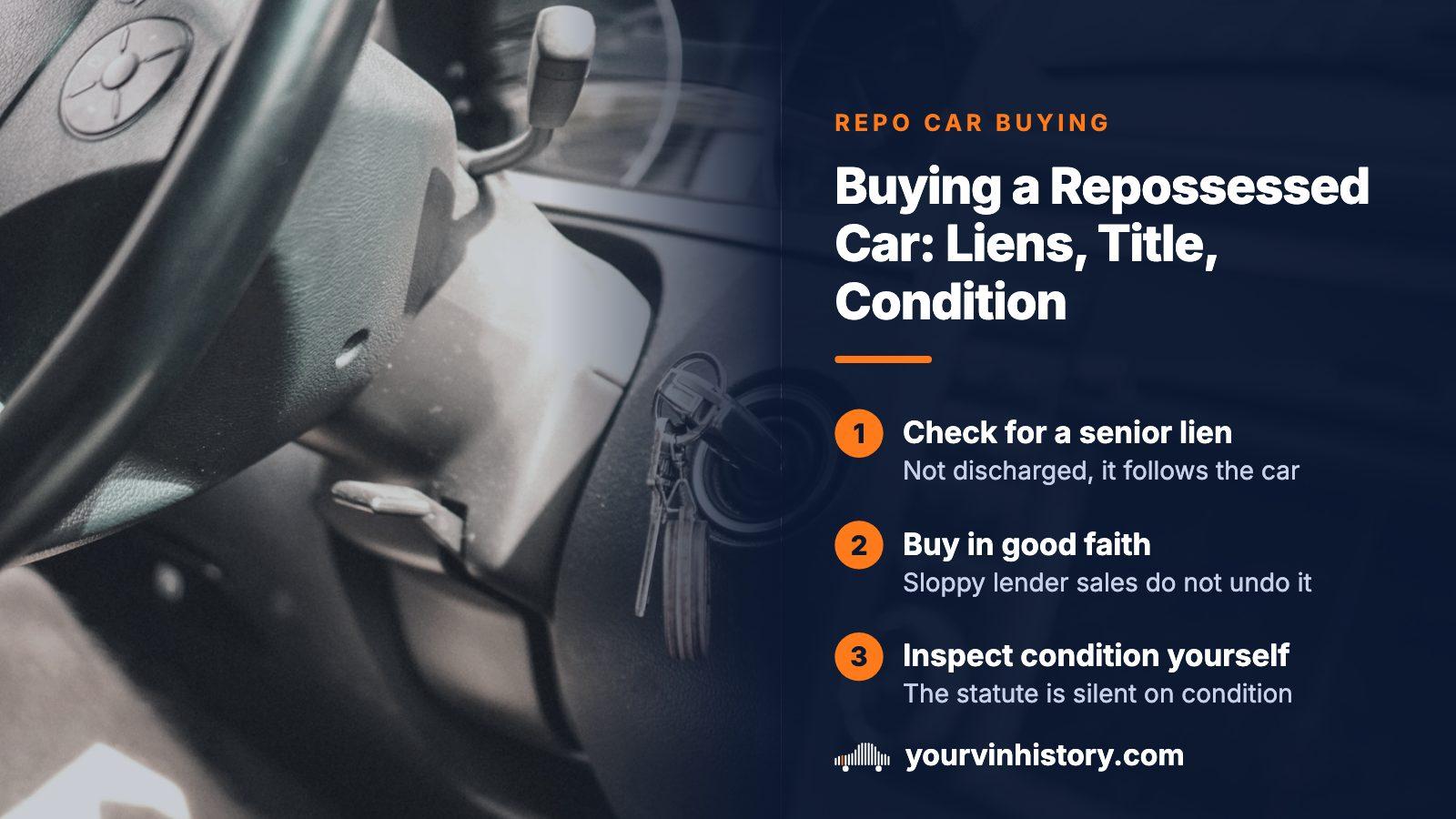
Buying a repossessed car passes the borrower's rights in the vehicle to you and discharges the repossessing lender's loan and any junior liens. A senior lien is not discharged and can still follow the car. If you buy in good faith, your title holds even when the lender ran the sale badly. The statute is silent on condition, so check liens, brands, recalls and mechanical shape yourself.
- Loan the sale ran under
- Discharged, along with junior liens
- Senior lien
- Not discharged, so it can follow the car
- Your title
- Protected if you buy in good faith
- Borrower's last chance
- Ends once a contract for the sale is made
Why a repossessed car is priced to move
A repossessed car is rarely cheap because something is wrong with it. It is cheap because the lender selling it wants a loan recovered, and the law behind the sale decides where the money goes. Under UCC 9-615, sale proceeds first cover the lender's reasonable costs of retaking, storing, preparing and selling the car. Whatever remains is applied to the loan the sale was made under.
Anything above that total is owed to the borrower, and any shortfall stays a debt the borrower answers for. The lender gains nothing by holding out for a high price and risks a lot by letting the sale drag. Its real target is a payoff figure you will never see.
So the discount is a feature of the process, not a hint about the car. A low price on a private listing often means the seller knows something. A low price on a repossession usually does not.
Where repossessed cars are sold, and what each source tells you
Where you buy sets how much you can learn before you bid.
- Banks and credit unions: the lender itself is selling, with the file in hand and the car typically still titled in its name, so the lien history is simple to trace.
- Public auto auctions: repossessions share the lane with fleet and trade-in units. Viewing time is brief and everything is sold as is, which puts more weight on your own record checks.
- Dealers who buy repossession stock: easiest to deal with and the priciest, since the dealer has already run the checks you are about to run.
- Government and municipal disposals: often seizures or fleet sales rather than a lender's sale after default, so the Article 9 rules here may not apply. Read the sale terms.
The borrower can still take the car back, until a contract exists
Before you grow attached to a car, know that the borrower may be able to reclaim it. UCC 9-623 lets the debtor, any secondary obligor, and any other lienholder redeem the collateral. Catching up on missed payments does not do it. The redeemer must tender everything the collateral secures, plus the lender's reasonable expenses and attorney's fees under 9-615(a)(1).
That bar is high, so redemption is uncommon. It is not impossible. A borrower holding out for a refinance, a settlement check or help from family can suddenly produce the cash.
| Stage of the sale | Can the borrower still redeem? |
|---|---|
| Repossessed, not yet listed | Yes, by paying the full debt and the lender's expenses |
| Listed, people viewing it | Yes; buyer interest changes nothing |
| Contract for the sale made | No; 9-623(c) ends the right at this point |
| Car delivered and paid for | No; 9-617(b) also protects your title |
The cutoff is the moment the lender enters a contract for the sale, not the day you collect the car or the title moves. Ask the seller when that contract is formed, and hold off on paying for transport or insurance until you know.
What the sale puts in your hands
The section that answers this is UCC 9-617(a). A lender's sale of collateral after default does three things at once for a buyer who pays value.
| What the sale does | What it means for you |
|---|---|
| Passes along all of the borrower's rights in the car | You step into the borrower's ownership, nothing more and nothing less |
| Discharges the lender's security interest behind the sale | The loan that caused the repossession no longer attaches to the car |
| Discharges junior security interests and liens | A second lender or later claimant ranking behind the repossessing lender loses its hold |
That is a strong package. The loan behind the repossession cannot chase the car, and neither can anything ranked beneath it. But the statute reads as a closed set, and what it leaves out matters more.
The senior lien that survives the sale
Liens have a rank, and the sale reaches only the loan being enforced and the liens ranked behind it. A lien that ranks ahead of that loan is not discharged, is not mentioned in the statute, and is untouched by the sale. Its holder can still look to the car after you own it.
This is not far-fetched. It arises when the repossessing lender was second in line and a first lienholder remains on record, or when a statutory lien has priority, such as one held by a repair shop or a tax authority in some states.
Verify this before you bid
A repossession sale clears one lien and those beneath it, not liens in general. A seller can vouch only for their own claim and rarely knows who else has one. Run an independent lien check on the VIN instead of accepting the seller's word.
A sloppy repossession should not cost you the car
Buyers worry most about this one. Suppose the lender sent a defective notice, or sold the car in a way that was not commercially reasonable. Under UCC 9-617(b), a buyer who acts in good faith takes the car free of the interests the sale cleared, even when the lender failed to follow the statute or a court's requirements. The borrower is not left without recourse, but the claim is against the lender. It does not reach the vehicle you bought.
Good faith is a real condition. If you know the sale is improper, or you join a scheme to strip the borrower of the car, you do not qualify. A buyer at an ordinary auction with no sign of trouble rarely has difficulty meeting it.
Who the sale rules protect, and why it is not you
The statute puts several duties on the lender that sound like buyer protections. They are not. Each one is owed to someone else.
| Section | What it does | Who it serves |
|---|---|---|
| 9-610(b) | Every aspect of the sale must be commercially reasonable | The borrower and others with an interest in the car |
| 9-611 | A signed notice of the sale must go out beforehand | The borrower and any secondary obligor |
| 9-615(a) | Proceeds are applied in the required order | The borrower, plus junior claimants that demanded payment |
| 9-617(b) | Good title despite the lender's lapses | You, as a good-faith buyer |
That means you have no basis to object if the auction was run poorly or the price came in low. Those duties stop a lender from dumping a borrower's car cheaply. What you receive is the last row: your purchase stands. Every question about the car itself stays with you.
Condition: the part no statute covers
Nothing in Article 9 says whether the car starts, shifts or stops. A repossession is about money, so it reveals nothing about the engine. Calling these cars ordinary used cars is the rosy view and calling them wrecks is the gloomy one. The likelier truth sits between.
An owner who falls behind on payments tends to cut maintenance first. After the lender takes the car, it may sit for weeks in a lot, often outdoors, often with no test drive offered. The seller owes you no disclosure of any of it, and none of it makes the sale defective.
- Expect deferred service rather than abuse. The usual pattern is neglect.
- Budget for a battery, brakes, belts, filters and fluids as a baseline cost.
- If the car sat outside for months, have the tires and brakes inspected before any highway driving.
- Check for a title brand on its own, since a repossession and a brand are unrelated and a car can have both.
- If the seller will not let you start the engine, subtract a repair allowance from your top bid.
Checks to run before you bid, in order of payoff
The statute gives you a protected title and no information, so the useful work happens on the vehicle side. Here are the checks in rough order of risk removed for the time they take.
- An independent lien check comes first: a senior lien is the legal exposure that survives the sale.
- A title brand check. Salvage, flood and odometer brands are not affected by a repossession.
- The federal NMVTIS title record, for ownership and brand history that the seller cannot reliably summarize.
- An open recall lookup on the NHTSA site, which costs nothing. Ask the dealer whether the fix is covered at no charge, since very old vehicles fall outside the federal free-repair rule.
- A hands-on inspection aimed at standing damage: tires, brakes, fluids, battery and rodent damage.
A vehicle history report from this site covers title brands, liens and impounds, salvage and auction records with photos, and open recalls. A free preview comes first; the full report is a one-time purchase.
Signs that should end the deal
Most of these are not judgment calls. The sale gives you a protected title and withholds information, which is hard to get once the money has moved.
- Nobody will give a straight answer about a senior lien.
- The seller cannot say which lender's loan the sale is being run under.
- The title carries a brand that the listing never mentioned, whatever explanation comes with it.
- The price no longer looks like a discount once catch-up maintenance is added.
- You are pushed to pay before running checks that take only minutes.
- The engine will not start, or the lot will not let you try. A car that has sat is where costly surprises concentrate.
Where this information comes from
- California Commercial Code 9617: rights of a transferee — California's text of the UCC section on what a sale after default passes to the buyer, what it discharges, and how a good-faith buyer is protected.
- California Commercial Code 9623: right to redeem — Who may redeem a repossessed vehicle, what they must tender, and the events that cut the right off.
- California Commercial Code 9615: application of proceeds — The order in which sale money is applied, and what happens to a surplus or a shortfall.
- California Commercial Code 9611: notice before a sale — Who the lender must notify before selling repossessed collateral.
- California Commercial Code 9610: how collateral is sold — The commercially reasonable standard the lender must meet for every part of the sale.
Sources and photos: Facts checked against the sources above in October 2026. Photo by tim on Unsplash; diagrams by YourVINHistory.
Keep reading
- Vehicle lien checkHow to find the senior lien that a repossession sale leaves in place.
- What is a branded title?Brands survive a repossession, so learn what each label means.
- Pre-purchase inspectionThe hands-on exam that stands in for the disclosure the sale never gives.
- As is, no warrantyWhat as is means for you once the lender has handed over the keys.
Frequently asked questions
Does a repossession sale wipe out the car loan?
It clears the loan the sale was run under and any lien ranked below it, which is what UCC 9-617(a) provides. A lien ranked above that loan sits outside the discharge. Ask which lender's interest the sale is enforcing, then confirm independently that nothing ranks ahead of it.
Can the previous owner take a repossessed car back from me?
Not once you have bought in good faith. The borrower's right to redeem ends when the lender makes a contract for the sale, and after that 9-617(b) shields your title even if the lender broke the notice or pricing rules. The borrower may have a claim against the lender. The exception to watch is a buyer who knew about the irregularity.
Is a repossessed car sold with no warranty?
Usually. The loan went unpaid, which says nothing about whether the car runs, but the sale terms typically give you no warranty. Read the written terms before bidding, because they decide what the seller owes you. With all of the risk on your side, an inspection is worth more here than on a typical dealer car.
Is a repossessed car the same as a salvage or branded car?
No. Repossession is a financial event, while a brand is a record of damage or special history on the title. A repossessed car can have a clean title or a brand, and the sale removes neither. Check the title record separately, since the repossession itself reveals nothing about accidents, floods or mileage tampering.
Can I inspect or test drive a repossessed car before bidding?
Sometimes. Public auctions give you short inspection time, and some lots let you look but not start the car. A bank or credit union sale may allow more. Ask before you travel. If starting the engine is off the table, lower your top bid to cover repairs you cannot see.
Now check the car itself
The guide explains what to look for. The report shows what this VIN has on record.