THE SHORT ANSWER
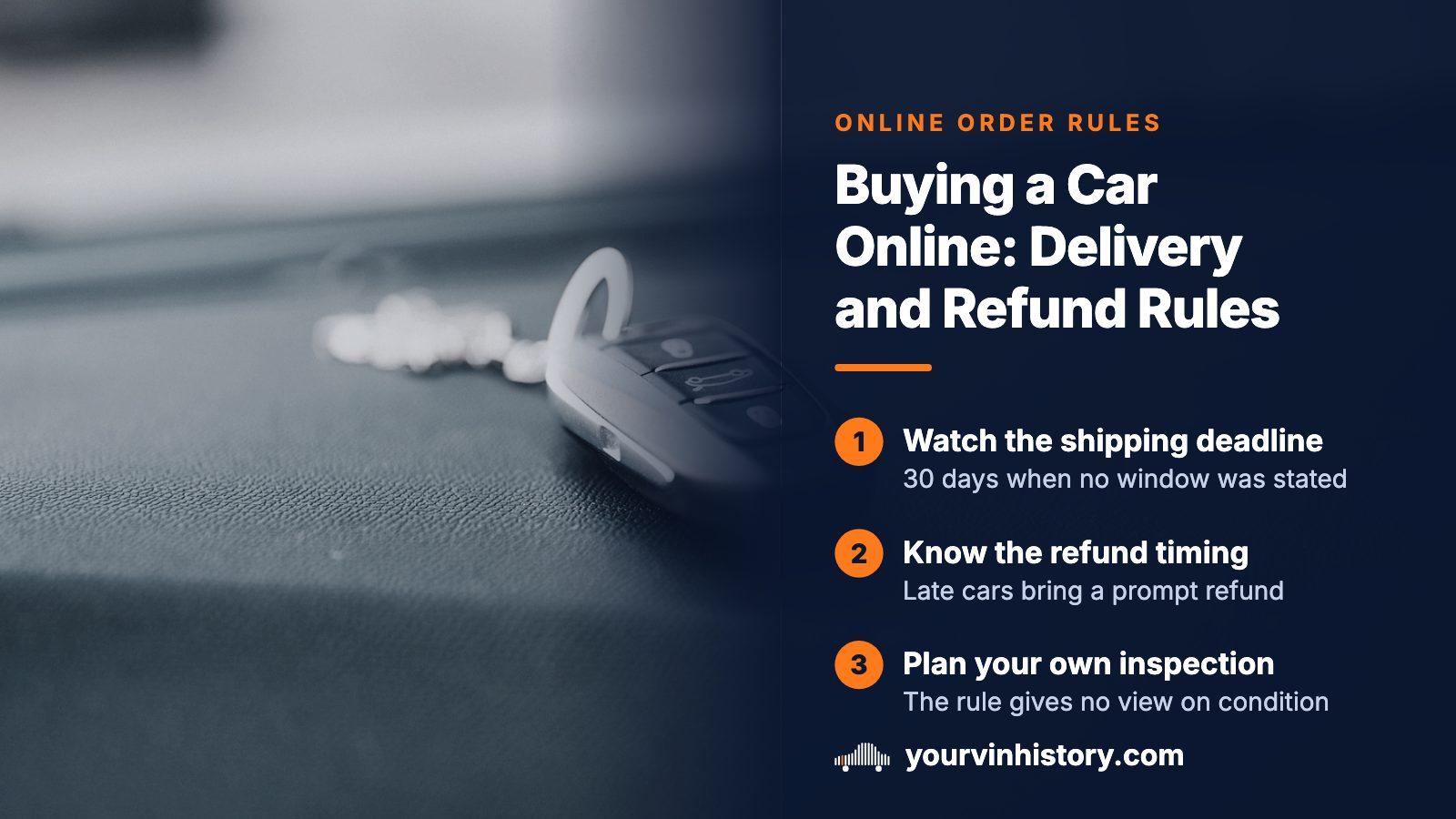
Federal rules reach a car ordered online. Under the FTC mail, internet and telephone order rule, the seller needs a reasonable basis to ship within the window it advertised, or within 30 days of a completed order if it named none. Seeking the seller's own credit stretches that to 50 days. A late car brings a right to cancel with a prompt refund, but no return right and no view on condition.
- Default ship deadline
- 30 days after a completed order, when no window was stated
- With seller credit
- 50 days instead of 30
- Refund speed
- Seven working days, or one billing cycle on the seller's own credit
- Exclusions in the rule
- Four, and none of them is a vehicle
A parcel rule that also covers a car
The Federal Trade Commission's Mail, Internet, or Telephone Order Merchandise Rule sits at 16 CFR Part 435. Known mostly as the late-package rule, it reaches, under section 435.1, any sale where you placed the order through the mail, a website or a phone call, however you paid. It sets no price floor and no list of product types. Section 435.3(a) names the only things left out:
| Left out of the rule | What it means |
|---|---|
| Serial subscriptions | Magazine-style orders, after the first shipment |
| Seeds and growing plants | A narrow carve-out for those goods |
| Collect-on-delivery orders | You pay when the goods arrive |
| Prenotification negative option plans | Handled by a separate FTC rule, 16 CFR Part 425 |
Vehicles are absent. Whether the rule fits a specific dispute is for a regulator or lawyer to say.
The delivery clock: the promise first, then 30 or 50 days
Section 435.2 treats it as unfair for a seller to take an order without a reasonable basis to expect it can ship on time. The deadline that counts depends on what you were told and how you pay.
- A delivery window stated clearly in the listing or checkout is the standard.
- With no stated window, the seller has 30 days from receiving a completed order.
- If you asked the seller for credit toward the car at the time of ordering, the seller has 50 days in place of 30.
That last line surprises people: online retailers make their own financing the easy path, and taking it adds twenty days. The clock also measures shipment, meaning the car is physically placed with the carrier, not the day it reaches your street.
Capture the promise on order day
A stated window beats both fallback numbers. Screenshot it and save the order confirmation.
When the clock starts, and what pushes it back
The countdown begins when the seller receives a completed order, a term defined in 435.1. That means your payment in the proper amount, full or partial, or your authorization to charge an account, plus every detail it requires to process and send the order. Browsing does not start it, and a missing detail on your side delays it as much as missing money.
Financing adds a wrinkle. If the seller learns that a check or similar payment bounced, or that you do not qualify for a credit sale, the order counts as completed only later: when the payment clears, when you tender the proper cash amount, or when the seller learns you qualify.
So a declined application or a lender swap can move the starting line without the seller breaking anything. Note the day your credit was approved as well as the day you clicked buy.
What the seller owes you when the date slips
When a seller knows it cannot ship in time, 435.2(b) requires it to offer you a choice without waiting for a demand: accept a delay, or cancel and receive a prompt refund. The offer must come soon after the seller learns of the problem, and never after the deadline itself. It must explain your right to cancel and give a definite new date, or say no date can be predicted.
What your silence means depends on the length of the delay:
- New date within 30 days of the deadline: the notice must say you are treated as accepting the wait unless you reject it and cancel before shipment and before the new date passes.
- New date more than 30 days out, or no date at all: the order is treated as cancelled unless the car ships within those 30 days or you give specific consent.
Section 435.2(c) lists further cases where an order must be deemed cancelled and refunded, such as when you cancel before shipment or the seller decides not to ship.
Open-ended waits and the answer "we cannot say when"
Vehicle orders stall for ordinary reasons: the car is on a truck, the title is missing, a lender is still finalizing. The rule allows open-ended delay but fences it in. A seller claiming it cannot predict the length needs a reasonable basis for saying so and must give you the reason. A bare "we do not know" falls short.
If you consent to an indefinite wait, you keep a continuing right to cancel after the old date, provided you notify the seller before the car ships. So agreeing to wait is not agreeing to wait forever, though the right lapses once the carrier has the car. The seller must supply adequate means, at its own expense, to send that cancellation.
Provision 435.2(a)(4) applies only in FTC enforcement cases: a seller without records of its shipping systems is presumed to have lacked a reasonable basis. You cannot invoke it yourself, but it shows what the agency expects sellers to explain.
How fast the money must come back
A prompt refund, as 435.1(b) sets it out, travels by a route at least as quick and dependable as first class mail. The deadline depends on how you paid.
| How you paid | What the seller sends | Deadline |
|---|---|---|
| Cash, check or money order | The same kind of payment, for the amount tendered | Seven working days from when your right to a refund arises |
| Credit, with an outside lender as creditor | A credit memo to the lender, with a copy to you | Seven working days |
| Credit, with the seller as creditor | A credit memo or statement showing the charge removed | One billing cycle |
| A method the seller cannot reverse | Cash, check or money order instead | Seven working days from discovering the problem |
A deposit sitting with a seller past a missed delivery is a real cost, and these figures give you something measurable to cite.
Your state can add to the federal floor
Section 435.3(b) explains how federal and local law fit together. The FTC says it does not mean to displace state or local rules in the same area unless they conflict with its own. State rights and remedies that equal or beat the federal ones stay intact, while provisions giving a buyer less are superseded.
The same section adds that state-law duties on sellers still apply when a seller covered by the rule fails to follow it. Treat the federal rule as the minimum, then ask your state motor vehicle agency or consumer protection office whether it adds anything on vehicle sales, delivery or deposits.
What the rule does not give you
This rule is easy to over-read. It governs timing and refunds, and little else:
- No right to send back a car that has arrived and disappoints you.
- Nothing on the car's condition, history or how accurately it was described.
- It is not the federal three-day cancellation rule, a separate regulation tied to where you agreed to the deal.
- It does not replace the retailer's return window, a contract term with its own conditions, such as mileage limits and fees.
If the car arrives and you dislike it, the retailer's policy is what you will rely on. Save a copy as it appeared at checkout.
The risk that stays with you: a car nobody inspected for you
Everything above protects the transaction. None of it touches the usual way an online purchase goes wrong: you bought a used car you never stood beside. The photos and condition report come from the party that wants the sale, which makes them helpful but not independent.
Records can replace part of the walkaround from any distance. A VIN decode confirms factory build and specifications. The NHTSA recall lookup, a free tool, shows open safety recalls. Title and lien checks show brands and outside claims. A yourvinhistory report gathers title brands, accidents with a damage map, odometer readings, salvage and auction photos and liens from the VIN; the preview is free and the full report is a one-time purchase.
If the platform lets a mechanic of your choosing look at the car before it ships, take that offer.
A checklist to finish before you pay
Work through these in order.
- Decode the VIN and run the NHTSA recall lookup for that exact car.
- Check the title for brands, and read what a brand means instead of trusting the label alone.
- Search for liens independently of the listing.
- Screenshot the stated delivery window and keep the order confirmation.
- Find out whether you are applying for the seller's own credit, since that sets the 50-day figure.
- Read the return terms and note any mileage cap and fee.
- Ask whether an independent inspection can happen before shipment.
Delivery day: ten minutes before the driver leaves
The walkaround you skipped is partly recoverable when the car arrives, and it is easier before the transporter drives off. Match the VIN plates on the dashboard and door frame against the paperwork. Lift the carpet and look in the spare tire well. Pull a seat belt all the way out and let it retract. Start the engine cold if the car has been sitting.
A mismatch found in the first hour is a conversation about a delivery. Found two weeks later, it becomes an argument over fault. Photograph anything wrong and write to the seller the same day.
Where this information comes from
- eCFR: 16 CFR 435.1, definitions — Defines a covered sale, a completed order, shipment and prompt refund, including the seven working day and one billing cycle standards.
- eCFR: 16 CFR 435.2, order sales — Sets the stated-window, 30 day and 50 day shipping deadlines and the seller's duties when a delivery date slips.
- eCFR: 16 CFR 435.3, limited applicability — Lists the four exclusions and explains how the rule sits alongside state and local consumer law.
- NHTSA: recalls lookup — A free government check for open safety recalls on a car you cannot yet inspect.
Sources and photos: Facts checked against the sources above in October 2026. Photo by Bence Balla-Schottner on Unsplash; diagrams by YourVINHistory.
Keep reading
- Can I return a used car?Explains the separate federal three-day rule and why it depends on where you agreed to the deal.
- Financing fell throughCovers what follows when a lender turns the deal down after the sale, a common reason online orders stall.
- Vehicle lien checkShows how to learn whether someone else holds a claim on the car before you send money.
- Pre-purchase inspectionDescribes what an independent inspection covers, the nearest substitute for a walkaround.
Frequently asked questions
Does a federal rule protect me when I buy a car on a website?
The FTC's order rule defines covered sales broadly, and its four exclusions do not mention vehicles. How it applies to a particular complaint is for a regulator or lawyer to say. Your state may add more, and the rule leaves stronger state rights in place.
What is the deadline for an online car seller to ship?
The window it clearly stated comes first. With none, the default is 30 days after a completed order, or 50 days if you sought credit from the seller. A declined application can move the start date, and the deadline is measured to shipment, not arrival at your door.
Can I cancel an online car order if delivery is late?
You get a choice rather than an automatic exit. The seller must offer a revised date or a cancellation with a prompt refund. These options apply before the car ships, so if you want out, say so in writing early and keep a copy of whatever you send.
How soon must a deposit come back after I cancel?
Paid by cash, check or money order, you should see it within seven working days of the moment your right to it arises. If an outside lender holds the credit, the seller sends it a credit memo in that period. If the seller itself extended the credit, the standard is one billing cycle.
Does a seven-day return policy come from this rule?
No. A return window is a promise the retailer chose to make, usually with mileage limits, fees and conditions that can change over time. The federal rule covers shipping deadlines and refunds when a car does not ship on time. Both can apply to one purchase, so save the policy as it read at checkout.
Now check the car itself
The guide explains what to look for. The report shows what this VIN has on record.