THE SHORT ANSWER
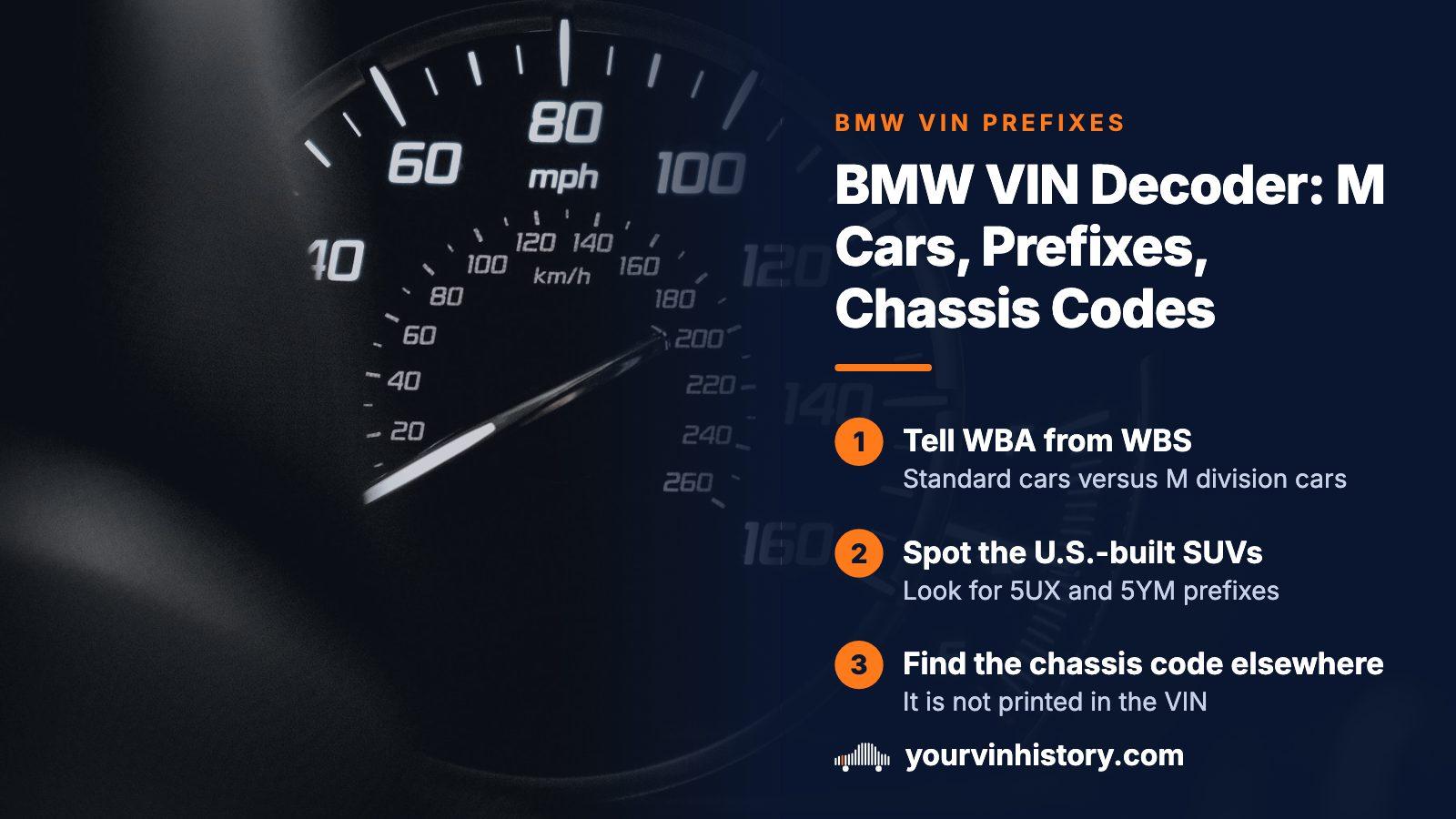
Split a BMW VIN into blocks. Characters one to three name the maker and country, and on BMW they separate standard cars (WBA), M division cars (WBS) and U.S.-built SUVs (5UX). Four to eight describe model, body and engine, nine is a check digit, ten is the model year, eleven is the assembly plant, and twelve to seventeen are the serial. The chassis code and option list are not in the VIN.
- M division prefix
- WBS
- Standard German-built car
- WBA
- U.S.-built SUVs
- 5UX and 5YM
- Chassis code
- Not printed in the VIN
Reading a BMW VIN from left to right
BMW VINs run to 17 characters, built from fixed blocks. A decode is only as useful as your reading of them.
| Positions | What they hold |
|---|---|
| 1 to 3 | Manufacturer and country; on BMW also the split between standard cars, M cars and U.S.-built SUVs |
| 4 to 8 | Model, body style and engine |
| 9 | Check digit, a calculated value that lets software test whether the number is consistent |
| 10 | Model year |
| 11 | Assembly plant |
| 12 to 17 | Production sequence of the individual car |
One copy is visible through the glass at the driver's end of the dashboard, another is printed in the driver's door jamb. Compare both with the title.
The prefixes BMW uses: WBA, WBS, WBY, WBX, 5UX and 5YM
The first three characters are the world manufacturer identifier, and BMW holds several. Here are the ones you will meet most often.
| Prefix | What it points to |
|---|---|
| WBA | Standard BMW passenger car built in Germany |
| WBS | BMW M division car |
| WBY | BMW electric models |
| WBX | German-built multipurpose vehicle, the category SUVs fall in, as NHTSA lists it |
| 5UX | U.S.-built multipurpose vehicle, the X models from the South Carolina plant |
| 5YM | A second U.S.-built multipurpose identifier registered to BMW |
The South Carolina plant builds X-model SUVs for American buyers and for export, so a U.S. prefix on one is correct, not a gray-market sign. A seller who insists a 5-prefix X model must be wrong has misread the brand.
NHTSA's vPIC lists more BMW identifiers than these, motorcycles among them. An unfamiliar prefix on a sound car calls for the full decode, not a walkout.
Real M car, M Sport package or M badges: what the prefix settles
This is the check that saves the most money. BMW sells two things that look alike from the curb: M division cars, with their own engines, brakes and chassis, and ordinary models dressed in the M Sport package. The asking prices sit many thousands of dollars apart.
| The ad says | The VIN shows | What you are buying |
|---|---|---|
| An M3 or M5 | WBS at the front | A car built by BMW M, with the M powertrain and brakes |
| M Sport | WBA, the same as any ordinary BMW | A standard car with sport trim, wheels and suspension tuning |
| M badges on the trunk | WBA, and nothing M in the decoded model | An ordinary car with badges an owner added |
Decode before you discuss price
Read the prefix and the decoded model name first. It takes half a minute, and it is one of the few places where the VIN alone gives a firm answer.
The prefix test is cleanest on German-built cars. An X model assembled in South Carolina wears a U.S. identifier whatever its trim, so on those the decoded model name and engine have to carry the weight.
Chassis codes come from the model year, not from the VIN
Enthusiasts, parts counters and independent shops all talk in chassis codes such as E46, F30 and G20. E-codes cover the older generations, F the middle period and G the recent ones. The code is BMW's internal label for a generation, and it is not printed anywhere in the number.
It matters because two 3 Series cars from different generations share a badge and little else. Engines, common faults and parts all differ, so reading about the model name blends them into a useless average. The VIN still gets you there.
- Decode the number to get the model and the model year.
- Match that pair to a generation code in a marque reference or owner forum.
- Read up on that generation's faults and service intervals, not the model's general reputation.
- Look for an independent specialist who works on that chassis.
Option codes, the build record and the engine family
Used BMWs were often ordered with long option lists, and that list is a large part of the value. A free decode will not return it. A BMW dealer can pull the build record by VIN, listing every option code the car shipped with. Ask for it before agreeing on a price.
- Seat type and upholstery
- Wheels, and whether they are the originals or a later swap
- Adaptive or sport suspension
- Driver-assistance and technology packages, and whether they still work
- Transmission choice, which on some models outweighs every other option
- Special-order paint or interior trim
The record shows what left the factory, not what is on the car today, so check each line against the car. For the engine, position eight feeds the decode, but a shop will ask for the engine family code, because BMW fits one engine across several model lines. Research the family, then use EPA's fueleconomy.gov to confirm official mileage for that engine and drivetrain.
What a W prefix means for who answers for the car
The first character does more than name a country. A W marks a German-built car, which reached the United States as an import, and subpart D of 49 CFR Part 551 requires an importing foreign manufacturer to name a U.S. agent for legal papers before offering vehicles here.
| Section | Rule in plain terms |
|---|---|
| 551.46 | No agent on file, no importing |
| 551.47 | The agent must be a permanent U.S. resident: a person, a domestic firm or a domestic corporation |
| 551.52 | The designation lasts until replaced or withdrawn; withdraw without replacing and imports must stop |
| 551.66 | Papers handed to the agent count as delivered to the manufacturer |
| 551.68 | If the agent cannot be found or reached, the papers can be posted with the Office of the Secretary of Transportation |
In practice the effect is narrow. If a dispute over a German-built BMW reaches formal legal process, the rules already say who in the U.S. receives the papers, and what happens if that person disappears. A 5-prefix car comes from a domestic builder and falls outside this subpart. None of this is legal advice or a claims route.
Where the decoder's data comes from
NHTSA's vPIC is public, and it holds two kinds of manufacturer-supplied data. One is the VIN structure BMW files so decoders can read its numbers. The other is identity: under 49 CFR 566.5 every vehicle maker sends NHTSA its legal name, its address, its state of incorporation where one applies, and a summary of each kind of vehicle it builds with approximate weight-rating ranges.
Under 566.6 a maker that starts building a new type has 30 days to file, and the same 30 days apply to updating an entry after a business change. A BMW decode is therefore no secret technology. It rests on a public register the manufacturer feeds itself.
Recalls attach to VIN ranges, so check the full number
A recall covers a defined batch of cars identified by VIN, not every car sharing a model name. NHTSA's lookup takes all 17 characters and lists open recalls on that exact vehicle, at no charge for the search.
A change of owner does not cancel an open recall. Federal law generally requires the manufacturer to do the repair at no cost to the owner, but with an age cutoff: the requirement does not apply to a vehicle first bought more than 15 calendar years before the recall notice, so a very old BMW can fall outside it. If the lookup shows an open item, call a BMW dealer with the VIN and ask what the remedy is and who pays.
Run the lookup when you first view the car and again just before you pay, since new campaigns are added over time.
What the specification forecasts for your bills
Decoding gives you a specification, and a specification predicts what the car will cost you. On a BMW, skipped maintenance snowballs faster than on a mainstream car.
- Adaptive suspension rides beautifully while it works and costs a great deal when it fails.
- All-wheel drive adds parts that need service.
- Large wheels mean pricier tires and more pothole damage.
- Turbocharged engines need on-time oil changes and punish any gap.
- M division cars carry M division bills for brakes, tires and fluids.
- On an older car, ask first about the cooling system, gaskets and suspension bushings.
A thick folder of service receipts counts for more here than on an average used car, so weigh it as heavily as the mileage.
A sensible order of checks on a used BMW
- Read the VIN off the car and the title, and confirm they match.
- Decode it and look at the prefix before any talk of price: standard, M division or U.S.-built.
- Work out the chassis code from model and year, then read up on that generation.
- Get the build record from a dealer and compare its options with the car.
- Note the engine family and look up its known problems.
- Run the NHTSA recall lookup on the full VIN.
- Order a history report on the VIN for title brands, accident records, odometer readings and salvage or auction history, since a decode shows the car as built, not as lived.
- Pay an independent BMW specialist to inspect it.
The order puts the irreversible step, handing over money, last.
Where this information comes from
- eCFR: 49 CFR Part 551, subpart D — The rules for foreign manufacturers naming a U.S. agent, how long that lasts and what serving the agent means.
- eCFR: 49 CFR 566.5, manufacturer identification — What every vehicle maker must file with NHTSA, and the 30-day timing found in the next section.
- NHTSA: vPIC VIN decoder — The public register behind the decode, including the list of identifiers registered to BMW.
- NHTSA: recalls — The lookup that checks a full VIN for open recalls on that specific car.
- EPA: fueleconomy.gov — Official mileage figures by engine and drivetrain, handy for checking a decoded configuration.
Sources and photos: Facts checked against the sources above in October 2026. Photo by Ambitious Studio* | Rick Barrett on Unsplash; diagrams by YourVINHistory.
Keep reading
- BMW recallsThe BMW recall history in detail, and how to read a campaign notice.
- Mercedes-BenzThe same prefix and chassis-code logic applied to the other big German luxury brand.
- How to read a VINEvery one of the 17 positions explained, with the year chart and the check digit.
- Pre-purchase inspectionWhat an inspection covers once the decode and the paperwork check out.
Frequently asked questions
Is there a free BMW VIN decoder?
Yes. NHTSA's vPIC decoder takes a 17-character VIN with no account and returns model year, model, body class, engine, drivetrain and assembly plant for a BMW. It describes the car as built. The option list lives in the dealer build record, and anything about the car's life since comes from title, service and accident records.
The seller calls it an M car but the VIN starts with WBA. What now?
Treat the mismatch as a question to settle before talking price. Compare the decoded model line with the listing, ask for the dealer build record, and look at the engine itself rather than the trunk badge. A WBA car with M styling is most likely an M Sport package car or one with badges added later, and it should be priced as such.
Why does my BMW VIN start with 5 instead of W?
The 5 means the car was built in the United States, at BMW's South Carolina plant, rather than in Germany. It is the same brand and the same dealer network, and a fully legitimate car. Position eleven of the VIN points to the assembly plant if you want to confirm where yours came from.
Does the same decoder work for BMW motorcycles?
BMW motorcycles carry their own prefixes, and NHTSA's vPIC lists WB1, WB3 and WB4 for BMW's motorcycle maker. The decoder is the same public tool, but car guidance on M division cars, chassis codes and X-model plants does not carry over to a bike, so read motorcycle-specific advice for those.
If the decode looks right, is the BMW's history clean?
No. A decode confirms what the factory built, and it cannot see a branded title, a collision, an odometer rollback or a lien. Those live in separate records. A yourvinhistory report starts with a free preview and then a one-time purchase if you want the full title, accident and odometer detail.
Now check the car itself
The guide explains what to look for. The report shows what this VIN has on record.