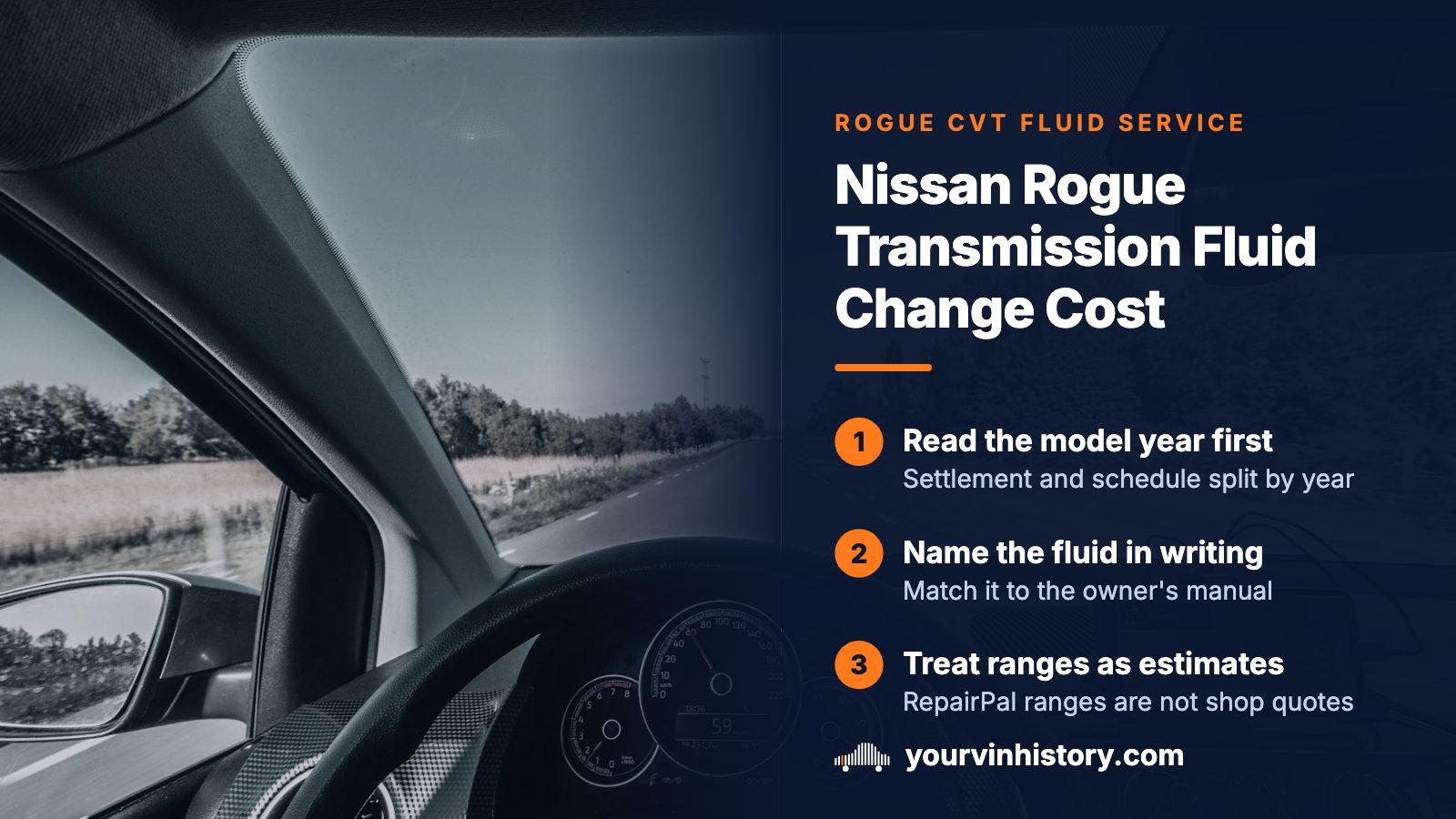
THE SHORT ANSWER
Published estimates put a Rogue CVT fluid service at $189 to $229 (RepairPal's general figure) or $160 to $188 (its pages for 2015, 2016, 2017 and 2019). Neither is a shop quote. The $277 million CVT settlement reached only 2014 through 2018 models and its claim deadline has passed, while the 2008 through 2013 cars hold most of the Rogue's power train complaints. Confirm the model year from the VIN, then ask for an itemized quote that names the fluid.
- RepairPal general estimate
- $189 to $229
- RepairPal 2015, 2016, 2017, 2019 pages
- $160 to $188 each
- CVT settlement
- $277 million, 2014 to 2018 Rogues
- Power train complaints
- 1,631 of 6,408 on file
Two RepairPal ranges and what each one covers
RepairPal publishes two kinds of figures for this job. Its general Nissan Rogue estimate for a transmission fluid change runs from $189 to $229. Its pages for the 2015, 2016, 2017 and 2019 model years, as retrieved in September 2026, each came back with the same $160 to $188 instead, a range that starts below the general one.
| Estimate page | Range printed | Reading |
|---|---|---|
| RepairPal, no model year chosen | $189 to $229 | A broad starting point for the job |
| RepairPal, 2015, 2016, 2017 and 2019 pages | $160 to $188 on every one | No spread between those four years |
These are RepairPal's numbers, not measurements made here, and none is a quote from a shop near you. This site sells vehicle history reports rather than repairs, so it prices no part of the work. Use the ranges as a sanity check on a routine service and nothing more.
What the fluid is doing inside a CVT
A continuously variable transmission has no fixed gears. It changes ratio by hydraulic pressure and moves torque through friction between a belt and a pair of pulleys. Nissan's maintenance page describes the fluid as what makes those ratio changes possible, what protects internal parts from wear and what still lets the belt grip the pulleys. It adds that heat and contaminants slowly strip the fluid of those properties.
That makes the fluid choice matter more than the labor line. Rogue CVTs are generally serviced with Nissan's own fluid, sold under the name NS-3, and a conventional automatic transmission fluid is formulated for a different kind of gearbox. Ask for the product name on the invoice and compare it with the owner's manual, which has the final word.
How Nissan's schedule page treats the service
Nissan posts a page per model year for each service item, and the 2018 Rogue page for CVT fluid is not one blanket rule. Every trim gets a regular inspection. The replacement entries then split by powertrain and by driving conditions. On the gas models, replacement appears only under the severe-driving schedule. On the hybrid trims it appears under both schedules, with a shorter span for severe use.
The page never defines severe driving. It sends owners to the owner's manual, the service maintenance guide or a dealer for complete information. Only the 2018 page was read for this guide, so another model year may read differently. Mileage figures are left out on purpose, because they depend on trim and use, and your VIN's model year decides which row applies.
Who the $277 million CVT settlement reached
Stringer v. Nissan North America ended with a $277 million settlement over alleged defects in some Nissan and Infiniti CVTs. The class takes in Rogues from model years 2014 to 2018, along with Pathfinders and Infiniti QX60 vehicles from 2015 to 2018. Eligible owners picked among three remedies: a longer warranty, reimbursement of repair bills up to a $5,000 cap, or a $1,000 credit toward buying a new Nissan or Infiniti. Final approval from the court came in March 2022, and the deadline to file a claim, as posted by the administrator, has gone by.
Older CVT class actions named other vehicles: the Altima from 2013 to 2016, the Sentra from 2013 to 2017, the Versa from 2012 to 2017, the Versa Note from 2014 to 2017 and the Juke from 2013 to 2017. A Rogue is not part of those. For a current owner, any refund for a past CVT repair depended on being in the class and filing on time. None of this is legal advice.
Where NHTSA's power train complaints sit
NHTSA's database holds 6,408 owner complaints for the 2008 through 2022 Rogue, and POWER TRAIN accounts for 1,631 of them, or 25.5%. Those reports fall unevenly across the model years, and the split matches the settlement window only in part.
| Model years | Inside the settlement class? | Power train complaints | Share of the 1,631 |
|---|---|---|---|
| 2008 to 2013 | No | 1,020 | 62.5% |
| 2014 to 2018 | Yes | 575 | 35.3% |
How to read the category
NHTSA files complaints by system, not by part. POWER TRAIN covers the transmission and other drivetrain components, so these counts are background and a ceiling for any CVT-specific question. They are also not failure rates, because the record says nothing about how many Rogues were sold in each year.
The 2008 to 2013 cars carry the heaviest share
More than three out of five of the Rogue's power train complaints, 1,020 of 1,631, belong to model years 2008 through 2013, and none of those cars was in the Stringer class. Power train is the most-reported category in five of the six years in that span. The 2011 model year is the peak: the category makes up 52.2% of that year's own complaints, the highest single-year share the Rogue has recorded.
That leaves the older cars in an awkward spot. They show the heaviest complaint history and have no settlement to check, so the lawsuit is not a useful lens for them. The record cannot say whether any particular 2008 to 2013 Rogue ever had a CVT problem. It can say that a fluid service on one deserves a close look at the paper trail behind it.
The quiet stretch from 2018 to 2021
In the 2018, 2019, 2020 and 2021 model years, POWER TRAIN fails to reach the top five complaint categories at all. A category below a year's fifth place is not at zero, only outranked. It returns in 2022 with 36 complaints, fifth place and 13.6% of that year's total, which is far from the 2011 peak.
A change this clean invites the conclusion that Nissan fixed something, and the data cannot support one. It shows what owners chose to report to NHTSA, and newer cars have had less time to collect reports. A lighter record is a reason to worry less about a 2018 to 2021 Rogue. It is not a reason to skip a fluid inspection or a pre-purchase road test.
Symptoms that turn a service into a diagnosis
A fluid change is maintenance. If the Rogue already misbehaves, describe the problem to the shop before approving anything, and expect the conversation to shift from the fluid to the diagnosis.
- A shudder, jerk or hesitation when pulling away gently
- A whine or hum that follows engine speed instead of road speed
- Late or uneven engagement when the selector moves from park to drive
- A transmission that runs hotter than usual, or a temperature warning on the dash
Heat deserves attention because Nissan's own page names it, along with contaminants, as what wears the fluid out. None of these symptoms proves a particular cause, and a fluid change may not clear them.
What a fair quote spells out
- The model year and trim on the work order, taken from the VIN rather than from memory.
- The fluid by name and the quantity, matched against the specification in the owner's manual.
- Labor on its own line, not folded into a flat-rate total.
- A note of whether the shop is treating the car under the standard or the severe-driving schedule, and why.
- Any earlier CVT warranty claim, extension or settlement payment on this car, asked of the seller or a dealer.
A shop that cannot say which fluid it is pouring is handing you the estimator's flat number again, with less information behind it.
Lookups to run before you pay or buy
Start with the VIN, because its tenth character encodes the model year and every band above turns on that. Then run NHTSA's recall lookup, which NHTSA offers at no charge. Dealers perform recall repairs at no cost to the owner within the limits of the federal rule, so an open campaign belongs at a dealer rather than on an independent shop's invoice.
For a car you are thinking of buying, a vehicle history report covers what a decode cannot: odometer readings, title records, open recalls, and ownership and use type. The last item bears on Nissan's severe-driving schedule, since a car used differently from a private commuter may have lived a harder life. Only the seller's service receipts can show that fluid was ever changed.
If you are buying a Rogue rather than servicing one
Treat the model-year bands as a question list, not a ranking. A 2008 to 2013 Rogue has the heaviest power train share in the complaint record and no settlement coverage, so a documented CVT service history counts for more than it would on a newer car. A 2014 to 2018 Rogue sat inside the settlement, but with the deadline gone, any benefit was already claimed or missed by whoever owned it then, so ask what was done. A 2018 to 2021 Rogue shows the lightest record, and the same fluid and inspection questions still apply.
Have an independent shop road-test the car for the symptoms listed earlier before you negotiate. Price a fluid service into your offer only after that drive, and compare the seller's story with the NHTSA figures above.
Where this information comes from
- NHTSA: Nissan Rogue complaints and recalls by model year — The federal complaint record behind the power train counts and model-year shares used in this guide.
- NHTSA: Check your vehicle for recalls — The official lookup that shows whether a specific VIN has an open safety recall campaign.
- RepairPal: Nissan Rogue transmission fluid change estimate — Source of the general range and the per-year ranges quoted here, retrieved in September 2026.
- Nissan: 2018 Rogue CVT transmission fluid maintenance schedule — Nissan's own description of what CVT fluid does and how its inspection and replacement entries vary by trim and driving.
Sources and photos: Facts checked against the sources above in October 2026. Photo by Sander Jeurissen on Unsplash; diagrams by YourVINHistory.
Keep reading
- Nissan Rogue years to avoid: 2013, 2017 and 2018 flaggedSee every Rogue model year measured against its own median, not only the power train category.
- Nissan Rogue transmission replacement cost: ranges, coverage, cheaper fixesThe next question if the problem is the CVT itself: replacement pricing and Nissan's coverage.
- Nissan warranty by VINFind out what factory or extended coverage may still apply before paying a shop.
- Transmission fluid by VINHow to pin down the fluid specification for one particular car from its VIN.
Frequently asked questions
How much does a Nissan Rogue transmission fluid change cost?
RepairPal's general estimate is $189 to $229, and its pages for the 2015, 2016, 2017 and 2019 model years show $160 to $188. Neither is a quote. The final bill turns on the fluid the shop uses, how much it drains and refills, its labor rate and whether it finds anything else, so ask for fluid, quantity and labor as separate lines before agreeing.
Can I put ordinary automatic transmission fluid in a Rogue?
A Rogue's CVT is a belt-and-pulley design, and Nissan sells a dedicated fluid for it under the name NS-3. Conventional automatic transmission fluid is made for a different kind of gearbox, so the owner's manual and the invoice should both name a CVT fluid. If a shop calls its product universal, ask which Nissan specification it meets before it opens the drain plug.
Is my Rogue part of the CVT class action settlement?
Only if it is a 2014 through 2018 model. The class also includes certain Pathfinder and Infiniti QX60 vehicles, and the claim deadline posted by the administrator has passed. Rogues from 2008 through 2013 and from 2019 on sit outside it. A Nissan dealer can look up any remaining warranty on your VIN, which is a separate question from the lawsuit.
Does the CVT fluid need changing if nothing seems wrong?
Nissan's 2018 Rogue schedule lists a regular inspection for every trim, while the replacement entry depends on powertrain and driving conditions. Gas models show replacement only under the severe schedule, and hybrids show it under both. Check the manual for your model year, and have the fluid inspected even when you decide to skip a replacement.
Can a fluid change fix a shuddering Rogue?
Possibly, since heat and contaminants wear fluid out, but a shudder, whine or late engagement can have other causes, so diagnosis should come first. Ask the shop what it tested on the road, and whether a Nissan service bulletin, warranty extension or settlement benefit applies to the car, before paying for work the manufacturer might handle.
Now check the car itself
The guide explains what to look for. The report shows what this VIN has on record.