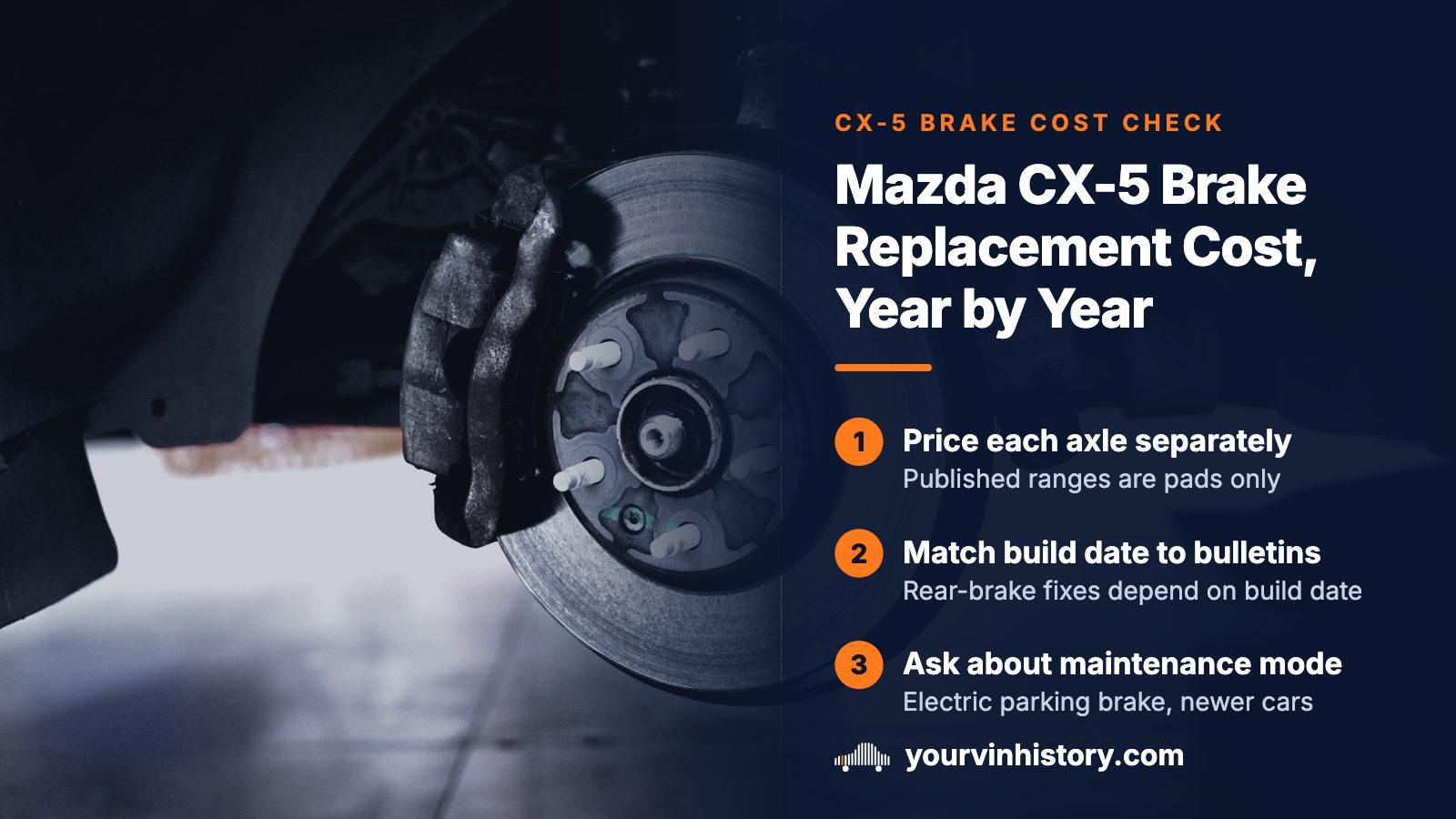
THE SHORT ANSWER
Kelley Blue Book's fair range for CX-5 pad work was $240 to $308 on a 2017 and $421 to $506 on a 2019; RepairPal lists $318 to $367 for a 2015 and $305 to $355 for a 2022. The Kelley Blue Book ranges cover one axle with pads only. NHTSA shows no CX-5 brake recall, so Mazda's rear-brake fixes were bulletins, paid for only inside its new-vehicle warranty.
- Published pad ranges
- $240 to $506 across four estimates
- Brake recalls, 2013 to 2022
- None in NHTSA's data
- Peak brake-complaint year
- 2016, with 69 of 138 counted
- Electric parking brake
- New standard equipment for 2016
Four published price ranges and the job each one describes
Each figure belongs to the company that published it; none was measured for this guide. The listings were captured on October 26, 2026, so a live page may differ. yourvinhistory sells vehicle history reports, not brake work.
| Publisher | Model year | Range | What it covers |
|---|---|---|---|
| Kelley Blue Book | 2017 CX-5 | $240 to $308 | ZIP 45401 (Dayton, Ohio), parts and labor |
| Kelley Blue Book | 2019 CX-5 | $421 to $506 | ZIP 98055 (Renton, Washington), parts and labor |
| RepairPal | 2015 CX-5 | $318 to $367 | Brake pad replacement |
| RepairPal | 2022 CX-5 | $305 to $355 | Brake pad replacement |
Kelley Blue Book varies its ranges by model year and ZIP code, so a Dayton 2017 and a Renton 2019 are not a trend line.
Why a pads-only range is the low end of the bill
Kelley Blue Book's page opens on a service it labels Brakes, Replace Pads, and a note says the figure applies to one end of the car, front or rear. So each of its ranges is one axle, pads only. Rotors add parts and labor, and the second axle is a second job.
Mazda's own labor numbers add a clue. On a 2016 CX-5, its grooved-rotor bulletin allows dealers 0.5 hours for the rear pads and one rotor; doing both sides is allowed 0.7 hours. That is a warranty allowance, not a shop's book time, yet it hints that a rear pad and rotor job takes under an hour when nothing is seized.
What the NHTSA brake complaints can and cannot tell you
The NHTSA tally used here counts 2,054 owner complaints on 2013 through 2022 CX-5s. In 5 of those 10 years SERVICE BRAKES landed among the year's five most-reported categories, and those years total 138 complaints, about 6.7% of the file. In the other five years it ranked lower, so 138 is a floor.
These counts do not measure pad life. Pads and rotors are consumables, and a CX-5 that needed a brake job at 40,000 miles would never reach NHTSA. Owners filing here describe what they take for defects: a parking brake that stays clamped, a smoking rear wheel, a pedal that failed to stop the car. Treat the count as a pointer, not a forecast of your bill.
NHTSA tracks Mazda's automatic braking under FORWARD COLLISION AVOIDANCE, in the CX-5's top five for 2018 through 2021, yet the 2020 brake narratives include stops made by the car itself. Automatic braking muddies the file and belongs nowhere on a pad quote.
Brake complaints for each model year, 2013 to 2022
| Model year | Brake complaints (at most = ceiling) | Brakes ranked within the year |
|---|---|---|
| 2013 | 26 | Fifth |
| 2014 | At most 39 | Below the top five |
| 2015 | 14 | Fourth |
| 2016 | 69 | Third |
| 2017 | 15 | Fourth |
| 2018 | At most 3 | Below the top five |
| 2019 | At most 16 | Below the top five |
| 2020 | 14 | Fourth |
| 2021 | At most 11 | Below the top five |
| 2022 | At most 5 | Below the top five |
Brakes never lead the CX-5 record. SERVICE BRAKES is not first or second in any year, and its best placing is third, in 2016. Electrical system tops the list in 4 years, Engine in 3 and Exterior lighting in 2. Of the brake complaints counted, 109 belong to 2013 through 2016 cars and 29 to the redesigned 2017-and-later cars. In 2016, the 69 brake reports equal 13.5% of that model year's complaints.
2013 and 2014: the outer rear pad that rusted in place
Mazda wrote up a rear-brake problem on the original CX-5 in bulletin 04-005/15, which applies to 2013 and 2014 cars built before October 9, 2013. In salt states, it says, corrosion can freeze the outer rear pad in its bracket, so it keeps rubbing and wears alone; the squeal owners hear is the wear indicator. The repair is a scrubbed and greased caliper support, new retainers and modified pads, covered by Mazda's 36 months or 36,000 miles warranty.
The 2013 complaint file fits: brakes rank fifth with 26 reports, and the narratives mention grinding at the rear, early pad wear and repeat jobs. Brakes missed the 2014 top five, so that year's count is at most 39. When pricing pads on either year, ask whether the modified pads were ever installed and the brackets cleaned and greased.
2016: the electric parking brake arrives, and rear drag with it
Mazda's February 9, 2015 announcement of 2016 CX-5 pricing listed, as a new standard feature, an electronic parking brake. A motor at each rear caliper replaced the hand lever, and brake complaints jump from 14 for 2015 to 69 for 2016. Narratives describe a brake that stays on, a rear wheel dragging until it smokes and an outer pad worn to metal.
| Bulletin | 2016 cars built before | What it addresses |
|---|---|---|
| 04-002/15 | June 9, 2015 | Warning light, and no release in temperatures from about -4 to 14°F |
| 04-005/16 | Feb. 22, 2016 | Rear drag and worn outer pads; remedy was a new control module |
| 04-001/18 | Sept. 9, 2016 | Same drag; modified rear calipers replace the earlier fix |
Bulletin 04-001/18 offers a test worth borrowing: with the parking brake set, pull away slowly and watch for a roll toward one side, then check that each rear rotor turns easily by hand once released. A caliper that fails gets the modified design; pads and rotors change only if damaged. The 36 months or 36,000 miles warranty that covered this is long gone for a 2016, so new pads alone may only restart the clock.
2016 to 2021: grooved rotors, hard rust and uneven pad wear
Three more rear-brake bulletins followed. None is a recall, and each is tied to a build date.
| Bulletin | Cars | Problem and change |
|---|---|---|
| 04-003/20 | 2016 to 2020 | Metal particles groove new rear rotors; rotor honing changed |
| 04-002/21 | 2016 cars built before Dec. 21, 2016; 2017 to 2020 cars built before Mar. 18, 2020 | Rear grinding blamed on hard black rust; pad material replaced |
| 04-004/21 | 2017 to 2020 and some 2021 | Vibration as the parking brake releases on its own, and rear pads wearing unevenly; the control module's logic was revised |
Grinding is the common one. In Mazda's account the factory rear pads could not wipe rust from the rotors; braking then baked it into a hard black crust the pads could not cut through. The fix is revised-compound rear pads plus new rear rotors, so on a rear job for a car built inside those dates, ask which pad is going on.
Servicing the rear on a 2016-and-newer CX-5
Each rear caliper on an electric-parking-brake CX-5 carries the system's motor and gear unit, so rear work goes through that system. Mazda's service alert SA130 for 2016 cars lists rear pads, rotors and calipers and requires maintenance mode before and after each; a car returned with the parking brake service incomplete may not operate correctly.
A later alert for 2017 and 2018 cars covers the emergency manual release: one turn of the spindle and no more, or the caliper may need replacing. A shop that treats every CX-5 as an older lever-brake car risks turning pads into calipers. The front axle is the ordinary half; none of the bulletins changes it.
NHTSA lists no CX-5 brake recall, and that decides who pays
A lookup of NHTSA's recall data across the 2013 through 2022 model years finds no CX-5 campaign on the service brakes or the parking brake. As a control, the same lookup returns parking-brake recall 17V393000 on the 2014 Mazda6 and Mazda3. The CX-5's own recalls cover other systems, such as a fuel filler pipe and a fuel pump.
Recall versus bulletin
A recall remedy is performed by a dealer at no charge to the owner, within the limits of the federal rule. A bulletin is only a repair procedure for dealers, and Mazda paid for the repairs in this guide only inside its new-vehicle warranty. Past that point, name the bulletin at the service desk; it gives the shop a diagnosis and the revised part.
What a fair rear-brake quote spells out
- The axle being done, and whether rotors are in the price
- Inner and outer pad thickness at each rear wheel, measured separately; a lopsided pair points to drag
- A hand-spin test of each rear rotor, parking brake off
- Mazda's revised pad, or the aftermarket one replacing it
- Maintenance mode named as a step on 2016 and newer cars
- Caliper support cleaned and greased on 2013 and 2014 cars from salted states
A recommendation for calipers needs a reason. On a 2016, a failed roll or spin test justifies it; outside the stated build dates, ask to see the diagnosis first.
Before you buy a used CX-5
On a test drive, set the parking brake and pull away gently, feeling for a tug to one side. After a short drive, a rear wheel much hotter than its twin signals drag. Decode the VIN for the model year and build date, since the date decides which bulletins could apply, then check NHTSA's recall lookup, which costs nothing. Ask for brake invoices, bulletin work included, and have a pre-purchase inspection measure the rear pads separately.
A yourvinhistory report adds factory specs, open recalls, and title, accident and odometer records, but it is no maintenance log. With no record of a fluid change, price brake fluid as its own service.
Where this information comes from
- NHTSA: 2016 Mazda CX-5 complaints and recalls — The federal complaint record behind the brake counts, browsable one model year at a time.
- NHTSA: recalls by vehicle, Mazda CX-5 — Recall data checked year by year for 2013 through 2022, looking for brake or parking-brake campaigns.
- NHTSA-hosted Mazda bulletin 04-001/18 — Build-date cutoff, roll test, rotor check and modified calipers for 2016 rear brake drag.
- NHTSA-hosted Mazda bulletin 04-005/15 — The corrosion-stuck outer rear pad on early 2013 and 2014 cars, with the revised pads and warranty terms.
- NHTSA-hosted Mazda bulletin 04-002/21 — Hard rust on rotors of parking-brake cars, the revised pad material and the build-date cutoffs.
- Kelley Blue Book: 2017 Mazda CX-5 brake repair — Source of the ZIP 45401 range and the statement that its pricing covers either the front or the rear brakes.
Sources and photos: Facts checked against the sources above in October 2026. Photo by ün LIU on Unsplash; diagrams by YourVINHistory.
Keep reading
- Mazda CX-5 years to avoid: 2013 to 2022 ranked by NHTSA complaintsEvery CX-5 model year scored against the model's own complaint median, brakes and every other system.
- 2016 Mazda CX-5 recalls, lighting complaints and what to checkThe 2016 model year alone: its recalls, complaint totals and what to inspect on the first electric parking brake car.
- Mazda CX-5 transmission fluid change cost: same gearbox from 2013 to 2022The other service question owners ask about this nameplate, priced from published figures the same way.
- Mazda recallsCheck one VIN for open recalls; the CX-5's own campaigns sit on systems other than the brakes.
Frequently asked questions
What should a Mazda CX-5 brake job cost?
Kelley Blue Book shows $240 to $308 for a 2017 in Dayton and $421 to $506 for a 2019 in Renton, each one axle with pads only; RepairPal lists $318 to $367 for a 2015 and $305 to $355 for a 2022. Rotors and the other axle cost extra, so ask every shop to itemize.
When did Mazda put an electric parking brake on the CX-5?
Starting with the 2016 model year; 2013 through 2015 cars used a hand lever. A Mazda service alert for 2016 cars requires maintenance mode around rear pad, rotor and caliper work. A later alert limits the manual release to one spindle turn.
Which CX-5 model year has the most brake complaints?
The 2016, with 69 of the 138 brake complaints counted across the 2013 to 2022 cars, or 13.5% of everything filed for that year. Years where brakes missed the top five are only bounded, so 138 is a floor. These are owner reports of suspected defects, not pad wear or a failure rate.
Will Mazda fix CX-5 brake problems at no charge?
Not through a recall, because NHTSA lists none for the brakes. Mazda's bulletin repairs for 2016 rear brake drag ran under a warranty of 36 months or 36,000 miles, which a 2016 has outlived. Recalls on other systems are repaired by dealers at no charge within the federal rule's limits.
How do I find out which CX-5 bulletins apply to my car?
Bulletins are keyed to build dates, so start with a VIN decode for the model year and build. Mazda's notice on its bulletins tells owners not to assume one applies to their car and to contact an authorized dealership. Take the bulletin number to the service desk.
Now check the car itself
The guide explains what to look for. The report shows what this VIN has on record.