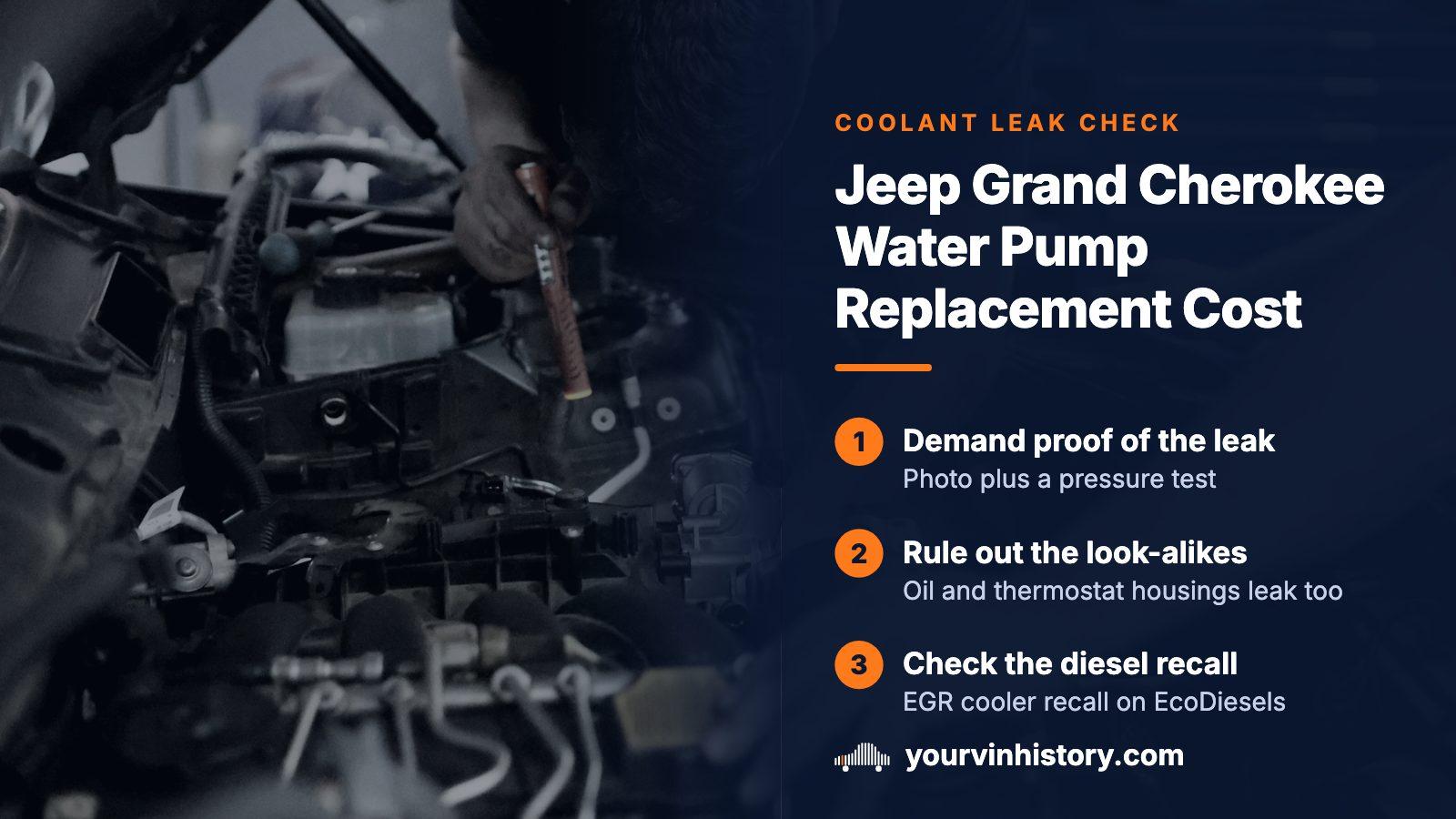
THE SHORT ANSWER
RepairPal's Grand Cherokee page lists $761 to $940 for a water pump. Kelley Blue Book's 2022 page, priced for one Ohio ZIP code, showed $806 to $910, mostly labor. On a 3.6L Pentastar, Stellantis instructs dealers to inspect and photograph the leak before swapping a pump, since the oil filter housing and thermostat housing can leak nearby. A 2014 to 2019 diesel should be checked against recall 20V699 first.
- RepairPal range
- $761 to $940 for a Grand Cherokee
- KBB, ZIP 43085
- $806 to $910 on a 2022 model
- Heaviest years
- 2011 to 2015 hold 66% of ENGINE complaints
- Pump recalls
- None found for 2008 to 2022
Two published ranges, and who stands behind each
Only two estimators gave Grand Cherokee figures, and neither belongs to this site. RepairPal's Grand Cherokee page, retrieved in October 2026, puts a pump job between $761 and $940. Kelley Blue Book's 2022 page, priced for ZIP code 43085 in central Ohio, showed a fair range of $806 to $910.
| Publisher | What it covers | Range | Fine print |
|---|---|---|---|
| RepairPal | Grand Cherokee, all years on one page | $761 to $940 | Not split out by engine |
| Kelley Blue Book | 2022 model, ZIP 43085 | $806 to $910 | Parts $276 to $324, labor $530 to $586 |
| Kelley Blue Book | Same page with no ZIP entered | $375 to $787 | General FAQ line, no local pricing shown |
That last row is a general water pump range, not a Grand Cherokee price; the page shows no local pricing without a ZIP code.
Reading the quote: parts, labor and the add-ons
In Kelley Blue Book's split, the only one found, parts are the smaller share and labor the larger. Coolant usually appears as its own line, and shops often add a serpentine belt and thermostat because the belt must come off to reach the pump.
Labor of that size suggests a bolt-on accessory job, though that is an inference. A Stellantis bulletin on the 2022 Pacifica hybrid with the 3.6L V6 says a snapped belt would stop both the water pump and the alternator, which ties the pump to the belt, not the timing chain. It covers one Pacifica build window, so it is evidence for a Grand Cherokee, not proof. A quote far above the published ranges deserves a question about extra parts or a different job.
Stellantis tells its own dealers to prove the leak first
Dealer notice 9100337, issued May 2, 2024 under the part name water pump, covers 2016 through 2024 models with the Pentastar Upgrade 3.6L, Grand Cherokee 2016 to 2022 included. On a suspected coolant leak, technicians must follow a separate inspection procedure before replacing any pump and submit photos of the leak area.
A little coolant residue by the pump's weep-hole plug may be expected; coolant actively dripping from there is not. If a technician is unsure, the notice sends them to a pressurized cooling-system test.
What the notice does and does not say
It is a dealer instruction, not a recall or warranty extension, and it never says how often pumps were replaced by mistake. It does give you a standard to ask for: a photo of the wet spot and a pressure-test result.
The oil filter housing in the engine valley
The Pentastar's oil filter housing, which Stellantis labels the oil filter adapter, sits in the valley beneath the intake. Leaks there trickle down the block, so from underneath you see a wet engine and a drip that can pass for pump trouble.
Bulletin 09-008-15 of August 7, 2015 addresses the 2014 Grand Cherokee with the 3.6L built by January 20, 2014: the valley can hold almost a quart of oil with no weeping showing. Its check lowers a long wooden dowel beside the housing, and roughly 10 mm of oil on the tip points to a housing that may need replacing.
A dealer notice dated March 31, 2021 covers Pentastar vehicles from 2012 to 2021. For a leak at the seam between adapter and block, it calls for a bolt-torque check and new O-rings and gaskets, not a new adapter. On 2014 models the adapter itself gets replaced instead. A seal job and a housing job are not priced alike.
All of this concerns oil. The Stellantis documents reviewed describe no coolant-side failure, though Standard Motor Products, a replacement-housing maker, says a failure can let oil into the coolant passage. Treat a coolant leak here as possible, not confirmed by the manufacturer.
The thermostat housing near the top of the engine
The documents reviewed hold no Grand Cherokee bulletin on this part, but a close relative shows the pattern. Bulletin 07-002-16 Rev. A (August 16, 2016) applies to the 2016 Ram 1500 pickup with a 3.6L V6 built from September 9, 2015 through April 17, 2016. The symptom is coolant at the housing's bleed screw. A technician removes the throttle body to reach it, and a wet screw, or one that will not hold its torque, means replacing the housing, a 0.7-hour labor entry.
A narrow build window on another truck says nothing against Grand Cherokee housings. It does show that a coolant leak high on the engine can have a short, modest repair worth ruling out first.
EcoDiesel and V8 trucks sit outside these numbers
Most Grand Cherokees carry the Pentastar, but other engines exist: the 2008 to 2010 older-body trucks predate it, and V8s, the 5.7L Hemi among them, were offered next to it. The Stellantis documents reviewed are silent on how the Hemi or SRT V8 pumps are driven, and neither estimator splits its range by engine, so no labor figure is offered for them.
The 3.0L EcoDiesel has its own coolant hazard. Recall 20V699 covers certain 2014 to 2019 Grand Cherokees with that engine: NHTSA's record says the EGR cooler may crack and let heated, vaporized coolant reach the EGR system, which can raise fire risk. Dealers replace the cooler at no charge to the owner and inspect the manifold. Check this recall before buying a pump for a diesel that loses coolant with no visible drip.
Where the engine complaints cluster by model year
NHTSA's complaint record for the 2008 to 2022 Grand Cherokee holds 11,797 reports, and 2,040 of them, about 17 percent, fall under the ENGINE category. By generation, the pattern is lopsided.
| Model years | Which engine era | ENGINE reports | Share of the 2,040 |
|---|---|---|---|
| 2008 to 2010 | Older WK body, before the Pentastar | 150 | 7% |
| 2011 to 2015 | First five Pentastar years | 1,338 | 66% |
| 2016 to 2022 | Pentastar Upgrade years | 552 | 27% |
Early Pentastar years average roughly 268 ENGINE reports apiece; upgrade years roughly 79. The 2014 model leads at 407. Inside that hot stretch the 2013 model dips to 105, which the record does not explain. The step up is abrupt: 21 reports for 2010, then 343 for 2011.
Why a complaint count is not a pump count
Read the table as context and an upper bound. ENGINE spans every engine Jeep fitted, V8s and diesels included, and every kind of engine fault. NHTSA also keeps a separate ENGINE AND ENGINE COOLING category. In the complaint data behind this page it makes a model year's top five only for 2008, with 39 reports. Elsewhere it sits below fifth place and only the top five are stored, so its exact count is unknown; in 2009 the fifth-ranked category had only 11 reports, so cooling complaints could not have exceeded that. A complaint count is also not a failure rate.
Recalls: what NHTSA's records include and omit
Searching NHTSA's recall records across the 2008 to 2022 Grand Cherokee model years turns up no campaign touching coolant hoses, the radiator, the thermostat or the water pump. Several other campaigns sit under the ENGINE AND ENGINE COOLING component without being cooling faults. Recall 11V487, for example, applied to certain 2012 models with the 3.6L made from August 31 through September 13, 2011: connecting rod bearings could fail because of debris in the block, and the fix was a replacement engine. Recalls 20V475 and 23V411 concern a crankshaft sensor tone wheel on the 3.0L diesel. None of them pays for a pump. NHTSA's lookup by VIN shows which campaigns are open on a specific vehicle.
If you are shopping for one instead of fixing one
The same record doubles as a shopping map. A 2011 to 2015 Grand Cherokee with the 3.6L falls in the model years with the heaviest ENGINE complaint totals, and 2014 is the one year where the dealer notice has the adapter itself swapped rather than resealed. Ask for invoices that show what was done, check the valley and engine front with a flashlight, and read the coolant level cold.
A pre-purchase inspection that adds a pressure test of the cooling system is a modest cost next to the repairs above. A yourvinhistory report adds the paper trail a seller may not volunteer: open recalls for the VIN, plus odometer, accident and ownership records. It does not replace repair invoices.
Where this information comes from
- Stellantis dealer notice 9100337 (NHTSA copy) — Source for the inspect-and-photograph instruction on 3.6L Pentastar Upgrade pumps and the weep-hole residue wording.
- Stellantis bulletin 09-008-15 (NHTSA copy) — Source for oil pooling in the valley of 2014 Grand Cherokees, the dowel test and the oil filter housing.
- Stellantis bulletin 09-004-23 Rev. A (NHTSA copy) — Pacifica hybrid bulletin used to infer that the 3.6L pump runs on the serpentine belt.
- NHTSA: Recalls lookup — Official recall search by VIN, where recall 20V699 for the EcoDiesel EGR cooler can be checked.
- RepairPal: Jeep Grand Cherokee repair costs — Where the $761 to $940 water pump range comes from, as retrieved in October 2026.
- Kelley Blue Book: 2022 Grand Cherokee water pump replacement — Source of the ZIP 43085 range with its parts and labor split, and of the general FAQ line.
Sources and photos: Facts checked against the sources above in October 2026. Photo by Mustafa Sheikhmouss on Unsplash; diagrams by YourVINHistory.
Keep reading
- Jeep Grand Cherokee years to avoid, and the ones with cleaner recordsThe full complaint record by model year, well beyond the engine.
- Jeep Grand Cherokee starter replacement cost, and the relay that mimics itAnother Grand Cherokee repair bill, with its own look-alike cause to rule out.
- Jeep recallsCheck a specific VIN for open campaigns, including 20V699 on the diesels.
- TSB vs recallExplains why a dealer notice is guidance for technicians and not a recall.
Frequently asked questions
How much does a Jeep Grand Cherokee water pump replacement cost?
Published figures run from $761 to $940 at RepairPal and $806 to $910 at Kelley Blue Book for a 2022 model in one Ohio ZIP code. Both are estimates, not quotes, and engine, region and shop type move the number. A belt, thermostat or coolant on the bill lifts it above a bare pump job.
Does the 3.6L Pentastar water pump run off the timing chain?
The documents reviewed point to the accessory belt. A Stellantis bulletin on a Pacifica hybrid with the 3.6L warns that a broken serpentine belt stops the water pump and alternator. No Grand Cherokee document states the drive outright, so treat it as a strong inference.
How do I tell a leaking water pump from a leaking oil filter housing?
Start with the fluid: the pump and thermostat housing carry coolant, while the filter housing is an oil part. Stellantis's 2015 bulletin warns that the valley can hold almost a quart of oil with no weeping on show, so a glance from underneath misleads. A dowel check or a pressurized cooling test separates them.
Is there a recall or extended warranty on the Grand Cherokee water pump?
No pump recall appears in NHTSA's records for the 2008 to 2022 model years. The nearest is 20V699, for 2014 to 2019 EcoDiesel trucks with a cracking EGR cooler, which dealers repair at no charge. Nothing reviewed shows a Stellantis extended warranty on Pentastar cooling parts. Bulletins guide technicians; they are not recalls.
Which Grand Cherokee years need the most care when buying?
The 2011 to 2015 cars, the first Pentastar years, hold most of the ENGINE complaints on file, led by the 2014. On a 2014, ask whether the oil filter housing was replaced, since that is the year Stellantis has dealers replace rather than reseal it. On a 2014 to 2019 diesel, confirm recall 20V699 was completed.
Now check the car itself
The guide explains what to look for. The report shows what this VIN has on record.