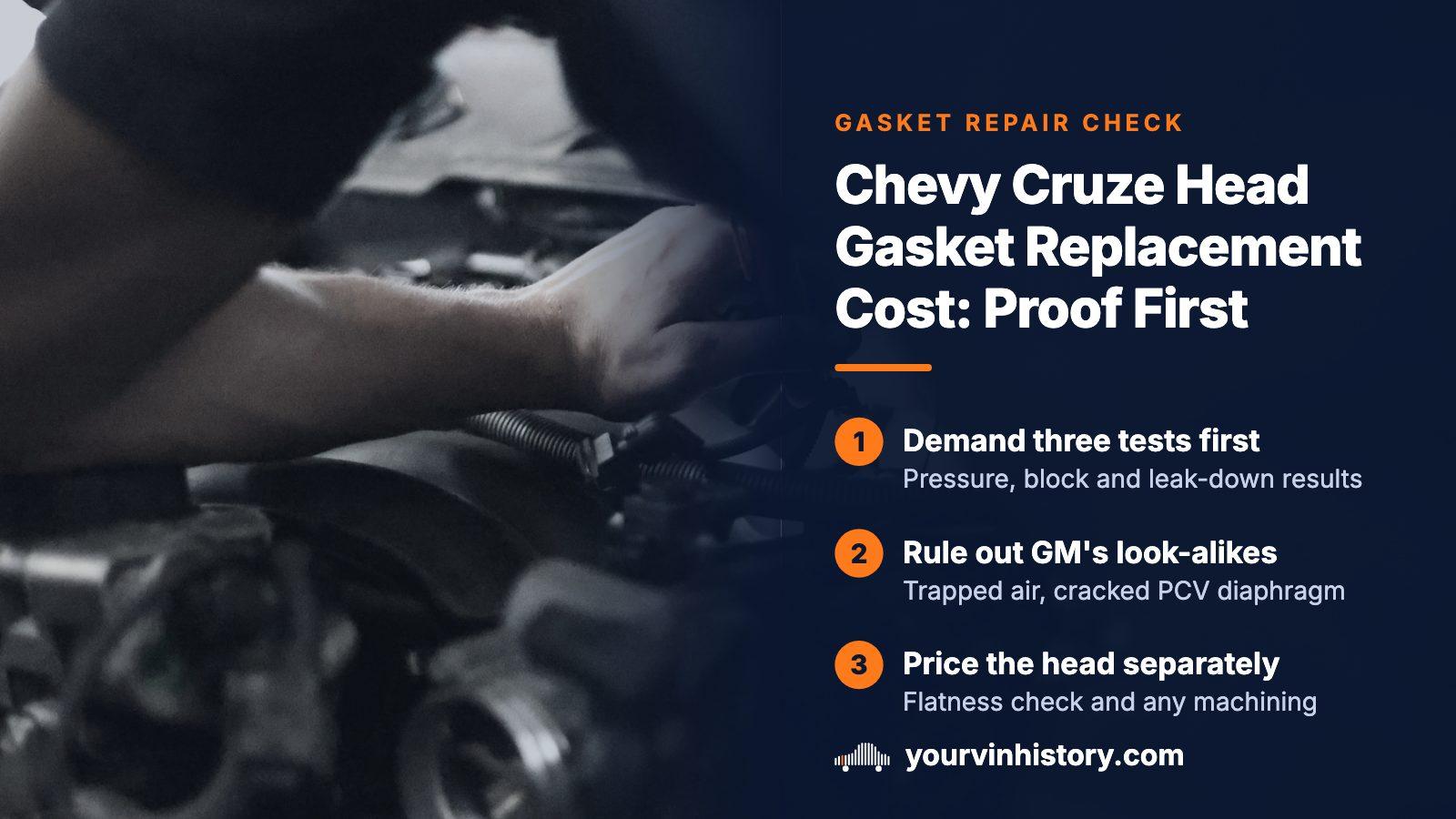
THE SHORT ANSWER
One published sample, RepairPal's figures as cited by ConsumerAffairs, lists a 2011 Cruze head gasket at $1,338 to $3,027, mostly labor, with head machining or overheating damage adding to it. NHTSA's files show no recall, bulletin or special coverage naming the gasket. Have the shop prove the fault with pressure, block and leak-down tests before you approve work, since GM documented gasket-like symptoms with other causes.
- Sample estimate
- $1,338 to $3,027 for a 2011 Cruze, RepairPal via ConsumerAffairs
- Recall naming the gasket
- None in NHTSA records for 2011 through 2019
- GM coolant-level program
- 14417A, ended August 12, 2016
- Engine share of complaints
- 33 percent for 2011 to 2015, 32 percent for 2017 to 2019
Reading a Cruze head gasket quote line by line
The most specific published price is a ConsumerAffairs table of RepairPal sample estimates with a 2011 Chevrolet Cruze row, read secondhand in October 2026 from a search listing. RepairPal's own site gave no readable Cruze head gasket estimate, and Kelley Blue Book's 2013 Cruze page listed no head gasket price.
| 2011 Cruze only, RepairPal sample via ConsumerAffairs | Low | High |
|---|---|---|
| Parts | $388 | $878 |
| Labor | $950 | $2,149 |
| Whole job | $1,338 | $3,027 |
Labor leads the bill because the head sits under so much: coolant, the intake and exhaust sides, the cam cover and the timing drive all come off first. Parts stay the smaller line unless the head returns warped and needs machining, or overheating hurt something else.
Weighing the quote against what a 2013 Cruze is worth
Kelley Blue Book's figures for a 2013 Cruze hold through October 25, 2026 and presume a car in good running order. A suspected gasket failure drags that down.
| Kelley Blue Book, 2013 Cruze | Typical amount, by trim |
|---|---|
| Trade-in | about $1,250 to $2,575 |
| Private-party sale | about $3,600 to $5,400 |
| Fair Purchase Price, LS and LT sedans | starts at $4,150 |
The $3,027 top of the repair sample sits above the trade-in range and below the private-party range, though pairing a 2011 estimate with 2013 values is rough. Repair can still beat hunting for a stranger's Cruze when the fault was caught early and the timing drive was serviced recently. It cannot rescue a wrong diagnosis: a gasket the engine never needed is money that stays gone at sale.
Signs that coolant, oil and exhaust are mixing
A leak inside the engine points at the gasket; one outside it usually does not.
| Sign | What it points toward |
|---|---|
| Coolant drops with no drips or crust anywhere | Possibly entering a cylinder or the oil |
| Bubbles rising in the coolant reservoir while the engine is on | Combustion gas forced into the coolant |
| Sweet white exhaust after warm-up | Coolant burning in a cylinder |
| One cylinder misfires after the car sat overnight | Coolant seeped onto a piston |
| Tan, milky film on the oil cap | Coolant in the oil, or short-trip condensation |
A technician's note on a 2016 Cruze in NHTSA's files shows the pattern: coolant on one piston, a soaked spark plug, oil mixed into the cooling system. A puddle at the front of the car is an outside leak, a different job. Early-car gasket stories often begin with a failing thermostat housing, water outlet or hose, then overheating.
Three GM papers on faults that imitate a gasket
| GM paper | Cars | Symptom | GM's finding |
|---|---|---|---|
| Program 14417A, August 2014 | 2011 to 2014, 1.4L (LUJ or LUV) | Low reservoir, no outside leak | Program closed August 12, 2016; air trapped at factory fill; top-up takes 0.3 hour |
| Special Coverage N202299080, July 2020 | 2011 to 2014, 1.4L | Rough idle, warning light, code P0171 | Cam cover's PCV diaphragm cracks, letting in unmeasured air; cover takes 0.6 hour |
| PIP5036, 2012 to 2013 | 2011 to 2013 Cruze | Oil use, blue smoke | Hunt for oil in the turbo, intake and PCV hoses, then examine pistons and rings |
Coolant that vanishes without a leak is what sends most owners toward a gasket quote, yet for 2011 to 2014 cars GM blamed trapped air. Dealers were told to purge the system through the radiator vent screw, top up with Dex-Cool, then keep the engine running through two fan cycles. A level that steadies after one bleed argues against the gasket; one that falls again each week argues for it.
Rough idle and a lit warning light: the cam cover check
Rough running with a check-engine light is the other symptom blamed on a gasket. Special Coverage N202299080 traces it, on 2011 to 2014 cars with the 1.4L, to a cracked PCV diaphragm inside the camshaft cover. GM's coverage lasted 10 years or 120,000 miles, counted from the day the car entered service, so it has lapsed on most of these cars.
Its diagnosis still applies: a whistle at the cam cover's PCV valve, and vacuum at the valve's vent. GM says the coverage excluded oil leaks, so oil seeping near the top of the engine is a cover matter, not a gasket one.
Tests that turn a suspicion into evidence
- Cooling-system pressure test, cold then warm, to find outside leaks
- Combustion leak (block) test, where the test fluid changes color if exhaust gas has reached the coolant
- Cylinder leak-down test, with someone listening at the coolant reservoir for escaping air
- Compression test on each of the four cylinders
- Spark plugs pulled and examined, since one clean, steam-washed plug is a strong clue
Get the results in writing. The block test is quickest and cheapest, and it separates a failed gasket from GM's trapped-air problem. A color change implicates the gasket, the head or the block. Leak-down results matter cylinder by cylinder, since trouble at one cylinder or two neighbors shows where to look once the head is off.
Price the cylinder head separately
NHTSA narratives tie most Cruze gasket failures to earlier overheating, and heat can warp an aluminum head. Ask whether the quote includes a flatness check and any machining, and what changes if the head is cracked.
What 3,707 owner complaints do and do not show
NHTSA holds 3,707 owner complaints on 2011 through 2019 Cruzes, and 1,253 of them, about 34 percent, fall under ENGINE, which ranks in the top five components in all nine model years. The share barely moves between generations: 33 percent across 2011 through 2015 (1,048 reports) and 32 percent across 2017 through 2019 (330 complaints in all).
The 2016 model year peaks at 40 percent, a year containing both the first-generation Cruze Limited and the redesigned car; the low, 25 percent, shows up in 2018 and again in 2019. Narratives with the words head gasket appear in the 2011 through 2016 files and in none from 2017 through 2019.
A share is not a failure rate
NHTSA has no head gasket category, and ENGINE holds every engine complaint, so the share is a ceiling on gasket trouble, never a count of it. These are unverified owner reports, and the late years are thin: 2019 has 20 complaints and 2017 through 2019 have 105 engine reports.
No recall, bulletin or coverage names the head gasket
Searching NHTSA's recall file for Cruzes of any year from 2011 to 2019 turns up no campaign whose summary mentions the head gasket, the cylinder head, coolant loss or overheating. GM's own bulletins, programs and special coverages in NHTSA's listings for those years were searched the same way, also with no hit on the gasket.
The gap matters because at least one owner complaint claims that Chevrolet recalled head gaskets on 2013 and 2014 Cruzes, and no such recall turned up. Anyone saying a recall covers the job should give a campaign number that NHTSA's recall lookup confirms against the VIN. A bulletin only tells technicians what to do; it does not oblige GM to pay.
Which engine is under the hood decides which paper applies
| Engine | Listed for | GM paper tied to it |
|---|---|---|
| 1.4L turbo, first generation | 2011 to 2015, 2016 Cruze Limited | The look-alike papers above |
| 1.4L turbo LE2 | 2016 Cruze, 2017 to 2019 | 16-NA-367: dexos1 full synthetic oil, to prevent piston damage |
| 1.8L | 2011 to 2015, 2016 Cruze Limited | Emissions recall 16186 (RPO LWE), catalytic converter |
| 2.0L diesel (LUZ) | 2014 and 2015 | None cited here |
| 1.6L diesel (LH7) | 2017 to 2019 | PIP5456 dealer exchange, 2017 to 2018; reason not stated |
No look-alike paper reaches past the early 1.4L, so a 1.8L, a diesel or an LE2 raises different questions. Confirm the engine first, since labor time and parts differ; an engine lookup by VIN settles it.
When to park a Cruze you suspect
- Temperature needle rising toward hot, or a hot-engine warning on the cluster
- Reservoir empty again a day or two after you topped it up
- White exhaust that stays after the engine is fully warm
- Rough running right after a start when the car has been sitting
The first three mean stop. Overheating that continues can warp the head and damage the pistons, and once that happens the conversation is about a used engine, not a gasket. A slow seep at the head joint, confirmed as external, is the rare case a careful owner can sometimes monitor. GM's Cruze papers call for Dex-Cool.
Repair, swap the engine or sell: settle these first
With the failure proven, the choice is arithmetic: the written quote against the car's worth running and as-is. On a high-mileage early Cruze needing head machining, get a used-engine quote too; a cleaner car with an early catch suits the gasket job. Before signing, get these in writing:
- Which test found the fault, on which cylinder, and what it showed
- Whether the head gets a flatness check and machining if needed
- What the quote assumes for the thermostat housing, water outlet and hoses
- Any open recalls, run by VIN, while the car is already in the shop
Buyers should demand the same tests before paying; a seller's gasket receipt counts for more when it names the test and the machine work. A yourvinhistory report shows open recalls, odometer readings and accident and title records, not engine repairs, so invoices and an independent inspection cover those.
Where this information comes from
- NHTSA: GM Program Bulletin 14417A (August 2014) — GM's program for 2011 to 2014 Cruzes with the 1.4L that showed low coolant but no leak: the trapped-air cause, the refill steps, the labor time and the end date.
- NHTSA: GM Special Coverage N202299080 (July 2020) — The cracked PCV diaphragm in the camshaft cover, the idle and lean-code symptoms, the coverage term and the oil-leak exclusion.
- NHTSA: recalls by vehicle and VIN — Where to check any Cruze VIN for open campaigns, and the record searched for a campaign naming the gasket.
- NHTSA: report a safety problem — The federal complaint system behind the engine-share figures and the owner narratives referred to here.
- ConsumerAffairs: head gasket replacement cost — Where the 2011 Cruze parts, labor and total ranges appear, credited to RepairPal sample estimates.
- Kelley Blue Book: 2013 Chevrolet Cruze values — National trade-in, private-party and Fair Purchase Price figures used for the comparison with the repair quote.
Sources and photos: Facts checked against the sources above in October 2026. Photo by Mustafa Sheikhmouss on Unsplash; diagrams by YourVINHistory.
Keep reading
- Chevrolet Cruze years to avoid, ranked by NHTSA complaintsEach Cruze model year measured against the model's own median complaint count, beyond the engine.
- Chevy Cruze water pump replacement cost, and when the pump is not the leakThe place to start when coolant is leaking outside the engine instead of vanishing.
- Engine size by VINSort out which engine is in the car (early 1.4L, LE2, 1.8L or diesel) before collecting quotes.
- TSB vs recallWhy a service bulletin guides a repair but does not mean the manufacturer pays for it.
Frequently asked questions
How much does a head gasket replacement cost on a Chevy Cruze?
The one Cruze-specific range found is a RepairPal sample, cited by ConsumerAffairs, for a 2011 car: $1,338 to $3,027 in all, with parts at $388 to $878 and labor at $950 to $2,149. Ask for an itemized quote that prices head inspection and machining separately.
Does GM cover a Cruze head gasket with a recall or warranty extension?
NHTSA's listings for 2011 through 2019 Cruzes show no recall, bulletin, program or special coverage naming the head gasket. Programs 14417A and N202299080 deal with look-alike faults, and the first ended August 12, 2016. For a newer Cruze, a VIN-based warranty lookup can show what factory coverage is left.
Should I pay to repair a head gasket on an older Cruze?
Only when the diagnosis is proven and the car is worth keeping. A 2013 Cruze lists at about $3,600 to $5,400 private-party at Kelley Blue Book, so a job near the sample's top takes a large share. The case that works is a confirmed, early-caught failure with no overheating damage.
Does milky residue on the oil cap mean my Cruze has a blown head gasket?
Not by itself. A tan, milky film can be coolant in the oil, but short trips also leave look-alike condensation. Weigh it against other signs, such as coolant falling with no outside leak, bubbles in the reservoir while the engine idles or a one-cylinder misfire after the car sits, then let a block test decide.
Why is my Cruze losing coolant when nothing is leaking?
Three explanations compete. On a 2011 to 2014 car with the 1.4L, GM's program 14417A blamed air trapped at the factory fill. A thin leak onto a hot part can boil away before it drips. An internal gasket leak is the third. See whether the level holds after a proper bleed, then let pressure and block tests sort them out.
Now check the car itself
The guide explains what to look for. The report shows what this VIN has on record.