THE SHORT ANSWER
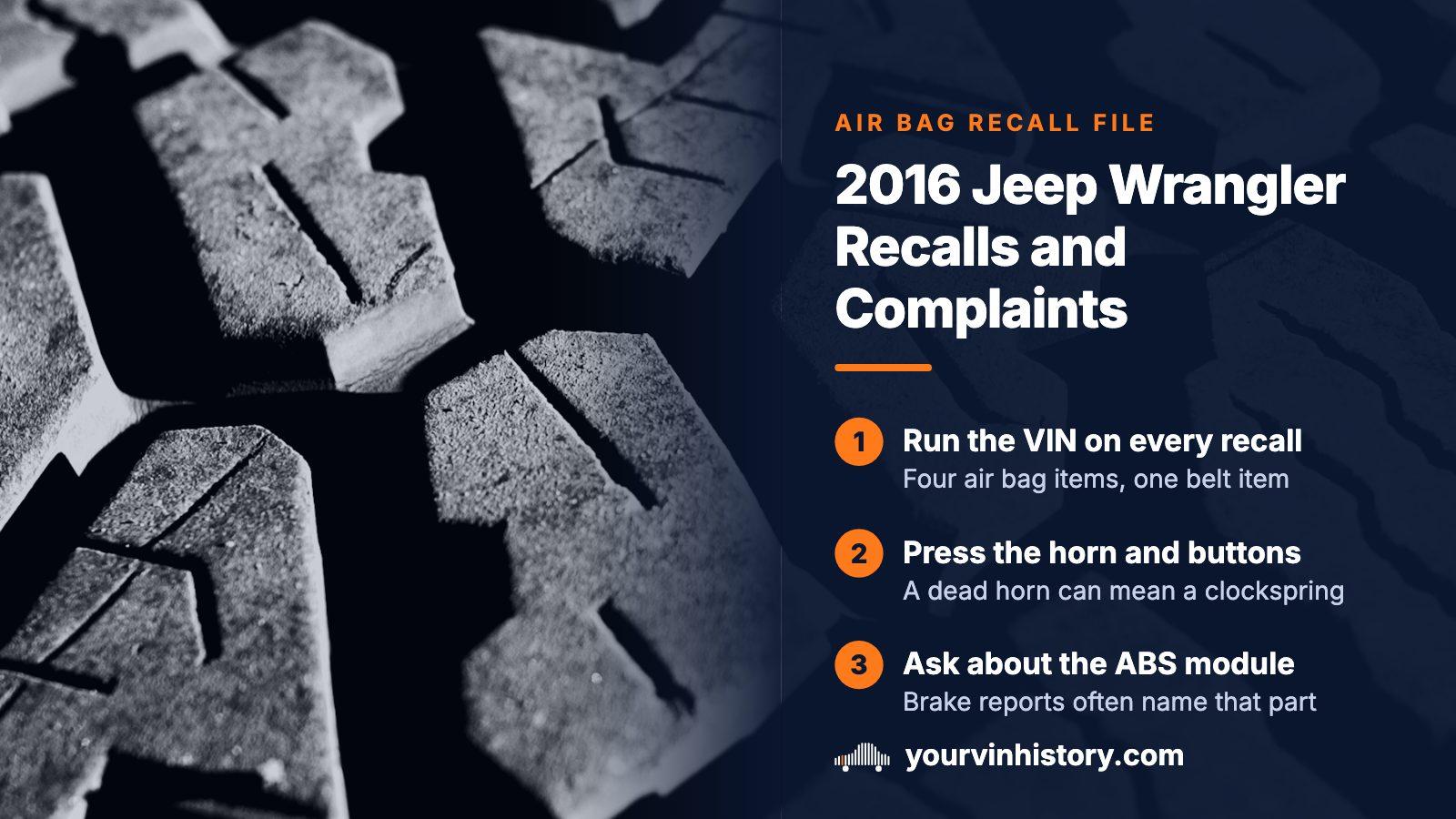
The 2016 Jeep Wrangler has 5 recall campaigns on file with NHTSA: four on air bag parts and one on a driver's seat belt buckle strap. Owners filed 455 complaints, led by service brakes at 132, then engine at 88 and air bags at 77. NHTSA gives no overall, frontal or side rating, and a rollover rating of 3 of 5. Recalls follow VIN ranges, so check the exact car with NHTSA's recall lookup.
- Recall campaigns
- 5 on file with NHTSA, all restraint related
- Owner complaints
- 455, led by service brakes at 132
- Crash rating
- Overall not rated; rollover 3 of 5
- Against other years
- 0.7 times the median Wrangler year
What the federal file holds for the 2016 Wrangler
Three kinds of record sit behind any model year at NHTSA, and each carries different weight. Recalls are defects the manufacturer accepted and owes a repair for: the 2016 Wrangler has 5. Complaints are single owners' unverified accounts: this year has 455. Investigations are the agency's own inquiries, and 3 of them, open or closed, touch this year.
Owners also describe what happened when they file. Of the 455, 28 mention a crash, 15 a fire and 38 an injury. Those are the owners' words, and one event can produce several filings, but they are the entries to read in full before you commit. The counts here are a snapshot, and the database keeps growing.
The five campaigns and the part each one repairs
All five campaigns concern a restraint: an air bag part in four cases, a seat belt part in the fifth. Listed by campaign number:
| Campaign | Part involved | Dealer's repair | Vehicles the notice names |
|---|---|---|---|
| 16V288000 | Driver clockspring | Replace clockspring and steering wheel trim | Right-hand drive, 2011-2016, built between February 16, 2010 and May 2, 2016 |
| 16V734000 | Front impact sensor wiring | Reroute wiring, move sensor branch | 2016-2017, built from June 16, 2015 through August 14, 2016 |
| 19V018000 | Passenger air bag inflator | Replace inflator | 2010-2016, shared with other Chrysler and Dodge models |
| 19V680000 | Driver belt buckle strap | Replace buckle | Right-hand drive, 2011-2018 |
| 24V196000 | Driver clockspring | Replace clockspring and steering wheel trim | Right-hand drive, 2016 |
Three of the five name right-hand-drive Wranglers only
Read each notice's vehicle description before assuming it applies. The buckle campaign, 19V680000, and both clockspring campaigns, 16V288000 and 24V196000, are written for right-hand-drive vehicles. A standard left-hand-drive Wrangler does not fit that wording, so those three may never have applied to it.
The other two reach further. Campaign 16V734000 hinges on a build window, so the manufacture date on the door-jamb label is worth reading, and 19V018000 is shared with other Chrysler and Dodge models. A lookup of the full 17-character VIN shows what NHTSA has attached to the car.
How the air bag and belt campaigns can fail the driver
Campaign 16V734000 concerns wiring from the front impact sensor. In certain crashes the wire can be pulled loose, so the restraint controller never hears about the impact and both front air bags and the belt pretensioners stay inactive.
The clockspring is the coiled connector in the steering column that keeps the driver's air bag wired while the wheel turns. The earlier campaign, 16V288000, began on August 11, 2016 and blames dust inside the assembly. The later one, 24V196000, blames debris and had owner letters mailed on April 4, 2024. Because the same part appears twice, ask for paperwork under each number.
Campaign 19V018000 covers the passenger-side inflator, which NHTSA says could explode on deployment and send metal fragments into the cabin. Its notice told owners not to drive the vehicle until repaired, and the recall began on February 4, 2019. Campaign 19V680000 involves the strap that anchors the driver's belt buckle, which can fracture and leave an inoperable belt. That recall began on March 26, 2020.
Where the 455 complaints land, component by component
Service brakes lead with 132, just over a quarter of the total. Judge the shape, not the sum: any popular vehicle collects complaints by existing, while a category towering over the rest hints at something structural. Here the leader holds 29% and the next two hold 19% and 17%, a spread rather than one dominant fault.
| Rank | Component | Complaints | Share of 455 |
|---|---|---|---|
| 1 | Service brakes | 132 | 29% |
| 2 | Engine | 88 | 19% |
| 3 | Air bags | 77 | 17% |
| 4 | Power train | 73 | 16% |
| 5 | Electrical system | 55 | 12% |
| 6 | Unknown or other | 54 | 12% |
| 7 | Vehicle speed control | 35 | 8% |
| 8 | Steering | 27 | 6% |
| 9 | Structure | 18 | 4% |
| 10 | Hydraulic, fuel and propulsion, stability control | 13 each | 3% each |
Rows overlap because one complaint can name several components, so do not add them up. A brake complaint is an owner reporting a defect, not a count of worn pads.
What the owner narratives behind those categories describe
A category count says nothing about what broke; the narratives do, and NHTSA's complaint search lets anyone read them. Among the brake-tagged reports for this model year, the dominant story is an ABS control module failing. The brake, ABS and traction control lights come on, stability and cruise functions drop out, and many owners say the replacement part sat on back order for months. The same module appears under electrical system and vehicle speed control, which explains some of the overlap.
The air bag reports include one cluster describing a dead horn, dead steering wheel buttons and a lit air bag light, the usual signs of a failing clockspring. Another cluster describes stalled recall repairs: parts shortages on the inflator, and dealers asking for extra labor to remove an aftermarket bumper or winch before the sensor wiring work. These are unverified accounts, but each converts into a question for the seller.
How old the car was when each system gave out
Each complaint carries the date of the failure, and subtracting the model year gives the car's age at that moment. Ordered from the latest median age to the earliest, for the main systems:
| System | Median age (years) | Dated reports | Share in first three years |
|---|---|---|---|
| Service brakes | 8.4 | 129 | 6% |
| Steering | 5.2 | 26 | 23% |
| Engine | 4.9 | 88 | 19% |
| Electrical system | 4.8 | 55 | 25% |
| Vehicle speed control | 4.6 | 34 | 29% |
| Air bags | 4.3 | 77 | 27% |
| Power train | 3.8 | 73 | 36% |
No system has most of its reports inside the first three years; power train comes closest at 36% and brakes sit at 6%. A brake median of 8.4 years fits the ABS module stories, a part giving out deep into the car's life.
Medians, not predictions
These summarize unverified reports. They show when people who complained say trouble began, not how likely a given car is to have it.
Where 2016 sits among Wrangler model years
To compare years fairly, divide each year's complaint count by the median year for the same nameplate, which damps the effect of sales volume. On that yardstick 2016 comes out at 0.7 times the median. It ranks 13th from the heaviest among the 15 model years on record, 2008 through 2022.
| Yardstick | Reading |
|---|---|
| 2016 against the median year | 0.7 times |
| Most complained-about year | 2018, at 2.77 times |
| Lightest settled year | 2017, at 0.47 times |
| Peak filing year for 2016 complaints | 2019 |
Crash ratings: mostly blank, with a rollover score of 3 of 5
Stars are earned by a new vehicle in a laboratory. They describe the design, not a used car's condition, and repairs, aftermarket parts or earlier damage never show in them.
| Test | Result for the 2016 Wrangler |
|---|---|
| Rollover stars | 3 of 5 |
| Chance of rollover | 27.9% |
| Overall stars | Not rated |
| Head-on test | Not rated |
| Side impact test | Not rated |
NHTSA lists two configurations, the 4DR 4WD and the 2DR 4WD, with identical results. Electronic stability control is standard on both, while forward collision and lane departure warning are not offered. A blank is not a failing grade, just no star result to publish, so the recall and complaint record carries the weight.
What to inspect on a used 2016 Wrangler, and what to ask
Take this list to a mechanic.
- Dash warnings: brake, ABS, traction control and air bag lights should clear once the engine starts.
- Horn and wheel buttons: press every one. Dead ones point to the clockspring, recall or not.
- ABS history: ask whether the module was ever replaced, and with what part, since owners describe long waits.
- Front end: look for an aftermarket bumper or winch that could block the sensor wiring repair, and for scorched or taped wiring, since fire reports exist.
- Engine and drivetrain: scan for stored codes, check for oil seepage, feel every gear change.
- Hood: structure reports include a hood that flutters at highway speed, so check how it seats and latches.
Then ask the seller:
- Which of the five campaigns apply to this VIN, and where is the dealer paperwork for each?
- Has the ABS module, clockspring or any air bag part ever been replaced?
- Has the car ever been in a crash, and who paid for the repairs?
- Is the title clean, in your name, with no lender's lien?
- Can my own mechanic inspect it before we settle on a price?
Running the VIN, and what no charge means at this age
Enter the car's VIN in NHTSA's recall lookup. It lists campaigns still open on that vehicle, and it is the only step that settles which of the five apply. Run it again just before you pay, since campaigns are added over time.
The no-charge rule has an edge
Under 49 U.S.C. 30120, a manufacturer must remedy a recalled vehicle without charge, but not when the first buyer bought it more than 15 calendar years before the notice to owners. The clock runs from first purchase to the notice date, not to today. If a shop quotes a price on a listed campaign, ask why.
The lookup covers safety campaigns only. Title brands, accident records, odometer readings and salvage history sit elsewhere. A report built on federal NMVTIS title data, such as the one this site sells after a free preview, covers them.
Where this information comes from
- NHTSA: Recalls — Where a VIN is entered to see which campaigns are still open on one car, and where each campaign's full notice is posted.
- NHTSA: Vehicle safety and complaints — Starting point for the public complaint database whose owner reports are tallied and read for this page.
- NHTSA: Ratings — The crash-test program behind the overall, frontal, side and rollover results quoted above.
- U.S. Code: 49 U.S.C. 30120 — The statute that requires a recall remedy without charge and sets the 15-year cutoff.
- NMVTIS: National title information — The federal title-record system; brands and title history are outside the safety file.
Sources and photos: Facts checked against the sources above in October 2026. Photo by Benjamin Brunner on Unsplash; diagrams by YourVINHistory.
Keep reading
- Jeep Wrangler years to avoid, ranked by NHTSA complaintsRanks all fifteen Wrangler years against one median so you can see how 2016 compares.
- Jeep recallsShows how to run any Jeep VIN through the recall lookup.
- Buying a car with an open recallExplains what to do when the lookup finds a campaign nobody repaired.
- Airbag deployed checkCovers how to find out whether a car's air bags have already fired.
Frequently asked questions
How many recalls are on the 2016 Jeep Wrangler?
Five campaigns are on file: 16V288000, 16V734000, 19V018000, 19V680000 and 24V196000. Each follows its own vehicle description, so two Wranglers on one lot can differ. Three name right-hand-drive vehicles, one depends on a build window, and the inflator campaign is shared with other Chrysler and Dodge models.
What are the most common problems with a 2016 Jeep Wrangler?
Service brakes lead at 132, followed by engine at 88, air bags at 77 and power train at 73. The narratives behind brake and electrical tags often describe a failed ABS control module and a long wait for the part. These are unverified reports, not failure rates, so treat them as a checklist for a mechanic.
Is the 2016 Jeep Wrangler safe?
NHTSA has not rated the 2016 Wrangler overall, in the frontal test or in the side test. Its rollover rating is 3 of 5, with a rollover probability of 27.9%, and electronic stability control is standard. A rating describes the design when new, so the condition and open recalls of the particular car matter just as much.
Will a dealer repair a 2016 Wrangler recall at no charge?
For a campaign on file, the manufacturer owes the remedy without charge, subject to the federal 15-year limit measured from first purchase to the notice date. Owners report parts shortages delaying inflator replacements, and extra labor quotes when an aftermarket bumper or winch is in the way.
How do I check a 2016 Jeep Wrangler for open recalls?
Enter the 17-character VIN on NHTSA's recall page and read the results for that exact car. Do it again shortly before you buy, and compare the result with the seller's paperwork. On a right-hand-drive example, the clockspring and seat belt campaigns are the ones most likely to appear.
Now check the car itself
The guide explains what to look for. The report shows what this VIN has on record.