THE SHORT ANSWER
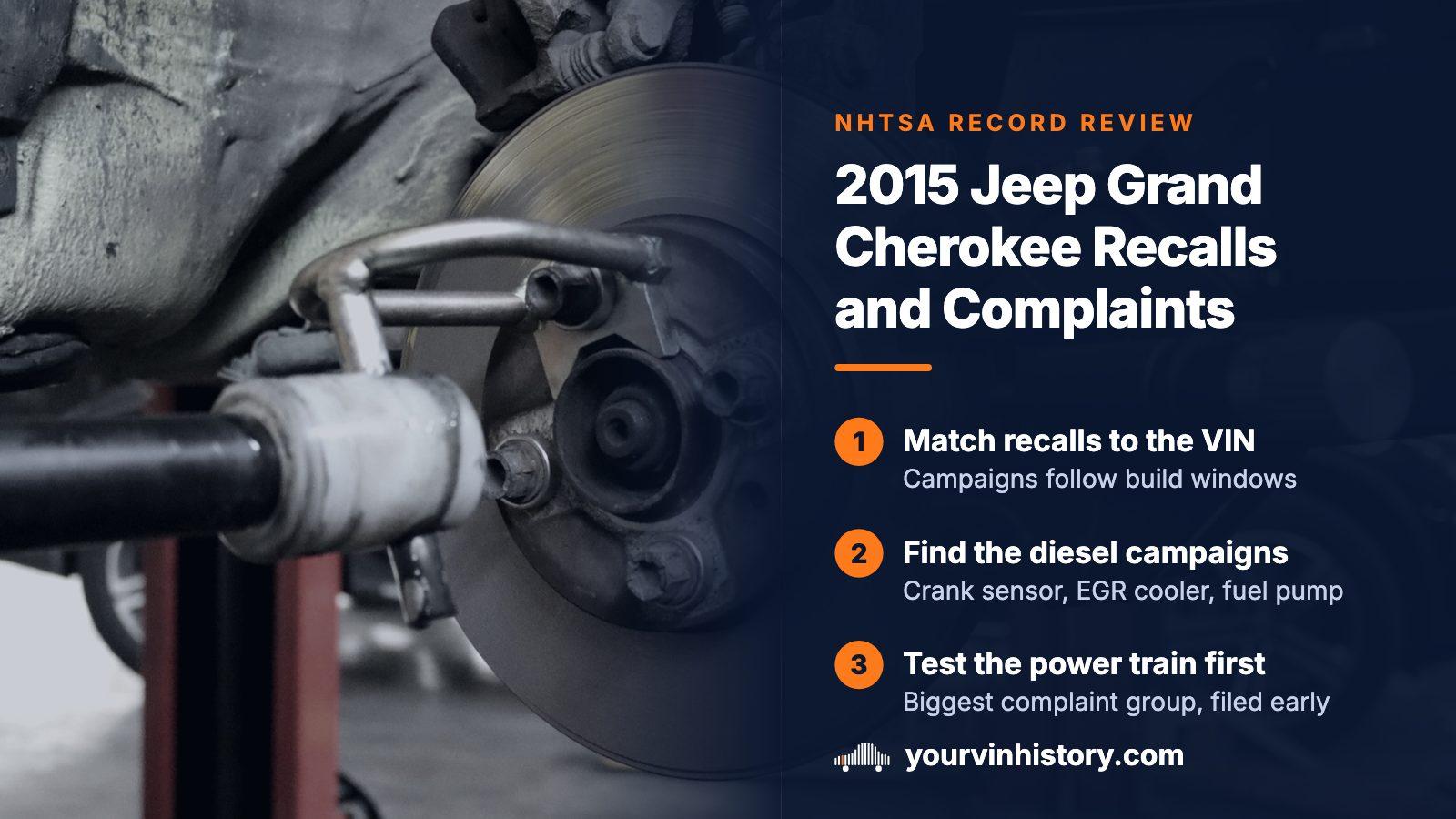
The 2015 Jeep Grand Cherokee has 10 recall campaigns on file with NHTSA and 1,350 owner complaints, led by power train at 350 and seats at 309. NHTSA gave the 4WD version 5 of 5 stars overall and 4 for rollover, while the 2WD version scored 4 overall. Recalls follow VIN ranges, so check the specific SUV in NHTSA's recall lookup and confirm each repair was finished.
- Recall campaigns
- 10 on file with NHTSA
- Owner complaints
- 1,350, led by power train at 350
- Crash rating
- 5 of 5 overall for 4WD, 4 of 5 for 2WD
- Against its own run
- Fourth heaviest of 15 years, 2.86 times the median
Reading NHTSA's two files on this SUV
NHTSA keeps a recall file and a complaint file for every model year, and they should not be mixed up. The 2015 Grand Cherokee carries 10 recall campaigns, each a defect that a maker agreed to repair, plus 1,350 owner complaints, which are accounts typed in by owners and never tested by the agency.
Some complaint entries carry flags taken from the owner's own description:
- 127 describe a crash
- 21 describe a fire
- 92 report an injury
One incident can produce several entries, and the flags are not findings, but they are the entries to read in full on NHTSA's site before paying. The agency also lists 8 investigations touching this model year. An investigation may or may not lead to a recall, so treat each one as an early warning.
All ten campaigns, grouped by the part involved
This list is sorted by the part involved, not by number. Where only NHTSA's filing category is available here, the last column says so.
| Part involved | Campaign | What the record says |
|---|---|---|
| Diesel crank sensor | 20V475000 | Tone wheel can delaminate; engine may stall |
| Diesel EGR cooler | 20V699000 | Cooler can crack; fire risk in the intake |
| Diesel fuel pump | 22V406000 | Diesel fuel delivery; no summary here |
| Engine and cooling | 23V411000 | Category only |
| Front left brake caliper | 16V168000 | Can crack; narrow build window |
| Rear lower control arm | 15V469000 | Can fracture; narrow build window |
| Transmission control module | 16V240000 | Category only |
| Wiring | 18V332000 | Category only |
| Radio | 15V461000 | Category only |
| Supercharger bracket | 17E061000 | Aftermarket kit, not the factory SUV |
The 3.0L diesel: crank sensor, EGR cooler and fuel pump
Campaign 20V475000 covers 2014 to 2016 Grand Cherokees with the 3.0L diesel, along with certain Ram 1500 trucks. The tone wheel on the crankshaft position sensor can delaminate, so the engine loses the timing signal for its injectors and camshaft and may stall. Dealers load a software update that lets the engine rely on the camshaft signal instead. FCA US tracks it as W58, and owner letters went out on May 13, 2021.
Campaign 20V699000 covers 2014 to 2019 Grand Cherokees with the 3.0L EcoDiesel. A cracked EGR cooler can pass heated coolant vapor into the intake, where it may burn and raise fire risk. Dealers replace the cooler and inspect the manifold, replacing it if needed. FCA US tracks it as W79. NHTSA's notice says parts were not yet available when it was written, so ask whether the work was completed, not merely scheduled.
Campaigns 22V406000 (diesel fuel pump) and 23V411000 (engine and cooling) have no summary here. Open both on NHTSA's recall page.
Control arm and brake caliper: recalls tied to build dates
Two campaigns reach only SUVs assembled inside short windows, so a given car may fall outside both. Campaign 15V469000 covers model year 2015 Grand Cherokees and Durangos built from June 12 to June 20, 2015, where rear lower control arms may have been heat treated wrongly. A fractured arm can change ride height, reduce rear stability and cut braking ability. Dealers inspect the arms and replace them as needed. The repair began July 29, 2015; FCA's code is R38, and it superseded 15V-407.
Campaign 16V168000 covers 2015 and 2016 model year Grand Cherokees and Durangos built from December 9, 2015, to January 14, 2016. The left front brake caliper was cast from the wrong material and may crack, lengthening stopping distance. Dealers check the casting date and replace the caliper where it applies. NHTSA gave a start date of May 12, 2016, and FCA's code is S16.
Transmission module, wiring, radio and a supercharger kit
Three campaigns arrive with a category and nothing more: 16V240000 for the automatic transmission's control module, 18V332000 for wiring in the electrical system, and 15V461000 for the radio and related equipment. The defects and remedies are not stated here, so open each number on NHTSA's recall page and compare it with the VIN.
The tenth, 17E061000, is an equipment recall. Accessible Technologies (ATI) recalled ProCharger supercharger kits sold for 2012 to 2017 Grand Cherokee SRT8 and SRT models, because the mounting bracket can damage the ABS line and leak brake fluid. It matters only if someone fitted that kit, and the remedy is a replacement bracket. On a factory-stock SUV it should not apply; on a supercharged SRT, ask.
Where the 1,350 complaints cluster
Raw volume largely follows sales, so the spread across components says more than the total. NHTSA files each report under the part the owner blamed, and the twelve largest groups are below.
| Complaints | Share | Component |
|---|---|---|
| 350 | 26% | Power train |
| 309 | 23% | Seats |
| 199 | 15% | Engine |
| 191 | 14% | Unknown or other |
| 136 | 10% | Electrical system |
| 102 | 8% | Air bags |
| 74 | 5% | Fuel or propulsion system |
| 58 | 4% | Seat belts |
| 53 | 4% | Vehicle speed control |
| 42 | 3% | Fuel system |
| 41 | 3% | Steering |
| 40 | 3% | Diesel |
Power train leads and seats follow closely, though the component label does not say what the seat reports describe, so sample them on NHTSA's complaint search. No single group swallows the rest, which looks more like scattered trouble than one failing part.
When owners say each system gave trouble
Every complaint has a date. Subtracting the model year from it gives the SUV's age when the owner says the trouble happened. Filings for this model year peaked in 2016.
| System | Reports | Median age at failure | Filed within three years |
|---|---|---|---|
| Power train | 350 | 1.5 years | 65% |
| Seats | 309 | 6.3 years | 3% |
| Engine | 199 | 6.2 years | 16% |
| Unknown or other | 191 | 4.8 years | 30% |
| Electrical system | 136 | 4.2 years | 41% |
| Air bags | 102 | 5.7 years | 13% |
| Fuel or propulsion system | 74 | 6.5 years | 14% |
| Seat belts | 58 | 7.3 years | 9% |
Power train stands apart: the median report came at 1.5 years and 65 percent landed inside three years, so the work may already be behind the SUV, and invoices would show it. Seats, engine and fuel reports cluster near six years, and seat belts arrive latest at 7.3 years. Treat these medians as summaries of unverified owner reports, never as failure rates; a well-serviced SUV can outlast every age in the table.
How 2015 compares with other Grand Cherokee years
The yardstick here is the Grand Cherokee's own median year, which sets aside most of the effect of sales volume. Measured that way, 2015 sits near the heavy end of the run:
- Fourth heaviest of the 15 model years on record, 2008 through 2022
- 2.86 times the median year
- The heaviest year, 2014, runs at 5.03 times the median
- The lightest settled year, 2010, runs at 0.25 times
A ranking counts complaints, not failures, so use it as context when two listings are priced alike. The full ranking is in the years-to-avoid guide linked below.
Crash-test stars depend on the drivetrain
NHTSA tests a representative new vehicle, so the stars say nothing about how well a used example was repaired after a collision. For the 4WD SUV that NHTSA tested, the results were:
| Measure | Result |
|---|---|
| Overall | 5 of 5 stars |
| Frontal crash | 5 of 5 stars |
| Side crash | 5 of 5 stars |
| Rollover | 4 of 5 stars |
| Rollover probability | 16.9% |
NHTSA scored two configurations separately. The 4WD earned 5 overall and 4 for rollover, while the 2WD earned 4 overall and 3 for rollover, so check which drivetrain you are looking at. Forward collision warning was optional on this model year, and lane departure warning was not offered.
An inspection plan built from the complaint pattern
Federal records point at areas; they do not diagnose a car. Give a mechanic this order of work:
- Read the engine from the VIN's build record, since the diesel campaigns do not touch a gasoline SUV.
- Begin with the power train, the largest complaint group, and ask for any transmission or drivetrain repair records.
- Work every seat adjuster, recline lever and belt, and watch for air bag warning lights, because seats, belts and air bags all rank among the leading groups.
- Inspect the engine bay and wiring for heat damage or amateur electrical work, given the 21 fire reports.
- On a 4WD SUV, confirm the system engages on a long drive, not only a short loop.
- Check tailgate seals, the spare well and roof-rail mounts for water entry and rust.
Questions for the seller, then the VIN
Put these to the seller before discussing price:
- Which of the 10 campaigns apply to this VIN, and where is the dealer paperwork?
- Was the power train ever repaired or replaced, and by whom?
- Which shop kept the maintenance records?
- Was there a collision, and did insurance pay for repairs?
- May a mechanic of my choosing inspect it first?
- Is the title in your name, with no lien?
Then run the VIN through NHTSA's recall lookup to see the campaigns open on that exact SUV. Recall work follows the vehicle, not the owner.
The no-charge repair has a limit
Federal law stops requiring a manufacturer to repair a vehicle at no charge once more than 15 calendar years have passed since its first purchase. A 2015 model is still inside that window as of this update, though parts shortages can delay a fix.
NHTSA's lookup covers recalls only. A yourvinhistory report for the VIN adds title brands, accident and odometer records, and salvage or auction history; the preview shows what exists before you buy.
Where this information comes from
- NHTSA: recalls by vehicle — Where a VIN is checked for open campaigns and where each notice's full text sits.
- NHTSA: vehicle safety and owner complaints — The agency's complaint records behind the owner report counts and flags used here.
- U.S. Code: 49 U.S.C. 30120 — The statute on remedies at no charge and the calendar-year limit that ends the duty.
- NHTSA: crash-test ratings — The federal program behind the star scores and the separate drivetrain configurations.
- BJA: NMVTIS title records — The national title database, which covers brands that safety records leave out.
Sources and photos: Facts checked against the sources above in October 2026. Photo by Media Digital on Unsplash; diagrams by YourVINHistory.
Keep reading
- Jeep Grand Cherokee years to avoid, and the ones with cleaner recordsRanks every Grand Cherokee model year by complaints, so you can see where 2015 falls and which neighbors run lighter.
- Jeep recallsWalks through pulling every Jeep campaign that applies to one VIN.
- Buying a car with an open recallWhat to do when the lookup shows an unrepaired campaign on the SUV you want.
- NMVTIS reportExplains the national title record that the recall and complaint files do not include.
Frequently asked questions
Does every 2015 Grand Cherokee have all 10 recalls?
No. NHTSA files 10 campaigns under the model year, but one is a bracket recall for an aftermarket supercharger kit, three sit in diesel categories and two reach only short build windows. A given SUV may face fewer. Only its VIN, run through NHTSA's lookup, gives the real tally.
What goes wrong most often on a 2015 Grand Cherokee?
By owner complaints, power train leads with 350 of 1,350 and seats follow with 309. Those are unverified reports, and NHTSA's categories do not say what an owner found. The median power train report came early, at 1.5 years, so ask whether that work was done and request the shop invoices.
Does the 2015 Grand Cherokee crash-test well?
NHTSA gave the 4WD version 5 of 5 stars overall and 4 for rollover, while the 2WD version scored 4 overall and 3 for rollover. Those scores describe a new vehicle in a test. A past collision or a poor repair can change the picture, so an inspection still matters.
Do the diesel recalls affect a gasoline Grand Cherokee?
The two summarized diesel campaigns, 20V475000 and 20V699000, name vehicles with the 3.0L diesel, so a gasoline SUV is not their target. Confirm the engine from the VIN because a listing can be wrong, then let NHTSA's lookup decide which campaigns are filed against that exact number.
Do recall repairs cost anything on a used Grand Cherokee?
Within the federal limit of 15 calendar years from first purchase, dealers perform open campaigns at no charge, whoever owns the SUV now. Expect delays when parts are short. Call a Jeep dealer with the VIN, ask for open campaigns, and keep the repair order showing each one closed.
Now check the car itself
The guide explains what to look for. The report shows what this VIN has on record.