THE SHORT ANSWER
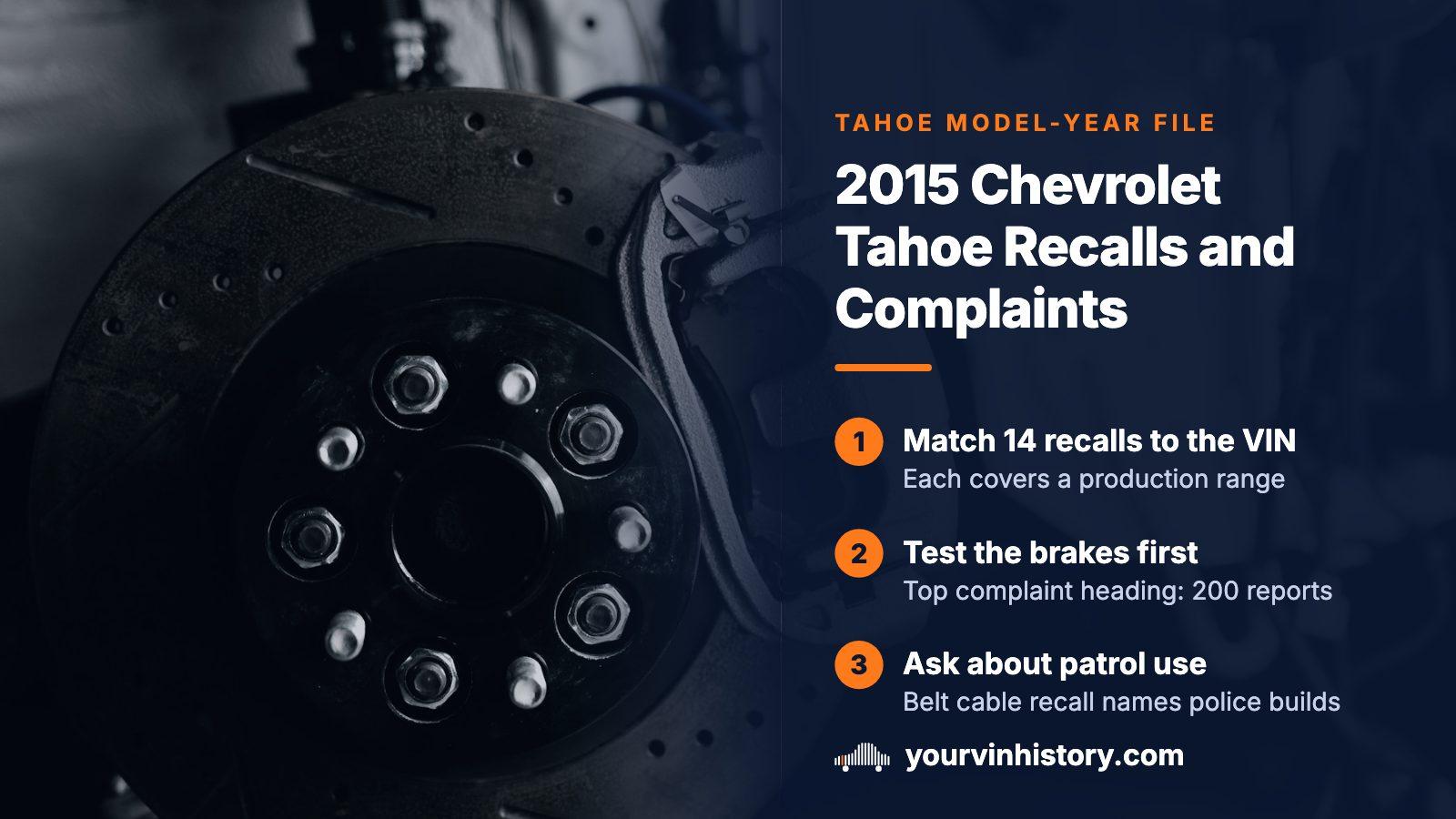
NHTSA lists 14 recall campaigns and 661 owner complaints for the 2015 Chevrolet Tahoe. Service brakes lead the complaints with 200, about 30%, followed by the electrical system with 135. Crash scores are 4 of 5 stars overall and 3 of 5 for rollover. Recalls attach to VIN ranges, so run the exact truck's VIN through NHTSA's recall lookup and ask for dealer paperwork on any repair already done.
- Recall campaigns
- 14 on file with NHTSA
- Owner complaints
- 661, led by service brakes at 200
- NHTSA stars
- 4 overall, 5 frontal, 3 rollover
- Against other Tahoe years
- 2.84 times the median year
Three federal records, each with its own limit
NHTSA keeps three separate files on this model year, and each is a different kind of evidence.
- Recalls: 14 campaigns, each a defect the manufacturer must repair on vehicles inside its production range. Only this file obliges anyone to fix anything.
- Complaints: 661 owner-written reports, unverified when counted, so they show where drivers believed the trouble sat.
- Investigations: 1 inquiry touching this model year. Some end in a recall and some in nothing, so read it as an early signal.
Within the complaints, 30 reports describe a crash, 2 a fire and 18 an injury. Those flags come from the owner's own account, and one event can generate several reports.
Fourteen campaigns, sorted by the system they touch
NHTSA tags every campaign with a component category. Sorted that way, steering and the restraint system make up most of the list.
| System | Campaign numbers | What the category names |
|---|---|---|
| Steering | 14V719000, 18V586000, 14V246000 | Electric power assist in two campaigns, a tie rod linkage in the third |
| Air bags | 14V451000, 16V651000, 17V437000 | A roof rail bag in the first, frontal bags in the other two |
| Seat belts | 18V291000, 21V245000 | Both filed under the front belts |
| Brakes | 19V645000, 19V761000 | Vacuum power assist, and an antilock wheel speed sensor or tone ring |
| Electrical | 15V640000, 14V301000 | The ignition circuit, and a software fix |
| Drivetrain | 14V152000, 14V374000 | Transmission cooler and lines, and the four-wheel-drive transfer case |
Campaign numbers open with the two-digit filing year, here 14 through 21, so notices kept arriving long after these trucks were sold.
Two campaigns worth reading line by line
Campaign 18V291000 (GM number 18156) covers the driver's belt pretensioner cable on certain 2015 and 2016 Silverado 1500 and Tahoe vehicles built as Police Pursuit or Special-Service models. A steel cable links the belt to the outer edge of the seat, and bending it over the side shield on every entry and exit can wear it until it parts, leaving the driver poorly restrained. Dealers replace the cable and shield. The recall began June 19, 2018.
Campaign 14V451000 (GM number 14359) is narrower: certain 2015 Tahoe, Tahoe LTZ, Suburban and Suburban LTZ trucks, plus the GMC Yukon and Yukon XL Denali, assembled on May 13, 2014. Roof rail air bags were not reinforced where they meet the roof carrier hardware, so a bag could tear on deployment. The repair is new attaching hardware.
The first notice raises a question for any used Tahoe: did it work as a patrol or service vehicle? The second shows why only a VIN lookup can place a truck inside a build-date window. The other 12 campaigns are in the table above, and some span other models, so read each full notice on NHTSA's site.
Where the 661 complaints land
Owners pick the component when they file, so the table shows what people believed had failed, under NHTSA's headings rather than part names. The rows add to more than the total because one filing can name several components.
| Reports | NHTSA heading | Share of the 661 |
|---|---|---|
| 200 | Service brakes | 30% |
| 135 | Electrical system | 20% |
| 90 | Unknown or other | 14% |
| 70 | Steering | 11% |
| 55 | Power train | 8% |
| 52 | Fuel / propulsion system | 8% |
| 52 | Exterior lighting | 8% |
| 52 | Suspension | 8% |
| 45 | Engine | 7% |
| 26 | Electronic stability control | 4% |
| 21 | Structure | 3% |
| 14 | Seat belts | 2% |
Read the shape before the sum. A popular SUV collects complaints just by being on the road, but one heading holding 30% suggests something more specific. The 90 under unknown or other show that many owners could not name the part. None of it is a failure rate.
Why the brakes get the first test drive
Service brakes is the heading with 200 reports. These are owners describing brake defects, not a tally of routine pad and rotor wear, though the category cannot say which part was involved.
Two campaigns sit in the same area: 19V645000 for the vacuum that assists the pedal, and 19V761000 for the wheel speed sensor or tone ring behind antilock and traction control. The file does not tie the 200 complaints to either one. On the drive, check these:
- Pedal feel at walking pace and at highway speed: firm and steady, with no sinking, buzzing or sudden stiffness.
- Antilock or stability control lights that stay lit after start-up. Stability control has 26 complaints of its own.
- Pulling to one side, or a shake through the wheel under firm braking.
- A mechanic's look at the lines, calipers and vacuum power assist.
How old the truck was when owners say trouble began
Filings for this model year peaked in 2019. A peak that late tends to point at wear arriving with age and mileage rather than a build flaw. Each complaint carries a failure date, so the gap from the model year gives the truck's age.
| NHTSA heading | Reports | Median age at failure | Share inside first 3 years |
|---|---|---|---|
| Fuel / propulsion system | 52 | 7.3 years | 6% |
| Power train | 55 | 6.3 years | 24% |
| Service brakes | 200 | 4.6 years | 11% |
| Electrical system | 135 | 4.5 years | 33% |
| Steering | 70 | 4.3 years | 29% |
| Suspension | 52 | 4.3 years | 13% |
| Unknown or other | 90 | 3.7 years | 39% |
| Exterior lighting | 52 | 3.3 years | 48% |
Fuel and propulsion reports arrive latest, at a median of 7.3 years, with power train next at 6.3. Brakes sit at 4.6 years with only 11% inside the first three, so most of those reports came after the original warranty ended.
These ages describe complaints, not odds
Each figure is a median of unverified owner reports, so it says when complainers say something broke, not how likely any one truck is to break. A well-kept Tahoe can outlast every age here; a neglected one can fall short of all of them.
Where 2015 sits among Tahoe years and similar SUVs
Measured against the nameplate's own history, 2015 is the heaviest of the 15 Tahoe model years on NHTSA's record, which span 2008 through 2022. Its complaint count is 2.84 times the median Tahoe year, while the lightest settled year, 2020, sits at 0.24 times. Comparing a model with itself removes most of the effect of sales volume.
Four nearby SUVs show how loose a cross-model comparison is:
- 2015 Jeep Grand Cherokee: 10 recalls and 1,350 complaints
- 2015 Nissan Pathfinder: 5 recalls and 319 complaints
- 2014 Jeep Cherokee: 13 recalls and 2,639 complaints
- 2014 Toyota RAV4: 7 recalls and 206 complaints
The Tahoe's 14 campaigns are the most of the five, yet its 661 complaints sit well under the 2014 Cherokee's. Sales and filing habits move these counts, so treat them as a prompt to inspect.
Crash scores and what they leave out
NHTSA's New Car Assessment Program tested this model year as a new truck in a lab, so the stars describe the design, not a used example's condition. Earlier collision repair, aftermarket parts and hidden damage change how a body behaves and never appear in the scores.
| Test | Result |
|---|---|
| Overall rating | 4 of 5 stars |
| Frontal crash | 5 of 5 stars |
| Side crash | 5 of 5 stars |
| Rollover rating | 3 of 5 stars |
| Rollover probability | 22.9% |
NHTSA scored the rear-wheel-drive and four-wheel-drive versions separately, and both landed at 4 stars overall with 3 for rollover. Forward collision warning was optional and lane departure warning was an option to confirm, so check the window sticker rather than assuming either is fitted.
An inspection order built from the file
Hand a mechanic this list in sequence; it follows the weight of the federal record.
- Brakes, as covered above, including warning lights and the vacuum power assist.
- Electrical and lighting: 135 electrical reports and 52 exterior lighting reports. Run every lamp, test the ignition and cluster, and look for aftermarket wiring.
- Engine bay: 2 complaints describe fires, so look for heat damage, melted insulation and amateur splices.
- Steering: 70 reports and three steering campaigns. Notice a heavy or inconsistent wheel and any play in the linkage.
- Four-wheel drive and transmission: two campaigns name the transfer case and the transmission cooler lines. Engage the drive system on the test drive and check the lines for leaks.
- Body wear common to big SUVs: tailgate seals and the spare well for dampness, folding or third-row seat mechanisms with the floor beneath them, and the roof rail and crossbar mounts.
Settling the question for the one truck in front of you
Everything above describes a model year. The truck on the lot has a VIN that decides which campaigns apply, whether the repairs were done and what its title says. Start with NHTSA's recall lookup, a free government tool, and match open items to the campaign numbers in the table.
The lookup does not cover the title. Brands such as salvage or rebuilt, and the latest odometer reading, live in the national title record, NMVTIS. A yourvinhistory report draws NMVTIS title records from ClearVin LLC, an approved provider, and adds accident, auction, lien and use-type records, which matters here because campaign 18V291000 names police and special-service builds.
Dealer recall repairs are at no charge only within federal limits. Questions for the seller:
- Were all 14 campaigns repaired, and can you show the dealer paperwork?
- Has the truck ever served as a police, fleet or service vehicle?
- Have the brakes ever been repaired or replaced, and who did the work?
- Has it had collision damage, and did an insurer pay for repairs?
- Is the title in your name and clear of liens, and may my own mechanic inspect it?
Where this information comes from
- NHTSA: Recalls — The lookup where a VIN returns the open campaigns for one specific Tahoe.
- NHTSA: Vehicle safety and owner complaints — Public record behind the 661 owner reports and their component headings.
- 49 U.S.C. 30120: Remedies for defects and noncompliance — The statute that sets when a manufacturer must repair a recalled vehicle at no charge, and when that duty ends.
- NHTSA: New Car Assessment Program ratings — The federal crash-test program that produces the overall, frontal, side and rollover stars.
- NMVTIS: National Motor Vehicle Title Information System — Government site for title brands and history, which the safety files do not include.
Sources and photos: Facts checked against the sources above in October 2026. Photo by Erik Mclean on Unsplash; diagrams by YourVINHistory.
Keep reading
- Chevrolet Tahoe years to avoid, and the model years that look quietestRanks every Tahoe model year by complaints against the nameplate's own median.
- Chevrolet recallsBrand-level steps for finding Chevrolet campaigns that match a VIN.
- Buying a car with an open recallWhat to do when the lookup shows a campaign nobody has repaired yet.
- Pre-purchase inspectionHow to book and brief a mechanic before you agree on a price.
Frequently asked questions
Is the 2015 Chevrolet Tahoe reliable?
Federal files do not measure reliability, and a complaint count is not a failure rate. They show 14 campaigns and the heaviest complaint volume among Tahoe years. Finished recall repairs and a documented service history on the truck you are buying say far more than model-year totals.
How do I find open recalls on a 2015 Tahoe?
Enter the 17-character VIN in NHTSA's recall lookup. It is stamped at the base of the windshield on the driver's side and printed on the door jamb sticker. If anything is open, call a Chevrolet dealer with the campaign number and keep the work order.
Are recall repairs on a 2015 Tahoe still at no charge?
Usually, within a boundary. Under 49 U.S.C. 30120 the manufacturer is excused from the no-charge remedy when the first buyer purchased the vehicle more than 15 calendar years before the notice or order, whichever came first. Ask the dealer for the campaign's notice date.
How can I tell if a 2015 Tahoe was a police or fleet truck?
Ask the seller and request the original build sheet or window sticker, which names the package. A history report can show a use type. In person, look for plugged holes in the dash or roof and a missing spotlight mount. Campaign 18V291000 names Police Pursuit and Special-Service builds.
Should I skip the 2015 Tahoe because it has the most complaints of any Tahoe year?
Not automatically. The count marks where to look, and the heaviest of 15 years still describes owner filings, not your truck. The lightest settled year, 2020, sits at 0.24 times the median, yet the newest years have had less time to collect complaints. Compare condition, records and price.
Now check the car itself
The guide explains what to look for. The report shows what this VIN has on record.