THE SHORT ANSWER
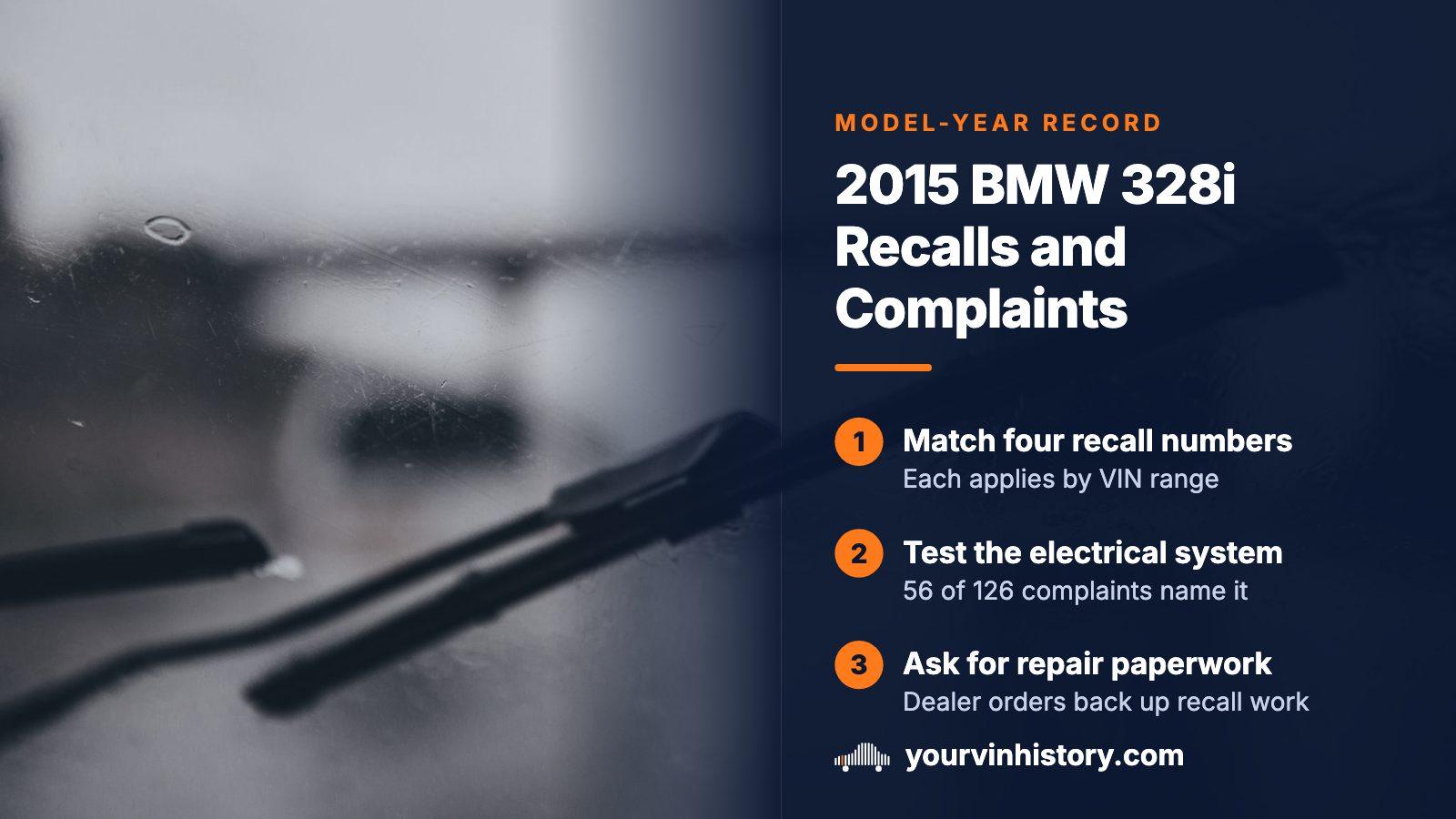
The 2015 BMW 328i has 4 recall campaigns on file with NHTSA: a lighting software fault, a head air bag inflator weld, a driver air bag inflator defect and a water pump connector that can short. Owners filed 126 complaints, led by the electrical system at 56 and engine and engine cooling at 42. NHTSA gives the car 5 stars overall and 4 in the frontal test. Recalls follow VIN ranges, so each car needs its own lookup.
- Recall campaigns
- 4 on file with NHTSA
- Owner complaints
- 126, with 56 naming the electrical system
- Crash rating
- 5 stars overall, 4 in the frontal test
- Fire descriptions
- 8 complaints mention a fire
What the federal file holds: four campaigns and 126 owner reports
Federal records on a car come in two kinds, and they deserve different weight. A recall is a defect the manufacturer has acknowledged and agreed to repair at no charge; the 2015 BMW 328i has 4. A complaint is an unchecked report from an owner; this model year has 126. Use recalls to test the car in front of you and complaints to decide where a mechanic looks first.
Owners also flagged what they saw. Six complaints describe a crash, 8 describe a fire and 2 report an injury. Those labels come from the owner's own account, and NHTSA has confirmed none of them. NHTSA also lists 1 investigation touching this model year, which is an early signal and not a finding.
The four campaigns at a glance
Quote the campaign number when you call a service department; it is faster than describing the defect.
| Campaign | Part involved | Hazard BMW reported | Dealer repair |
|---|---|---|---|
| 15V520000 | Front side markers, run by software | Markers may stay dark with parking lights or headlights on | Software upload |
| 24V288000 | Head air bag inflator | A weld can fail, leaking gas or rupturing the inflator | Head air bags replaced |
| 24V527000 | Driver's air bag inflator | A manufacturing defect may make it explode on deployment | Driver's front air bag replaced |
| 24V608000 | Water pump electrical connector | A poorly sealed plug can take on water and short, raising fire risk | Pump and plug checked or replaced, shield added |
Owner letters for the three newest campaigns went out between September 2024 and March 2025. They were mailed to owners at the time, so a recent change of hands can leave a repair undone.
15V520000: a software update that darkened the side markers
The oldest campaign is a lighting fault, not a mechanical one. Certain 3 Series cars built from October 2011 to June 2015 received software that left the front side marker lights dead when the parking lights or headlights were on. That breaks the federal lighting standard, FMVSS 108, and BMW's concern was visibility after dark.
The remedy was a dealer software upload, and the recall began on October 7, 2015. A fix that is only code leaves little paper behind, so ask for the dealer record or run the lookup. A dusk walk-around with the parking lights on is a fair spot check, but the update applied to a production window and not to every 328i.
24V288000 and 24V527000: two inflator defects, two separate repairs
Both air bag campaigns name 2014-2015 3 Series sedans among the affected cars. In 24V288000 a weld in the head air bag inflator can give way. The result is either leaked gas, so the bag only partly fills in a crash, or a ruptured inflator that throws metal fragments. Dealers replace the head air bags; letters went out in November 2024.
In 24V527000 the driver's inflator has a manufacturing defect and may explode during deployment, sending fragments toward the occupants. Dealers replace the driver's front air bag; letters were mailed in September 2024. The notice names many BMW models, so the VIN lookup shows whether this 328i falls inside it.
One car can carry both. Confirm each number on its own instead of accepting a seller's remark that the air bag recall was handled.
24V608000: the water pump connector and the fire reports
The newest campaign involves the cooling system. BMW reported that the electrical connector on the water pump may not be sealed properly, which lets water reach it and cause a short circuit. The stated hazard is fire. The notice lists the 328i and 328xi among 2012 through 2016 cars, and letters were mailed on March 28, 2025. Dealers inspect the pump and plug, replace them as necessary and fit a shield.
Two facts make this one worth a second look. Engine and engine cooling is the second-largest complaint category for the model year, and 8 complaints describe a fire. The federal file does not connect them to the recall, but both justify one direct question for the seller: was the pump and plug replaced, or only inspected?
Where the 126 complaints cluster
Owners pick the component category themselves when they file, so the counts show where people believed the trouble sat. The table keeps the eight largest of the 20 categories listed for this model year.
| Reports | Share of 126 | NHTSA category |
|---|---|---|
| 56 | 44% | Electrical system |
| 42 | 33% | Engine and engine cooling |
| 23 | 18% | Engine |
| 19 | 15% | Unknown or other |
| 15 | 12% | Fuel and propulsion system |
| 13 | 10% | Power train |
| 9 | 7% | Service brakes |
| 7 | 6% | Exterior lighting |
One filing can sit in more than one category, which is why the counts add up to well over 126. The electrical share stands out, but that category takes in batteries, wiring, lighting and control modules, so 56 is a ceiling on any single electrical fault and not a count of one.
How old the car was when owners said each system failed
Each complaint carries the date the owner gave for the failure, and subtracting the model year gives the car's age at that moment. The table shows each category's median age, report count and the share inside the first three years.
| System | Reports | Median age (years) | Inside first 3 years |
|---|---|---|---|
| Electrical system | 56 | 9.7 | 4% |
| Engine and engine cooling | 42 | 9.8 | 0% |
| Engine | 23 | 8.8 | 4% |
| Unknown or other | 19 | 6.6 | 16% |
| Fuel and propulsion system | 15 | 8 | 7% |
| Power train | 13 | 8 | 8% |
| Service brakes | 9 | 8.3 | 11% |
Nothing piles up in the first three years, so the bills mostly landed on whoever owned the car later. Engine and engine cooling has the highest median, 9.8 years, which makes it the system to budget for. Filings peaked in 2025, consistent with age catching up.
Medians, not odds
These are midpoints of unverified owner reports. They say when owners who complained placed the failure, not how likely a failure is.
Crash-test stars and the driver-assist question
NHTSA's rating applies to the 2015 BMW 328i as a four-door, rear-wheel-drive sedan. The results from that test:
- Overall: 5 of 5 stars
- Frontal crash: 4 of 5 stars
- Side crash: 5 of 5 stars
- Rollover: 5 of 5 stars, with a rollover probability of 9.5%
Stars grade the car as engineered, not the car as it sits on the lot now. They help when comparing model years and say little about an example whose structure has been repaired. Driver-assist equipment also varied: forward collision warning and lane departure warning were options, so confirm what the specific car has instead of assuming it from the badge.
How long a recall repair stays at no charge
Federal law, 49 U.S.C. §30120, requires the manufacturer to fix a recalled defect without charging the owner. It also sets a cutoff for older cars: the duty does not apply when the first retail buyer purchased the vehicle more than 15 calendar years before the earlier of the manufacturer's notice or NHTSA's order. The three campaigns noticed in 2024 and 2025 fall well inside that window for a car of this age.
Enter the VIN in NHTSA's recall lookup, which lists the open campaigns for that exact car, and repeat it on the day you buy. If it shows work was never done, the guide on buying a car with an open recall covers the next step.
What to hand a mechanic before buying a 2015 328i
Start with the areas owners reported, then add the checks any used sedan needs.
- Electrical system, 56 reports: a fault scan of every control module, plus battery, charging and wiring tests.
- Engine and engine cooling, 42 reports: look for coolant loss near the pump, and ask for proof the connector recall was done.
- Engine, 23 reports: a cold start, the oil's level and condition, and the service history.
- Engine bay: scorch marks, melted insulation or amateur wiring, since 8 filings describe a fire.
- Trunk floor and spare well: standing water or signs of collision repair.
- Suspension corners: uneven ride height can point to an undisclosed hit.
- Footwells, firewall seals and cabin filter housing: dampness means a leak.
- Subframe and control-arm bushings: clunks that a short drive can expose.
A documented maintenance trail counts for more than any complaint tally.
Questions for the seller, and what the safety file cannot show
- Which of the four campaigns were completed, and can you show the dealer paperwork?
- Was anything in the electrical system repaired or swapped out, and by whom?
- Where was the car maintained, and do you have the invoices?
- Any collision history, and did an insurer pay for the work?
- Is the title in your name with no lien, and can my own mechanic inspect the car before we agree on a price?
The safety file leaves out title brands, odometer readings, accident damage and liens. A history report run on the VIN adds those, along with salvage and auction records and theft and insurance entries. Run the preview before you drive out to see a car and the full report before you hand over money.
Where this information comes from
- NHTSA: recalls lookup by VIN — Where a VIN is entered to see open campaigns; the four campaign summaries above come from the same agency records.
- NHTSA: vehicle safety and owner complaints — Entry point to the owner filings behind the 126 total, the category counts and the crash, fire and injury flags.
- 49 U.S.C. §30120: remedy without charge — Statute text for the no-charge repair duty and the 15 calendar year limit counted from the first retail sale.
- NHTSA: 5-Star Safety Ratings — The federal crash-test program behind the overall, frontal, side and rollover results.
- NMVTIS: national title information system — Federal source for title brands and history, which a safety record does not include.
Sources and photos: Facts checked against the sources above in October 2026. Photo by Thibault Valjevac on Unsplash; diagrams by YourVINHistory.
Keep reading
- BMW recallsExplains how to check any BMW by VIN for open campaigns.
- Buying a car with an open recallCovers what to do when the lookup shows a repair was never made.
- Pre-purchase inspectionShows what an independent inspection covers before you pay.
- NMVTIS reportDescribes the federal title record that this safety file leaves out.
Frequently asked questions
Does a 2015 BMW 328i have open recalls?
Possibly, and only the VIN can say. The four campaigns cover production ranges, so one car may fall inside some and outside others. Enter the 17-character VIN in NHTSA's recall lookup, which reports unrepaired campaigns for that exact car. Do it again on the day you buy, because the seller's last check may be stale.
What do 2015 BMW 328i owners complain about most?
The electrical system leads with 56 of the 126 complaints, followed by engine and engine cooling with 42 and engine with 23. These are NHTSA categories that owners chose themselves, and none identifies one failing part. Use them to decide where a mechanic should spend the first hour with the car.
Is the 2015 BMW 328i safe in a crash?
NHTSA's stars were strong for the tested four-door, rear-drive car: 5 overall, 5 for side impact and rollover, and 4 for the frontal test. Rollover probability was 9.5%. The stars describe the design as built, so a body repaired after a collision may not behave the same way, and the two inflator recalls are worth completing for the same reason.
Should the fire complaints on a 2015 328i worry a buyer?
Eight complaints describe a fire, out of 126 in total. They are owner accounts that NHTSA has not verified, and the file does not say what started each one. Campaign 24V608000 does name a fire risk from a short at the water pump connector. Confirm that repair was done and have the engine bay checked for heat damage and aftermarket wiring.
How can I prove recall work on a 328i was actually done?
Ask for the dealer repair order showing the campaign number, then confirm with the VIN lookup, which should stop listing that campaign as open. BMW mailed notification letters, so a car that changed hands afterward may never have been alerted. With no paperwork and an open lookup, treat the repair as undone and book it with a dealer.
Now check the car itself
The guide explains what to look for. The report shows what this VIN has on record.