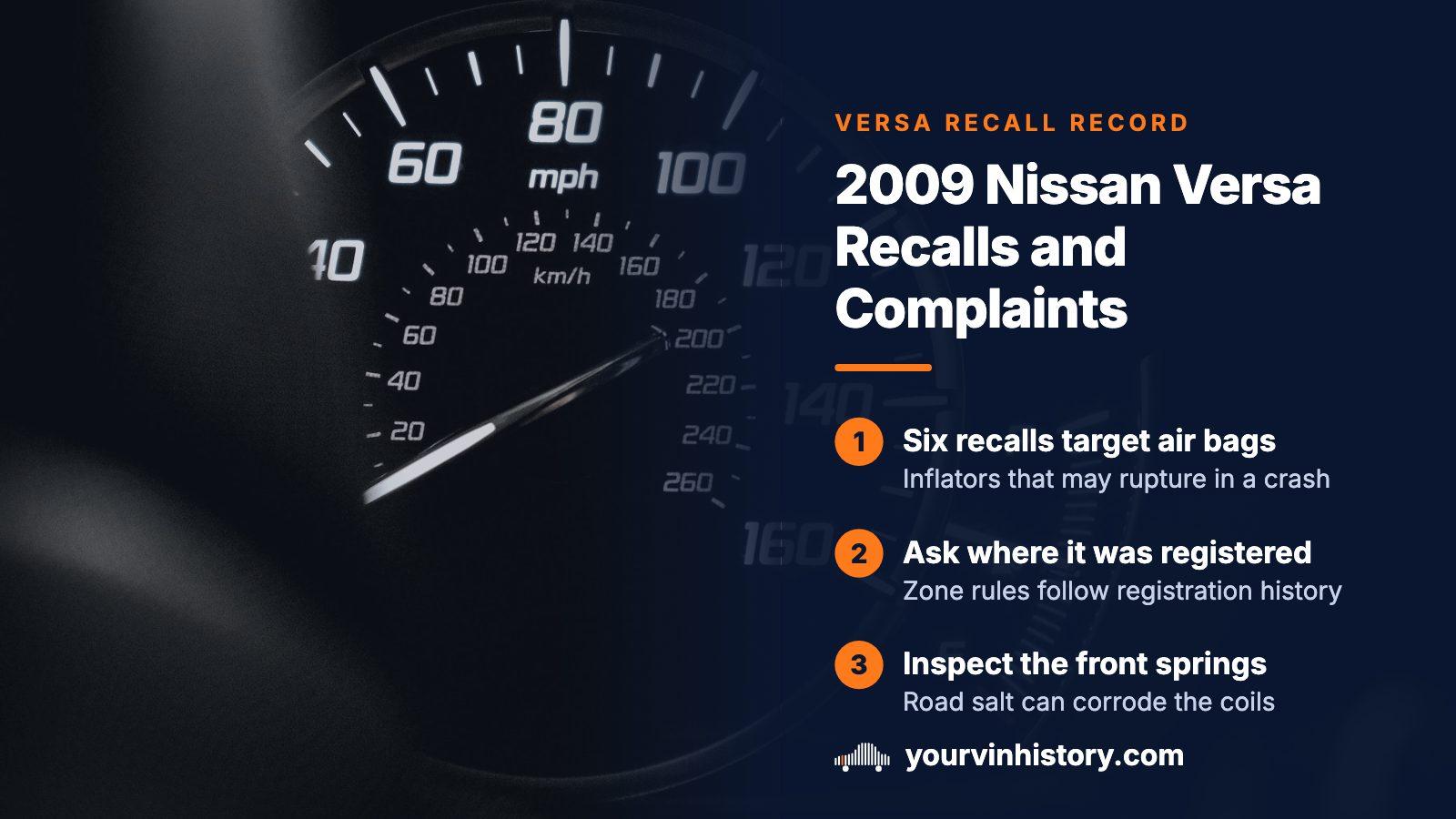
THE SHORT ANSWER
The 2009 Nissan Versa has 8 recall campaigns on record with NHTSA: six for frontal air bag inflators, one for front coil springs that road salt can corrode, and one for the battery in a Garmin navigation unit. Owners filed 503 complaints, 182 about suspension and 179 about air bags. NHTSA shows no crash-test rating for the configuration it lists for this model year.
- Recall campaigns
- 8 on file with NHTSA, six about air bag inflators
- Owner complaints
- 503, led by suspension and air bags
- Crash rating
- None published for this configuration
- Against other Versa years
- 2.47 times the median year
Six of the eight campaigns are about air bag inflators
Open the NHTSA file for this model year and air bags dominate it. Four campaigns involve passenger-side inflators and two are filed under the driver side. The filings give one explanation again and again: propellant inside the inflator can degrade after long exposure to humidity and temperature swings, so in a crash the part may rupture or explode. NHTSA states the consequence as metal fragments striking occupants, with serious injury or death possible.
One of the six, 20V008000, adds a wrinkle. It covers passenger inflators using a propellant called PSAN that were fitted as stopgap parts during earlier Takata recalls. A Versa that already had an air bag repair can therefore still appear on a list.
The eight campaigns, one line each
Carry the campaign number to a dealer's service desk. Every campaign on this model year is below, grouped by part.
| Part involved | Campaign | Who the notice reaches |
|---|---|---|
| Passenger inflator | 16V349000 | 2009 cars in Zone A states only |
| Passenger inflator | 17V028000 | 2009 cars in Zone B states |
| Passenger inflator | 18V044000 | 2009 cars in all three zones |
| Passenger inflator | 20V008000 | Cars with the stopgap PSAN inflators |
| Driver inflator | 17V449000 | Sedans 2007 to 2011, hatchbacks 2007 to 2012 |
| Inflator service parts | 22E066000 | Replacements fitted during repairs |
| Front coil springs | 15V573000 | Built May 8, 2006 to November 12, 2012, salt-belt states |
| Navigation battery | 10V401000 | Cars with a Garmin navigation unit |
Fixes differ. The zone-based recalls call for a new passenger inflator, 20V008000 specifies a desiccated design, and 17V449000 brings a driver inflator from a different supplier. Campaign 22E066000 has dealers inspect and replace as needed. Garmin technicians do 10V401000, swapping the battery and adding a spacer.
Zones, registration history and earlier air bag work
Three passenger-side campaigns sort cars by geography. Zone A is the hot, humid group: Florida, Texas, Georgia, Louisiana, California, Hawaii and some territories. Zone B runs from Arizona and Nevada east to the mid-Atlantic. Zone C covers the northern and mountain states, from Alaska and Montana to New York and Maine.
A 2009 Versa is in scope for 18V044000 in every zone, for 16V349000 only in Zone A and for 17V028000 only in Zone B. The key phrase is ever registered: a Versa now titled in Minnesota that once lived in Texas can still land in a hot-zone group. Each campaign covers only certain vehicles, so the VIN has the last word.
An earlier repair does not settle it either. Campaign 22E066000, the newest here, covers replacement inflators sold as service parts that may have been fitted during a theft or collision repair. If a seller mentions air bag work, ask for the invoice and run the VIN again.
The coil spring recall and the road salt states
Campaign 15V573000 is the mechanical outlier. Nissan found that road salt can corrode the front coil springs on certain 2007 to 2012 Versa models, which could lead a spring to fracture. The filing explains the danger: a broken spring may touch the tire, possibly puncture it and raise the risk of a crash.
It targets cars tied to D.C. and a block of states from Maine and Virginia to Minnesota and Missouri, the winter-salt belt. Dealers replace both front springs, and the recall began on February 2, 2016.
Suspension is also the largest complaint category, at 182 reports, but NHTSA's figures do not say how many involve springs. Treat the overlap as a reason to look, not as proof. Flaking rust on a coil, a cracked coil end or one corner riding low all deserve a mechanic's attention.
What the 503 owner complaints cluster around
Owners pick the component when they file, so the table shows what people believed had failed. Two categories carry most of the weight.
| Reports | Share | Category chosen by the owner |
|---|---|---|
| 182 | 36% | Suspension |
| 179 | 36% | Air bags |
| 28 | 6% | Steering |
| 26 | 5% | Wheels |
| 23 | 5% | Engine and engine cooling |
| 20 | 4% | Power train |
| 18 | 4% | Engine |
| 18 | 4% | Structure |
Inside the filings, 27 describe a crash, 2 a fire and 16 an injury. These flags reflect the owner's own account, not an NHTSA finding, and one event can generate several reports. NHTSA also lists 2 investigations, open or closed, touching this model year; an investigation is an early signal, not a verdict.
A count is not a failure rate
These totals tally what owners chose to report. They ignore how many Versas were built and how many problems went unreported, so read them as a map of where to look, not as odds of a breakdown.
How old the car was when owners complained
Each complaint carries the date of the problem, which lets you estimate the car's age at that moment. Filings for this model year peaked in 2017.
| System | Median age when reported | Share within three years |
|---|---|---|
| Suspension | 6.3 years | 3% |
| Air bags | 8.3 years | 2% |
| Steering | 5.7 years | 21% |
| Wheels | 5.2 years | 8% |
| Engine and engine cooling | 4.3 years | 43% |
| Power train | 6.8 years | 25% |
| Engine | 7.3 years | 11% |
| Structure | 5.2 years | 22% |
The two largest groups barely show up early. Counting 8.3 years from 2009 lands in 2017, the year filings peaked, though the data cannot say whether recall publicity prompted owners to file. Engine and engine cooling has the earliest profile at 43% inside three years, yet it rests on only 23 reports. These medians come from unverified reports and are not odds.
Where 2009 sits among Versa years and its 2009 peers
Against its own nameplate, 2009 is the heaviest of the 15 model years NHTSA has on record, from 2008 to 2022, at 2.47 times the median Versa year. Comparing a year with its own model's median removes most of the sales-volume effect on raw counts.
Raw totals across models read differently. Other 2009 models profiled on this site show 5 recalls and 824 complaints for the Chevrolet Impala, 8 and 1,594 for the Dodge Journey, 4 and 635 for the Nissan Murano, and 7 and 903 for the Volkswagen Jetta. The Versa's 503 complaints are the lowest of that group and its 8 recalls match the Journey, but sales differ by model, so neither figure ranks the cars.
Crash ratings and driver-assist equipment
NHTSA's crash-test program has no published result for the four-door configuration it lists for this model year. Overall, frontal, side and rollover results all read not rated, and no rollover probability is published. The equipment notes are equally thin: NHTSA shows no forward collision warning offered and no lane departure warning available.
A blank is not a failing grade; it means this configuration was not tested or published. Even a published rating describes the design as built, and says little about a used car with structural repairs since. Here, the recall file and an inspection stand in for stars.
How long a no-charge recall repair stays available
Recall repairs are done at no charge, but the rule has an edge. Under 49 U.S.C. 30120(g), the no-charge requirement does not apply to a vehicle first bought more than 15 calendar years before the manufacturer gave notice or NHTSA issued an order, whichever came first.
On the dates in NHTSA's record, all eight campaigns were announced in 2022 or earlier, well inside that span for a car first sold in 2008 or 2009. A campaign announced years from now may not carry the same promise for a car this old. Some dealers repair such cars anyway, but get that answer in writing before you buy.
What a mechanic should look at on a used 2009 Versa
This list follows the complaint clusters and the recall text, on top of a normal pre-purchase inspection.
- Air bag history: startup warning-light behavior, and any invoice showing an inflator was replaced and by whom.
- Front springs, mounts and bushings: heavy rust, a cracked coil end or uneven ride height.
- Steering feel and play, the third-largest complaint group.
- Wheels and tires, both of which appear in the complaint table.
- Engine bay wiring and cooling system: two fire reports make heat damage and amateur electrical work worth ruling out.
- Rust on the rear axle beam and underbody.
- Cold-start clutch or transmission behavior, and interior wear against the odometer.
Questions for the seller, then the VIN
Put these to the seller before agreeing on a price, and keep the answers in writing.
- Which of the eight campaigns did a dealer complete, and where is the paperwork?
- In which states has the car been registered since new?
- Has anyone replaced an air bag inflator after a collision, theft or recall?
- Have the front springs or other suspension parts been replaced, and when?
- May my own mechanic inspect it first?
Then run the VIN through NHTSA's recall lookup, a free tool that reports which campaigns still need work on that exact car. For the car's own past, a yourvinhistory report, bought once after a free preview, covers accident and damage records, title brands, odometer readings and salvage or auction entries, evidence of a collision repair that could have put a recalled replacement inflator into the car.
Where this information comes from
- NHTSA: Recalls — VIN lookup for open campaigns, and the recall records behind the eight listed here.
- NHTSA: Vehicle safety and complaints — Where owner complaints are filed and searched, the source of the 503 total and its category split.
- U.S. Code: 49 U.S.C. 30120 — The statute behind no-charge recall repairs, including the 15-calendar-year limit.
- NHTSA: Ratings — The federal crash-test program whose star ratings are missing for this configuration.
- NMVTIS: National Motor Vehicle Title Information System — Federal title-record system, covering the brands and history that recall data leaves out.
Sources and photos: Facts checked against the sources above in October 2026. Photo by NATHAN MULLET on Unsplash; diagrams by YourVINHistory.
Keep reading
- Nissan Versa years to avoid, ranked by NHTSA complaintsRanks every Versa model year by complaints, so you can see how 2009 compares.
- Nissan recallsWalks through checking Nissan recalls by VIN across all model years.
- Buying a car with an open recallWhat to do when the lookup shows an unrepaired campaign on a car you want.
- Airbag deployed checkUseful when a seller mentions air bag work or a past collision.
Frequently asked questions
How do I find out which recalls are open on a 2009 Nissan Versa?
Enter the 17-character VIN, not the model year, in NHTSA's recall lookup. Campaigns follow production ranges and registration zones, so two Versas from the same year can get different results. Give any open campaign number to a Nissan dealer. Some campaigns, such as 17V028000, send a second notice when parts arrive.
Do the Versa sedan and hatchback share the same recalls?
Mostly. The air bag campaigns name both body styles, though some give the hatchback a longer run of model years: 17V449000 reaches sedans through 2011 and hatchbacks through 2012. The spring recall refers to Versa vehicles generally. The VIN decides whether a given car is in range.
Does a 2009 Versa from a cold northern state still fall under the hot-zone air bag recalls?
It can. The zone-based passenger inflator campaigns key on where the car was first sold or has ever been registered, not where it sits today. A Versa from Minnesota lands in Zone C and can fall under 18V044000, and one that also spent time in Florida or Texas may be pulled into Zone A as well. Ask the seller about every state.
Do the two fire complaints mean the 2009 Versa catches fire?
Not by themselves. Two of the 503 complaints describe a fire, and they are owner accounts, not NHTSA findings. Separately, campaign 10V401000 concerns a Garmin navigation unit whose battery can overheat and cause a fire, but only on cars fitted with that unit. Nothing in the figures links the two, so check for the unit and for heat damage.
Can a dealer refuse a recall repair on a 2009 Versa because it is old?
Only where the federal limit applies. The no-charge requirement stops covering a car whose first sale came over 15 calendar years before the notice went out. The eight campaigns here were announced well inside that span. For a newer campaign, ask Nissan or the dealer first whether the repair will be done at no charge.
Now check the car itself
The guide explains what to look for. The report shows what this VIN has on record.