THE SHORT ANSWER
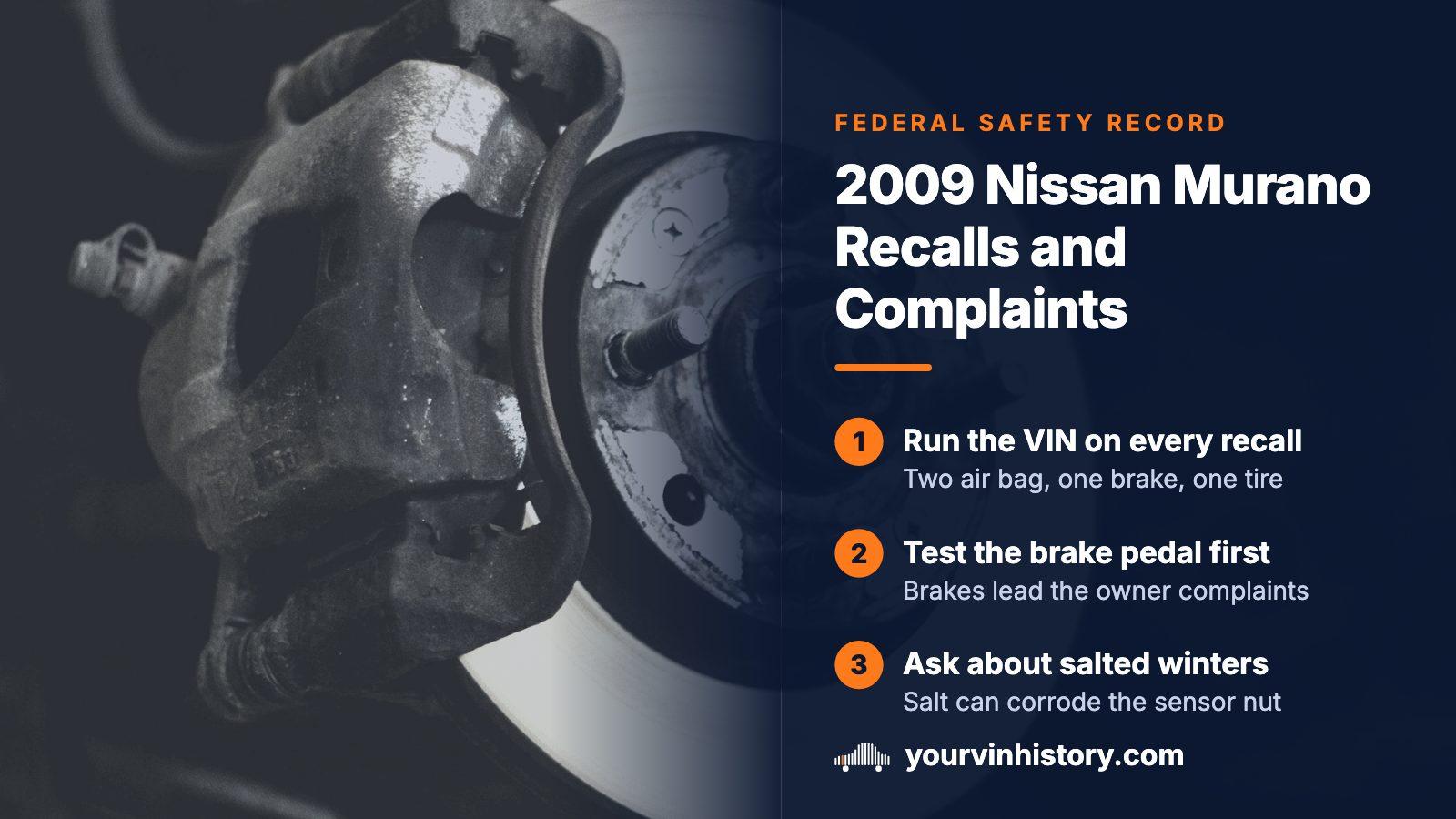
The 2009 Nissan Murano has 4 recall campaigns with NHTSA: two on the passenger air bag, one on ABS valves and one on a tire pressure sensor nut. Owners filed 635 complaints, 269 about service brakes. NHTSA has no overall, frontal or side crash rating for this configuration, only a rollover score of 4 of 5. Recalls follow VIN ranges, so run the specific car.
- Recall campaigns
- 4 on file with NHTSA
- Owner complaints
- 635, with 42% about service brakes
- Rollover rating
- 4 of 5; no overall, frontal or side score
- Against other Murano years
- 5.93 times the median year
What NHTSA's file on this Murano holds, and what it does not
The federal file has three layers of different weight. A recall is a defect the manufacturer has acknowledged and owes a remedy for; this model year has 4. A complaint is one owner's unverified account sent to NHTSA; there are 635. An investigation is the agency probing a possible pattern, and 2 touch this model year.
Filers can flag what happened. Among the 635, 24 describe a crash, 4 a fire and 26 an injury. Those flags are the owner's own words, one incident can produce several reports, and none is a finding. A complaint list says where to look; only the car says what is there.
The four campaigns in the order they were issued
Two campaigns date from 2008, one from 2009 and one from 2019, and only the last touches the brakes. Dates below are when NHTSA says each remedy began or was due to begin.
| Campaign | What it addresses | Remedy start |
|---|---|---|
| 08V066000 | Passenger air bag control software | February 19, 2008 |
| 08V521000 | Passenger seat occupant sensor | November 4, 2008 |
| 09V393000 | Corroding nut on the tire pressure sensor | On or before November 9, 2009 |
| 18V916000 | Valves in the ABS hydraulic unit | February 7, 2019 |
The next sections take them by system.
The ABS valve recall and the brake complaint pile
Campaign 18V916000 concerns the hydraulic control unit of the antilock brake system. Nissan found that brake fluid with certain corrosion-preventing additives can react with valves inside the unit, and a valve that does not seat means the pedal travels farther before the car slows. NHTSA lists a higher crash risk as the consequence.
The repair is a brake system flush with DOT 4 fluid and a test for a stuck valve, with the unit replaced at no charge if one turns up. The remedy began February 7, 2019. Brakes are also the loudest complaint category: 269 of 635, about 42%. That bucket covers every brake complaint, so it cannot say how many involve this valve. The symptom to test for is a pedal that sinks lower than it should, and the dealer paperwork should show the campaign was done.
Two air bag recalls, both about the passenger seat
Both 2008 campaigns ask whether the front passenger air bag fires when it should. Campaign 08V066000 is a software fault: with a badly discharged battery, the air bag control unit could stop the passenger bag working as designed. Dealers reprogram the unit. It covers 16,365 vehicles, the 2008 Infiniti EX35 among them.
Campaign 08V521000 is a hardware fault. A component in the occupant classification unit under the passenger seat cushion may have been built outside specification, which could cut the signal to the air bag control unit and suppress the bag in a crash. It spans 204,361 vehicles across several Nissan and Infiniti models. Dealers test the signal and replace the cushion if it fails.
Owners filed 91 air bag complaints, about 14%. On a test drive, watch the warning lamp through start-up; one that stays lit deserves a shop visit first.
The tire sensor nut and the road-salt states
Campaign 09V393000 depends on geography. It targets vehicles first sold in, or now registered in, heavily salted states: much of the Northeast and Midwest, plus Maryland, Delaware, West Virginia and Washington, D.C. A Murano that has wintered there is the one to ask about.
The nut clamping the pressure sensor in each wheel can corrode and crack. When it lets go the TPMS lamp lights, and a driver who ignores it may end up with a tire losing air steadily toward a flat. Dealers fit a sturdier nut at no charge, with the work due to start by November 9, 2009. A lit lamp on the test drive, or a seller who says the car just does that, calls for recall paperwork.
Where the 635 owner complaints land
NHTSA files each complaint under the component the owner blamed. Raw totals mostly follow sales volume, so the shape of the distribution tells you more than the total does.
| Share | Reports | NHTSA category |
|---|---|---|
| 42% | 269 | Service brakes |
| 14% | 91 | Air bags |
| 13% | 83 | Electrical system |
| 11% | 69 | Power train |
| 6% | 40 | Unknown or other |
| 5% | 34 | Steering |
Brakes at 42% sit far ahead of air bags, a concentration that can point to a specific weakness rather than ordinary wear. These are broad buckets, not part names: the electrical system bucket takes in the battery, wiring, lighting and modules, and power train covers more than the transmission.
How old the car was when owners reported each problem
Each complaint carries the date the owner says the problem happened, which gives the car's age at that moment.
| System | Median age in years | Dated reports | Within three years |
|---|---|---|---|
| Service brakes | 8.8 | 269 | 1% |
| Air bags | 8.3 | 90 | 7% |
| Electrical system | 6.4 | 82 | 18% |
| Power train | 6.8 | 69 | 13% |
| Unknown or other | 10.3 | 40 | 3% |
| Steering | 5.3 | 34 | 21% |
| Engine | 7.9 | 33 | 0% |
No group piles up in the first three years, so most reports arrived after the original warranty and the cost fell on the owner. Filings peaked in 2017, which fits parts that age out more than a launch-year defect.
A median is not a prediction
Treat the table as a record of when the people who complained said something went wrong. It says nothing about how likely a given Murano is to have the problem.
How 2009 stacks up against other Murano years
A complaint count means more beside the same nameplate's other years. The yardstick is the median Murano model year, a figure that cancels most of the effect of how many were sold in any given year.
| Measure | 2009 Murano |
|---|---|
| Rank for complaint volume | 1st of 15 model years, 2008 to 2022 |
| Multiple of the median year | 5.93 times |
| Lightest settled year in the run | 2008, at 0.05 times the median |
That spread is why Murano years should be read one at a time: two listings at the same asking price can sit on very different records.
Crash tests: no overall score, one rollover result
NHTSA's New Car Assessment Program crashes a representative new vehicle and publishes star ratings. For the 4-door configuration it lists for the 2009 Murano, the overall, frontal and side lines all read not rated. Rollover earned 4 of 5, with a rollover probability of 18.5%.
Not rated means no published score, which is common for configurations the agency did not test. It is not a failing grade. Forward collision warning was not offered on this model year, and lane departure warning was not available. A star table also cannot see how well a car was repaired after a collision, so completed recalls and a clean collision history count for more.
When recall repairs stop being free
The no-charge remedy has an age limit. Under 49 U.S.C. §30120(g), a manufacturer need not provide the repair at no cost if the first purchaser bought the vehicle more than 15 calendar years before notice was given or an order was issued, whichever came first.
All four known campaigns were announced between 2008 and 2019, inside that window for a car first sold around its model year. A campaign announced today is different: a Murano sold new in 2008 or 2009 has already passed the 15-year mark, and the right may not exist. Some dealers do the work anyway, but that is goodwill, not an entitlement. Get the answer in writing before you agree on a price.
What to put in front of a mechanic
The federal record points; it diagnoses nothing. These checks follow this model year's own pattern, then the general used-SUV list.
- Brakes: pedal height and feel, any ABS lamp, and the fluid service history.
- Air bags: normal lamp behavior at start-up, plus proof that both passenger-side campaigns were done.
- Wiring: 4 reports describe fires, so look for heat damage, brittle insulation and amateur electrical work.
- Tire pressure lamp: any glow, especially on a car with a salted-state past.
- Recall completion: all 4 campaigns repaired, not just mailed about.
- Rust and suspension wear, which at this age outweigh any federal record.
- All-wheel-drive engagement, if equipped; coupling trouble is costly and easy to miss.
- Tailgate seals and the spare-tire well, where water collects unseen.
Questions for the seller, then the VIN
- Which of the 4 campaigns have been done, and where is the dealer paperwork?
- Has anyone repaired or flushed the brake system, and who?
- Has the car been registered in a salted state?
- Which shops have serviced it, and may I read the records?
- Was there ever a collision, and did an insurer pay?
- May my own mechanic look it over first?
- Does the title carry your name alone, with the lien cleared?
Then use the VIN. NHTSA's recall lookup is a free government tool: enter the 17-character number and it lists open campaigns for that exact vehicle. Recalls are only the safety half. Title brands, accident and salvage records, odometer readings and liens sit in a vehicle history report. A yourvinhistory report covers those, with title records from ClearVin LLC, an approved NMVTIS data provider. The preview is free; the full report is a one-time purchase.
Where this information comes from
- NHTSA: recalls lookup by VIN — Where a VIN is entered to see open campaigns; the four campaign summaries here come from the same records.
- NHTSA: vehicle safety and owner complaints — Entry point to the complaint filings behind the 635 total, the category shares and the investigations count.
- NHTSA: 5-Star Safety Ratings — The federal crash-test program whose rollover score and not-rated lines are described above.
- 49 U.S.C. §30120: remedies for defects — Statute text for the no-charge remedy and the 15-calendar-year limit.
- NMVTIS: national title information system — Federal source for title brands and history, which safety records never cover.
Sources and photos: Facts checked against the sources above in October 2026. Photo by Benjamin Brunner on Unsplash; diagrams by YourVINHistory.
Keep reading
- Nissan Murano years to avoid: 2009 stands far above the restCompares the 2009 with every other Murano year on complaints and recalls.
- Nissan recallsWalks through checking any Nissan by VIN for open campaigns.
- Buying a car with an open recallCovers what to do when the lookup shows a repair was never made.
- Nissan Murano alternator replacement cost: two ranges and a 2009-2010 stallLooks at the electrical side, the third largest group of 2009 complaints.
Frequently asked questions
Which recalls apply to the 2009 Nissan Murano?
Four. Two cover the passenger air bag (08V066000 and 08V521000), one covers the tire pressure sensor nut (09V393000) and one covers ABS valves (18V916000). Both air bag campaigns also reach other Nissan or Infiniti models. Whether a given car is affected depends on its VIN range, and a finished repair is logged against the VIN.
What do 2009 Murano owners complain about most?
Service brakes lead with 269 of 635 reports, then air bags at 91 and the electrical system at 83. Those are NHTSA's broad buckets, not part names, and owners choose the bucket themselves. The agency does not verify the account, so a bucket is a topic for your mechanic, not a diagnosis.
Is a 2009 Nissan Murano safe to buy?
NHTSA gives no overall, frontal or side rating for the configuration it lists, which is not the same as a poor score. The rollover result is 4 of 5. For a particular car, finished recall repairs and its collision history matter more than the star table.
Will Nissan still fix a 2009 Murano recall at no charge?
It turns on two dates: when the first buyer purchased the car and when the notice went out or the order was issued, whichever was earlier. Federal law lifts the no-charge duty after 15 calendar years. The four known campaigns date from 2008 to 2019, but a brand-new one may fall outside. Confirm with a dealer in writing.
How do I check a specific 2009 Murano for open recalls?
Type the 17-character VIN into NHTSA's recall lookup. The result lists unrepaired campaigns for that exact vehicle. Run it again on the day you buy, because new campaigns can appear after a listing goes up, and ask the seller for dealer paperwork on any repair already made. The lookup covers safety recalls only; title brands and accident records need a history report.
Now check the car itself
The guide explains what to look for. The report shows what this VIN has on record.