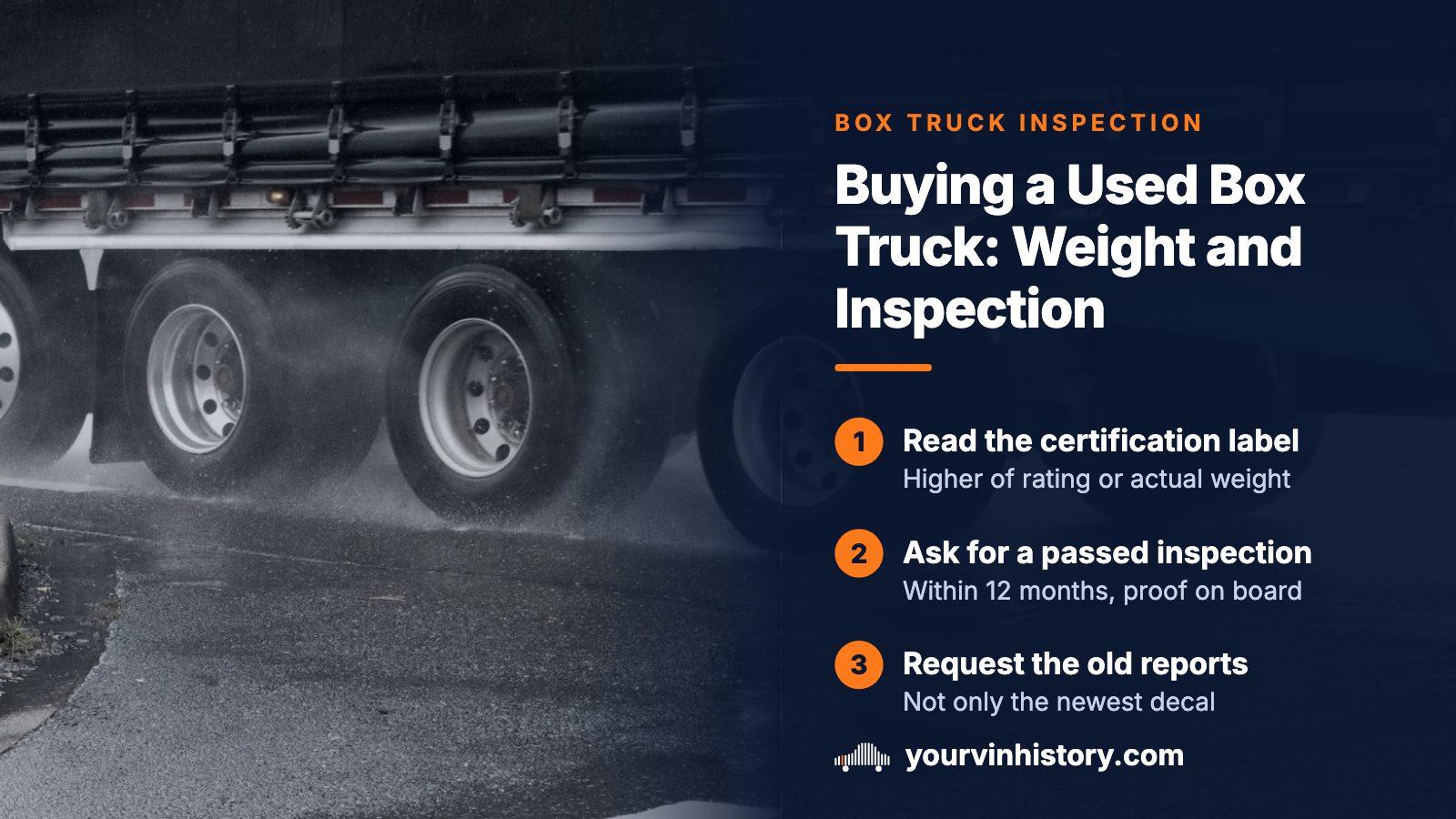
THE SHORT ANSWER
Federal rules treat a truck as a commercial motor vehicle when it is used in interstate commerce and its weight rating, or its actual weight, reaches 10,001 pounds, whichever is higher. Passenger counts and placardable hazardous materials are separate triggers. Once a truck qualifies, whoever operates it needs a passed inspection of every Appendix A component within 12 months, with documentation aboard the vehicle.
- Weight line
- 10,001 pounds, using the higher of rating and actual weight
- Look-back
- A passed inspection within the past 12 months
- Proof
- Report, sticker or decal kept on the truck itself
- Failure list
- Appendix A, fifteen groups of defects
Where a work truck becomes a regulated vehicle
Federal motor carrier rules do not care what a truck is called. A box truck, a cutaway van and a one-ton flatbed pickup are sorted the same way, by weight and by use. In 49 CFR 390.5, the weight trigger is 4,536 kilograms, restated as 10,001 pounds, and it applies to a vehicle that hauls people or cargo over public roads as part of interstate commerce.
The figure that counts is the higher of two readings: the manufacturer's rating or what the vehicle actually weighs. A modest number on the label does not exempt a truck that is routinely loaded past it. A combined rating counts too, so a lighter truck that pulls a trailer may cross the line as a pair. A cab and a box give no hint of which side a given truck falls on.
Read the certification label, not the listing
Listings round, guess and copy each other. The certification label does not. It usually sits on the driver's door or jamb and gives the gross vehicle weight rating plus the axle ratings. Photograph it and compare it with whatever the seller said.
Box trucks and cutaways are commonly finished in stages, with a body company building on another maker's chassis, and the label is one place that shows it. A label that is missing, painted over or unreadable is a question to settle in writing before money moves.
If it will tow
Work out the combined figure for truck and trailer together, not the truck's own rating. That higher number is the one that puts you under the stricter rules, and it is easier to learn before you choose between two trucks.
Passengers and placards: the other ways in
Weight is the usual route for a box truck, but it is one of four independent tests. A crew van or a truck hauling placarded chemicals can qualify at any weight.
| Trigger | What qualifies a vehicle |
|---|---|
| Weight | 4,536 kg, or 10,001 pounds, rating or loaded weight |
| Paid passengers | Built or used for more than 8 people, driver included, carried for pay |
| Unpaid passengers | Built or used for more than 15 people, driver included, with no fare |
| Hazardous materials | A hazardous material in a quantity that requires placards |
Interstate commerce is about the trip, not the border
The weight line only bites when the truck serves interstate commerce, and the definition in 390.5 is wider than a state border. It covers trips between a place in one state and a place outside it, trips between two places in the same state that pass through another state or country, and a same-state leg of a shipment that starts or ends elsewhere. A local route can therefore count, depending on where the freight began or is headed.
Buyers err in both directions, assuming a local route is exempt or assuming it never is. Get a definite answer for your own routes from your state's motor carrier office or FMCSA. Some states apply similar inspection rules to in-state work too.
What this guide leaves out
Registering for a USDOT number, driver files, logbook limits, drug testing and license classes sit in other parts of the regulations. This page covers the weight test and the annual inspection as a buying aid, not legal advice about your business.
The inspection rule stops use, not the sale
Nothing in 49 CFR 396.17 stops anyone from selling you a truck whose inspection has run out. The prohibition falls on the motor carrier that uses the vehicle, and once the title is in your name, that is you. The carrier may not operate the truck unless every Appendix A component passed inspection at least once in the last 12 months and the proof is aboard.
A truck delivered without current proof cannot lawfully go to work on Monday morning. Each unit in a combination counts separately, so a trailer you plan to pull may need its own record. The fix is to book an inspection, which may find repairs that must be done first. That is why the date belongs in the negotiation, not the aftermath.
What the proof on board should show
The rule is picky about location. A report filed in the seller's office does not count, because the documentation has to ride in the vehicle. It can be the report itself or a sticker or decal based on it. Under 396.17(c), the document should show:
- The date the inspection was performed
- The name and address of the place where the full report is kept
- Identifying information for the vehicle, if the truck is not clearly marked with it
- A statement certifying that the vehicle passed an inspection under this section
At the viewing, find the decal, read the date and count forward twelve months. Then compare any vehicle information on it with the VIN on the truck. It takes seconds, and it ties the document to this truck and not another one in the seller's yard.
Appendix A is a list of ways to fail
Appendix A to part 396 opens by saying a vehicle does not pass if it has any listed defect. That makes it a rejection list, which suits a walkaround better than a generic used-car checklist. Its fifteen groups run from brakes, steering and suspension through frame, tires and wheels to glazing, seats and the rear impact guard.
| Group | What fails it on a used box truck |
|---|---|
| Brakes | Missing or broken parts, oil on the linings, cracked drums or rotors, audible air leaks |
| Tires | Exposed cords, tread or sidewall separation, flat tires, any tire rubbing the vehicle |
| Frame | Cracked, broken or sagging members, and loose or missing fasteners |
| Rear impact guard | Missing, loosely attached, or mounted too high or too far forward |
Brakes, suspension and frame take the beating on a truck that carries loads all day, so give them the longest look. Any repair quote for them is a figure to take off your offer.
Ask for the old reports, not only the newest decal
The decal shows status. The reports show history. Under 49 CFR 396.21, an inspector's report names six things: the inspector, the carrier operating the truck, the date, the vehicle, the components checked with their results, and a certification that the report is accurate and complete. The results include any component that fell short of the Appendix A minimums.
That last item is the nearest thing a commercial truck has to a service log. A run of reports flagging the same group, such as brakes or the rear guard, tells you where the next bill is coming from. Clean consecutive reports are evidence of upkeep, not a promise of it.
Ask early, because the retention window is short. The party responsible must keep a report for 14 months from its date, where the vehicle is housed or maintained. A seller who can hand over several years of them has kept records beyond what the rule asks.
When the inspection has lapsed, who can fix it
A missing or expired inspection does not make a truck unbuyable. It makes the price negotiable. The carrier can inspect vehicles it controls, can hire a garage, fleet leasing company or truck stop as its agent, or can rely on a state periodic inspection program that meets the Appendix A standards.
Whoever does the work must be qualified under 49 CFR 396.19: able to apply the part 393 criteria, spot defective components and use the proper tools and methods. Qualification comes from a Federal or State training program, a state or Canadian certificate, or training and experience adding up to at least 1 year.
Price it in
Get a quote for the inspection, and for the repairs likely to follow, before you settle on a number. If the seller will not allow one before purchase, deduct for the unknown.
The ordinary used-vehicle checks still apply
A commercial truck is still a used vehicle with a title, possibly a lender and an odometer. A VIN report from yourvinhistory covers title brands, liens, odometer readings, accidents and open recalls, and the preview shows what records exist before you pay.
Run the VIN through NHTSA's recall lookup too. It costs nothing and works for trucks as well as cars. If a campaign is open, ask what the remedy is and who pays for it, and do not assume the repair costs nothing, since the federal free-repair rule leaves out very old vehicles.
On a box truck, add the body to the list. A different company may have mounted it on the chassis, so look at how it is attached and ask who built it.
Signs to walk away
Used commercial trucks reward patience. Most buyers are businesses, and a well-kept example shows itself through paperwork, so passing on one costs little.
- The door label is gone, or its rating disagrees with what you were told
- Nothing in the cab proves an inspection and nobody can say when it last passed
- The seller finds a question about inspection dates odd, though any working truck gets asked it
- Fixes needed to pass would cost more than the discount offered
- You are pushed to close before you have seen the date
- Several years of reports flag the same group again and again
Where this information comes from
- 49 CFR 390.5: Definitions — Source for the weight test, the passenger and placard tests, and the meaning of interstate commerce.
- 49 CFR 396.17: Periodic inspection — Source for the 12-month rule, the proof kept on the vehicle, and the self-inspection, agent and state routes.
- 49 CFR 396.21: Periodic inspection recordkeeping — Source for the six items an inspection report must name and for how long the report is kept.
- 49 CFR 396.19: Inspector qualifications — Source for what makes an inspector qualified to sign an annual inspection.
- NHTSA: Recalls — Where to look up open safety recalls by VIN, for trucks as well as cars.
Sources and photos: Facts checked against the sources above in October 2026. Photo by fr0ggy5 on Unsplash; diagrams by YourVINHistory.
Keep reading
- Towing capacity by VINIf the truck will pull a trailer, learn what the rating figures mean and where the limit really sits.
- Vehicle maintenance reportInspection reports are one kind of service record, so see what other maintenance history can and cannot show.
- Pre-purchase inspectionAn independent mechanic can look at the frame, brakes and body before you commit.
- Semi trucksThe next size up has its own VIN quirks worth knowing if you are moving into heavier trucks.
Frequently asked questions
Does a box truck under 10,001 pounds need an annual inspection?
The federal annual inspection rule attaches to commercial motor vehicles, and weight is only one way in. A lighter vehicle can still qualify by carrying more than 8 paying passengers, more than 15 unpaid ones, or placarded hazardous materials. Some states also add their own rules, so check with yours before assuming a lighter truck is exempt.
Can I find a truck's weight rating from the VIN?
Use the VIN to identify the exact build, then read the rating from the certification label on the driver's door or jamb, which is the figure of record. Listings and decoded summaries can be off. If you plan to tow, find the combined rating too.
Who is allowed to sign off on an annual inspection?
The inspector must be qualified under 396.19, and the report must name that person and certify that it is accurate and complete. The carrier has to keep evidence of the inspector's qualifications, so ask what qualifies the person named. A state program inspector, a garage acting as the carrier's agent or the carrier's own staff can qualify.
Is a state inspection sticker the same as the federal annual inspection?
Only when the state's periodic program meets the Appendix A minimum standards. Then it counts as the annual inspection, and the 12 months run from the last day of the month in which it was performed. Find out whether the program meets those standards instead of assuming any windshield sticker does.
What should I ask the seller about the inspection?
Ask when the last annual inspection happened, who performed it, and whether the decal or report is in the cab. Then ask for earlier reports and for the name of whoever built the body. Write the answers down and compare the dates with what you see on the truck.
Now check the car itself
The guide explains what to look for. The report shows what this VIN has on record.