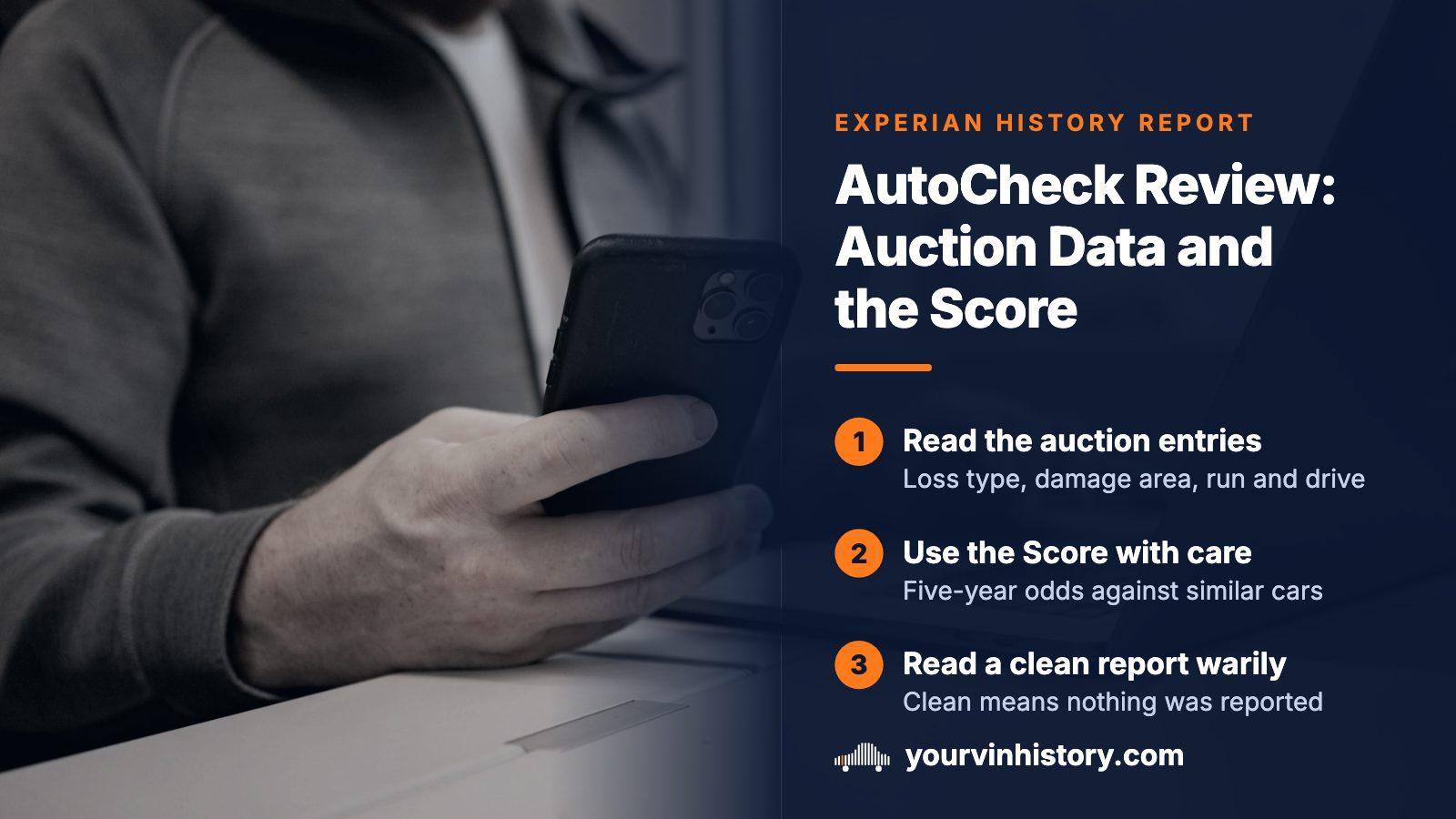
THE SHORT ANSWER
AutoCheck is Experian's vehicle history report, and it is best known for auction detail: the type of loss, the damaged area, whether the car was running and driving, and the sale date. Its Score runs from 1 to 100 and estimates how likely a car is to stay on the road for five years compared with similar cars. That suits dealers sorting many cars better than a buyer weighing one.
- Best known for
- Wholesale and salvage auction entries
- The Score
- 1 to 100, five-year odds against similar cars
- Federal list
- Experian.com is under commercial customers only
- Edmunds test, one 2014 Boxster
- 15 service records on Carfax, 3 on AutoCheck
What AutoCheck is and when buyers reach for it
AutoCheck is Experian's vehicle history product. Like Carfax, its main rival, it gathers events reported against one VIN and lays them out as a timeline of owners, accidents, title changes and sales. Two features define how people talk about it: the detail in its auction entries and a single summary number called the Score.
Buyers tend to reach for it at particular moments. The price looks low, the seller's story sounds a little too tidy, or a dealer car arrives with nothing to explain where it came from. This review takes the auction entries and the Score in turn, then looks at an independent side-by-side test, the gaps every report shares and the federal list of title data providers, so you can decide whether it answers the question you actually have.
Auction entries are the part of the report worth reading closely
Of everything in the report, the auction section is where AutoCheck is best known. Its coverage is usually traced to wholesale houses such as Manheim and ADESA and to salvage sellers such as IAAI and Copart. A listing is meant to tell you four things.
- What kind of loss was recorded, such as an insurer's total-loss entry
- Which part of the car took the primary damage
- Whether the vehicle was running and driving when it went through the lane
- The date of the sale
That detail changes how you read a car. A vehicle can cross a salvage block, get repaired, and turn up on a retail lot with a title that looks ordinary. An auction line stays attached to the VIN, so it can reveal a sale that the paperwork in the seller's hand never mentions. It can also expose a more everyday story: a car described as lightly used that a dealer picked up at wholesale only weeks ago. Coverage of any single sale still depends on what the feeds captured, so a missing entry is not proof that nothing happened.
How to read the AutoCheck Score
The Score is a number from 1 to 100. Think of it as a forecast: the odds that this vehicle is still on the road five years from now, compared with cars of its own class and model age. Each report prints the car's number beside the typical range for its peer group, and that range is the part to read first. A 78 sounds strong, but it means one thing when comparable cars run from 70 to 90 and something quite different when they run from 40 to 60.
Believe the record over the number
A Score is a statistical estimate for a peer group. An auction line, an accident entry or a total-loss entry is a fact about this one vehicle. If a high Score sits next to a salvage-auction appearance, give the appearance more weight.
Why a dealer's shortcut does not settle one car
Experian designed the Score mainly with dealers in mind. At an auction a buyer faces hundreds of cars and a few minutes for each, and one comparable number is a sensible way to sort them. A private buyer has the opposite problem: one car and plenty of time. For that person, the entries underneath the number carry more information than the summary built from them.
Use the Score to see how the car stacks up against its peers, then go line by line through what produced it: owners, accidents, title events, auctions. Any line that prompts a question is worth putting to the seller before you talk price.
What Edmunds found running both reports on the same cars
Claims about how much AutoCheck and Carfax overlap are easy to find and hard to source. A named test is better evidence, and Edmunds published one, running both products against the same vehicles.
| Case in the test | What came back | What to take from it |
|---|---|---|
| 2014 Porsche Boxster, a Florida car for most of its years | Carfax returned 15 service records, AutoCheck returned 3 | Service depth differed sharply on this car |
| Same Boxster, ownership count | One report showed five owners, the other three | Carfax counted dealerships that held the car between private owners, AutoCheck counted only buyers |
| 2017 Honda Accord with a salvage title | Both showed the two earlier accidents, including an insurer's total loss, and only Carfax showed front-end damage from November 2024 | Run in early December 2024, AutoCheck's latest incident was dated July 2022 |
Two cars are too few to rank either product. What they show is that two services can describe one car differently, because of which networks feed them, how they count, and when an event arrives.
Why a clean report means only that nothing was reported
The Accord case is a timing problem, and it applies to every service. The 2024 damage may well reach AutoCheck later. A report is a snapshot of what reached that network by the day you pulled it, so the fresher the event, the less likely it appears everywhere. Beyond timing, some things rarely make it into any history report:
- Routine maintenance such as oil changes, which looked sparser on AutoCheck than on Carfax in the Boxster test
- Minor accidents repaired privately, with no claim, police report or title event
- Repairs covered by a warranty and done at a shop that sends data to neither network
- The names of past owners, which privacy law keeps out of reports
- The car's mechanical condition today, which no history report measures
A clean AutoCheck, a clean NMVTIS title record and a hands-on inspection together put you in a stronger position than any one of them alone.
Where Experian sits on the federal provider list
The Department of Justice keeps a page of approved NMVTIS data providers and splits them by who they may serve. Experian.com is in the commercial-only group, next to Carfax, which carries a note that it serves commercial customers in California only. The page also states plainly that consumers cannot receive NMVTIS reports from Carfax, DMVDesk or Experian, because those entities supply dealerships only. A logo tile on the same page labels the Experian entry as AutoCheck, a part of Experian.
That describes who can buy NMVTIS reports from Experian. It says nothing about the quality of AutoCheck's own records. A buyer who specifically wants the federal title record can pick from the providers the page lists for the public, and several of those own sister storefronts that sell reports with the same federal data. Treat AutoCheck as a complement with different strengths, not a substitute. Lists change, so open the page itself before relying on this summary.
Which buyers get the most from AutoCheck
The best fit is a car priced well under comparable listings, anything that may have been through a salvage lane, plus a car on a dealer lot whose earlier life you want to understand. Dealers and frequent buyers also fit, since the Score was built around their workflow.
The fit is weaker for a car with thorough paperwork, kept by one owner for years and backed by a folder of receipts. There, maintenance depth tells you more than auction history, and the Boxster test suggests Carfax may show more of it. Neither report replaces a mechanic. The FTC notes that history reports can show accidents and flood damage but usually do not reveal mechanical problems, and that they are no substitute for an independent inspection.
Single report or bundle: decide before you pay
AutoCheck offers one-off reports as well as multi-report packages. Prices change, so read them on the seller's own page rather than trusting any article, this one included. The useful question is how many cars you will realistically check.
Someone comparing several candidates over a few weeks may come out ahead with a package. The usual mistake runs the other way: buying a multi-report bundle, running one car, and forgetting the rest. If a bundle comes with an expiry date, put it in your calendar on the day you buy. If you are only looking at one car, a single report matched to your worry is the simpler choice.
A sequence of checks that makes the purchase count
- Run the VIN through the NHTSA recall lookup, a free tool from the regulator.
- Search NICB VINCheck, a free screen for theft and total-loss records that stands apart from any history network.
- Buy one history report matched to your question: AutoCheck if auction and salvage history is the worry, Carfax if service history is.
- Add a federal title record from a provider on the Justice Department's public list. A yourvinhistory report is one such route, with title records supplied by ClearVin LLC, an approved NMVTIS data provider, and accident, salvage and auction entries alongside them.
- Pay an independent mechanic to inspect the car, which the FTC recommends even when the dealer calls it certified.
Where this information comes from
- U.S. Department of Justice: Approved NMVTIS data providers — Shows which providers serve the public, which serve commercial customers only, and where Experian.com is placed.
- Edmunds: AutoCheck vs. Carfax on the same vehicles — A hands-on comparison behind the Boxster and Accord examples: service record counts, owner counts and report dates.
- NHTSA: Recalls — The regulator's own lookup for open safety recalls by VIN, usable whichever history report you buy.
- NICB: VINCheck — A theft and total-loss screen that does not depend on any commercial history network.
- FTC: Buying a used car from a dealer — Explains the Buyers Guide, as-is sales, and why a history report does not replace an independent inspection.
Sources and photos: Facts checked against the sources above in October 2026. Photo by Anastasiia Nelen on Unsplash; diagrams by YourVINHistory.
Keep reading
- AutoCheck vs CarfaxThe two reports side by side, for when only one fits the budget.
- Carfax reviewThe other major report, including who can buy its federal title record.
- NMVTIS reportWhat the federal title record covers and how it differs from a commercial report.
- Auction history by VINHow to find pre-repair photos and damage notes for a car that went through a salvage sale.
Frequently asked questions
Is AutoCheck better than Carfax?
Neither is a superset of the other, so the better choice depends on the car. AutoCheck is known for auction entries, while Carfax returned more service records in the Edmunds Boxster test. If budget allows only one, choose by worry: salvage and auction lanes point to AutoCheck, a long maintenance trail points to Carfax. Buyers with room in the budget sometimes pull both.
What is a good AutoCheck score?
There is no universal passing mark. The report prints a peer range for the car's class and age, and the number only means something against that range. A higher score within it implies better odds of staying on the road for five years. It says nothing about any particular accident or auction line, so read those entries separately.
Does AutoCheck show salvage auction history?
It is designed to. Entries can include the loss type, the main damage area, whether the car was running and driving, and the sale date. A sale that no feed captured would not appear, though, so an empty section is not a guarantee. NICB VINCheck is a free second screen for total-loss records.
How many owners does AutoCheck show?
It shows an owner count, but counting rules differ between services. In the Edmunds Boxster test the two reports gave three and five owners, because one counted dealerships that held the car between private buyers and the other counted only purchasers. Ask what a count includes, then compare it with the title and the seller's account.
Is a report worth buying if the title already looks clean?
A clean-looking title can follow a car that sold at a salvage auction, since a brand depends on what a state recorded and when. Auction entries and an NMVTIS title record are separate checks. For a car with a low price or a thin story, one report matched to that worry is a small step next to the purchase itself.
Now check the car itself
The guide explains what to look for. The report shows what this VIN has on record.